
Introduction
“How much should I save?” gets a different honest answer depending on your salary, city, and life stage — a flat “save 20%” answer ignores that 20% of ₹25,000 and 20% of ₹1,50,000 represent very different levels of difficulty. This guide gives you a realistic target by bracket, and — more importantly — the reasoning behind each one, so you can adjust it to your specific situation rather than following a number that doesn’t fit.
Why a Single Flat Percentage Doesn’t Work
At lower incomes, a large share of salary goes to genuinely fixed costs (rent, food, transport) that don’t scale down proportionally just because income is lower — a room costs roughly the same whether you earn ₹25,000 or ₹60,000. This is exactly the tension explored in our piece on the 50-30-20 rule at ₹30k/month: the “needs” percentage shrinks as income rises, which is precisely why the savings percentage should rise with income, not stay flat.
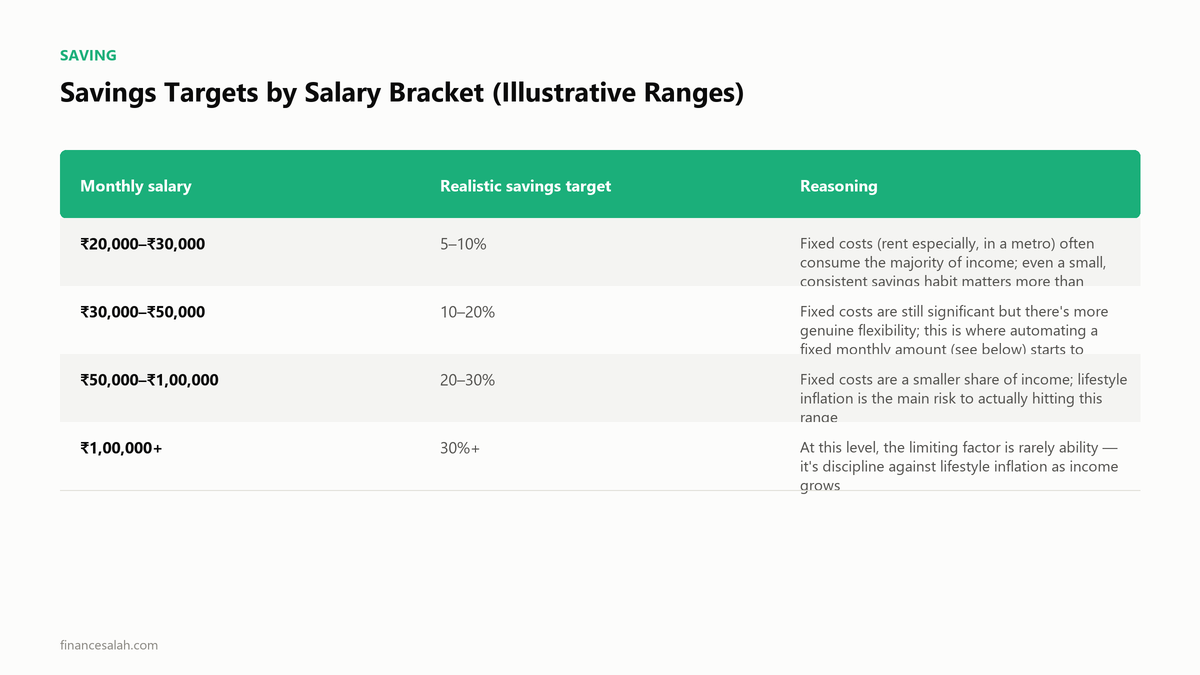
Savings Targets by Salary Bracket (Illustrative Ranges)
| Monthly salary | Realistic savings target | Reasoning |
|---|---|---|
| ₹20,000–₹30,000 | 5–10% | Fixed costs (rent especially, in a metro) often consume the majority of income; even a small, consistent savings habit matters more than hitting a percentage |
| ₹30,000–₹50,000 | 10–20% | Fixed costs are still significant but there’s more genuine flexibility; this is where automating a fixed monthly amount (see below) starts to compound meaningfully |
| ₹50,000–₹1,00,000 | 20–30% | Fixed costs are a smaller share of income; lifestyle inflation is the main risk to actually hitting this range |
| ₹1,00,000+ | 30%+ | At this level, the limiting factor is rarely ability — it’s discipline against lifestyle inflation as income grows |
These are ranges, not mandates — someone at ₹35,000 supporting only themselves in a smaller city can likely save more than someone at ₹35,000 in a metro supporting a dependent. Use the bracket as a starting anchor, then adjust for your actual fixed costs.
The Bigger Lever Than the Percentage: Automate It
Across every bracket, the single biggest determinant of whether the target is actually hit isn’t willpower — it’s whether the saving happens automatically, on payday, before the money is available to spend. See our full breakdown on automatic savings for exactly how to set this up. A modest, automated 10% consistently beats an aspirational, manual 25% that gets skipped in months when spending runs high.
What Counts as “Savings” in This Framework?
For this target, count:
– Money moved to an emergency fund (until it’s fully built — see our emergency fund calculator)
– SIP/mutual fund investments
– Any extra (beyond minimum) debt payoff, once you’re past the emergency-fund-first stage covered in our guide on emergency fund vs paying off debt
– PPF, EPF voluntary contributions, or other long-term retirement savings
Don’t count: money sitting in your regular spending account that you simply haven’t spent yet by month-end — that’s not a deliberate savings decision, and it tends to get absorbed into next month’s spending without you noticing.
A Practical Way to Find Your Real Number
Rather than picking a target from a table and hoping it fits:
- Track your actual essential expenses for one real month — rent, groceries, utilities, transport, minimum debt payments.
- Subtract that from your take-home salary. What’s left is your realistic ceiling for savings + discretionary spending combined.
- Decide a fixed rupee amount (not just a percentage) to automate as savings from that remainder — start smaller than feels ambitious; consistency matters more than the size of the first few months.
- Increase the automated amount every time you get a raise, before lifestyle inflation claims it. This single habit — saving a meaningful chunk of every raise rather than all of it — is what separates people who reach the 30%+ bracket over time from those whose savings rate stays flat despite rising income.
Frequently Asked Questions
Q: Should I save a fixed percentage or a fixed rupee amount every month?
A: A fixed rupee amount is usually easier to automate and stick to; you can revisit and increase it periodically (e.g., every 6 months or with each raise) rather than recalculating a percentage every month as expenses fluctuate slightly.
Q: What if I genuinely can’t save anything some months?
A: This is normal occasionally — the goal is a consistent trend over a year, not a perfect record every single month. If it’s happening most months, it’s a signal to revisit your fixed-cost assumptions (see the 50-30-20 rule discussion) rather than a personal failing.
Q: Should I save more before or after building my emergency fund?
A: Prioritize your emergency fund first (or at least a starter version of it), since it protects you from the specific risk of needing to go into debt for common unexpected expenses — see our detailed sequencing in emergency fund vs paying off debt.
Q: Does this framework change once I have dependents?
A: Yes — supporting dependents typically pushes your realistic savings percentage down within your bracket, at least temporarily. The framework’s logic (automate a fixed amount, revisit with income changes) still applies; only the specific number shifts.
Conclusion
There’s no single correct savings percentage — the honest answer scales with your salary bracket and genuinely fixed costs, and the biggest lever isn’t finding the perfect number, it’s automating whatever number you land on so it happens before you can spend it. Start smaller and consistent rather than ambitious and abandoned by month three.
Related Reading
- 50-30-20 Budget Rule for Indian Salaries: Does It Work at ₹30k?
- Automatic Savings: How to Save Money Without Thinking About It
- Emergency Fund Calculator for Young Indians
This article is for general educational purposes and does not constitute personalized financial advice. Savings targets are illustrative and should be adjusted to your individual circumstances.