
Introduction
Most people open their first savings account wherever their salary gets credited, and never revisit the choice. That’s not necessarily wrong — but it’s worth knowing what you’d actually be comparing if you did shop around, because savings accounts vary more than most people assume, well beyond the headline interest rate.
What Actually Varies Between Savings Accounts
1. Interest Rate — Matters Less Than You’d Think
Savings account interest (commonly in the 2.5–4% range for major banks, occasionally higher for select digital-first banks) is calculated on your daily balance and paid quarterly. For most young professionals keeping a working balance of a few thousand to a lakh or two, the difference between a 3% and 4% account amounts to a few hundred to low-thousands of rupees a year — real, but rarely the deciding factor compared to what follows.
2. Minimum Balance Requirement (and the Penalty for Missing It)
This is where the real cost differences hide. Many “regular” savings accounts require a minimum average monthly balance (commonly ₹5,000–₹10,000, sometimes higher in metro branches), with penalties for falling short that can run into hundreds of rupees per instance. Zero-balance accounts (sometimes called Basic Savings Bank Deposit Accounts, or specific “digital” savings products) waive this requirement entirely — genuinely useful for someone early in their career whose balance fluctuates.
3. Digital Experience
For a young professional, this often matters more than interest rate: app reliability, UPI integration quality, how easily you can freeze/unfreeze a card, set spending limits, or get instant e-statements. This is highly bank- and app-specific, and worth testing (many banks let you preview app screenshots or read recent reviews) before committing.
4. ATM and Transaction Fees
Free transaction limits at other banks’ ATMs, debit card annual fees, and charges for physical passbook/chequebook requests can add up. A “free” savings account with a ₹500 renewal debit card fee tucked in isn’t actually free.
5. Linked Products and Auto-Sweep Features
Some accounts offer an auto-sweep facility — balance above a threshold automatically moves into a higher-interest fixed deposit, then sweeps back if you need it. This can meaningfully boost effective returns on idle savings without sacrificing liquidity, and is worth asking about specifically.
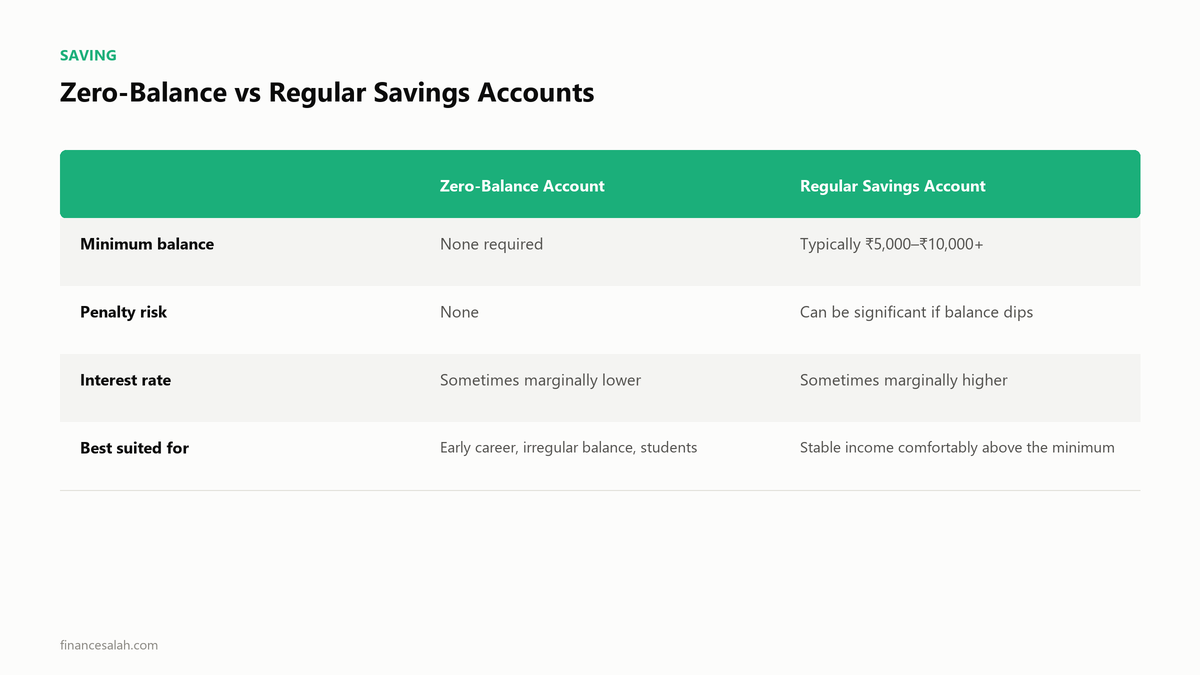
Zero-Balance vs Regular Savings Accounts
| Zero-Balance Account | Regular Savings Account | |
|---|---|---|
| Minimum balance | None required | Typically ₹5,000–₹10,000+ |
| Penalty risk | None | Can be significant if balance dips |
| Interest rate | Sometimes marginally lower | Sometimes marginally higher |
| Best suited for | Early career, irregular balance, students | Stable income comfortably above the minimum |
For most people in their first 1-3 years of a career, a zero-balance account removes a genuine, recurring source of unnecessary fees — the interest-rate trade-off is usually small enough not to matter.
What About “High-Interest” Savings Accounts?
Some newer-generation digital banks and select accounts advertise notably higher savings interest (sometimes 6-7%+) — often tied to maintaining a certain balance or being a full digital/neobank product. These can be genuinely worth using for money you want liquid but not actively spending, though it’s worth checking:
– Whether the advertised rate applies to your full balance or only above/below a certain threshold
– Deposit insurance coverage (in India, bank deposits are insured up to a set limit per depositor per bank via DICGC — verify this applies to the specific institution, especially for newer or smaller banks)
– Whether the “high interest” is a promotional rate for a limited period
A Simple Framework for Choosing
- If your balance regularly dips low or fluctuates (common in the first couple of years of a career, or with variable income) — prioritize a zero-balance account to eliminate penalty risk entirely.
- If you comfortably and consistently maintain a higher balance — the minimum balance requirement becomes irrelevant, and you can prioritize the best combination of interest rate and digital experience instead.
- Keep your emergency fund in a slightly different product than your everyday spending account — many people use their primary savings account for daily spending and a separate high-interest savings account or liquid fund specifically for the emergency fund, so it isn’t accidentally spent. See our comparison of liquid funds vs FD vs savings account for emergency funds for how to think about this split.
Frequently Asked Questions
Q: Is a higher interest rate always worth switching banks for?
A: Usually not on its own — the rate difference on a typical working balance is often smaller in absolute rupees than the friction of switching your salary account, updating auto-debits, and re-verifying KYC elsewhere. It’s worth it if the gap is large or if you’re also fixing a fee/experience problem at the same time.
Q: Do I need multiple savings accounts?
A: Not necessarily, but many people find it useful to separate “spending” and “saving” into different accounts specifically to reduce the temptation to dip into savings for everyday purchases — this is a behavioral choice as much as a financial one.
Q: Is savings account interest taxable in India?
A: Yes, savings account interest is added to your taxable income, though a deduction is available up to a specified limit under the applicable section of the Income Tax Act for individuals below senior citizen age — check current limits with a tax professional or the Income Tax Department’s official resources, as these figures are periodically revised.
Q: Should a young professional prioritize a savings account or start investing immediately?
A: These aren’t mutually exclusive — a savings account (or liquid fund) should hold your emergency fund and near-term spending money, while separate investment vehicles like SIPs are for longer-term goals. See our emergency fund calculator to figure out how much should stay liquid before the rest goes toward investing.
Conclusion
For most young professionals, the single highest-leverage decision isn’t chasing the highest advertised interest rate — it’s avoiding unnecessary minimum-balance penalties (often solved simply by choosing a zero-balance account) and picking a digital experience you’ll actually use well. The interest-rate difference between banks is real but usually smaller than these other factors combined.
Related Reading
- How Much Should I Save Every Month in India (By Salary Bracket)
- Liquid Funds vs FD vs Savings Account: Where to Keep Your Emergency Fund
- Automatic Savings: How to Save Money Without Thinking About It
This article is for general educational purposes and does not constitute personalized financial advice. Interest rates and fee structures vary by bank and change over time — verify current terms directly with the bank before opening an account.