

How to Choose Your First Mutual Fund India: Your Investment Journey Starts Here
Choosing your first mutual fund feels like picking your first job—overwhelming, confusing, and everyone has different advice! But here’s the thing: with over 40 lakh Indians starting their mutual fund journey each year, you’re not alone in this confusion. I’ve helped dozens of friends navigate this maze, from my neighbor Priya who earns ₹30,000 monthly to my college buddy Arjun with his ₹80,000 salary. The good news? How to choose your first mutual fund India isn’t rocket science—it’s more like learning to make the perfect chai. Follow the right steps, and you’ll get it right.Why First-Time Mutual Fund Selection Matters (Real Talk)
Mutual fund selection guide for beginners isn’t just about picking any fund—it’s about building the right foundation. My friend Ravi invested ₹5,000 monthly in a random “top-performing” fund in 2022. Two years later, he switched to a better-suited fund, but those initial 24 months of wrong choice cost him ₹35,000 in potential returns. The First Fund Effect: Your first mutual fund shapes your investment behavior. Pick wrong, get disappointed, stop investing. Pick right, see growth, invest more confidently.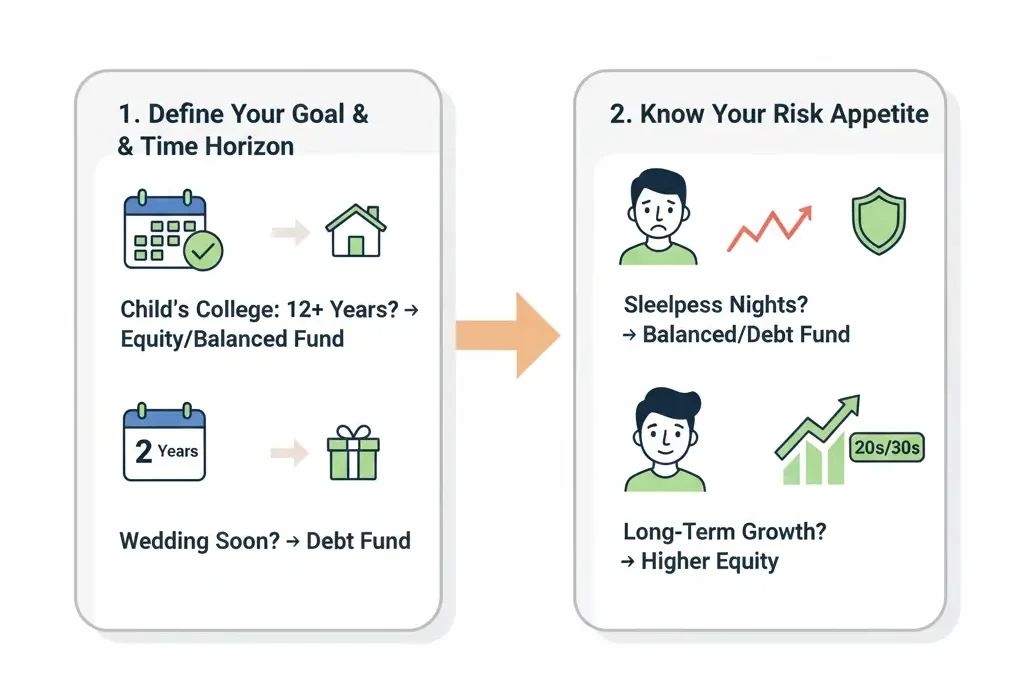
Step 0: Build Your Emergency Fund Before Buying Mutual Funds
I know you’re excited to start investing in mutual funds. But let me share something important from my experience working with beginners.
Before you buy ANY mutual fund, you need financial security. This is non-negotiable.
Why? Because life happens. Your car breaks down, medical emergency strikes, job becomes uncertain. If you don’t have emergency savings:
- You’ll liquidate your mutual fund portfolio at a loss
- You’ll pay unnecessary taxes on premature exit
- Your 20-year wealth plan collapses in one bad month
Use our Emergency Fund Calculator to know your exact requirement:
💰 Calculate Your Emergency Fund →
Safe location for emergency fund: High-yield savings account, liquid mutual funds, or ultra-short duration funds (not stock market).
Once your emergency fund is ready and sitting safely, follow the steps below to choose your FIRST mutual fund with complete peace of mind.
Step 1: Define Your Investment Goal (Before You Even Look at Funds)
How to pick mutual fund for new investor starts with knowing WHY you’re investing, not WHAT to invest in.
Common Goals for First-Time Investors:
Short-term (1-3 years):
-
Emergency fund building → Liquid/Ultra-short funds
-
Wedding expenses → Conservative hybrid funds
-
Car down payment → Short-term debt funds
Medium-term (3-7 years):
-
Home down payment → Balanced advantage funds
-
Child’s education → Aggressive hybrid funds
-
Foreign vacation fund → Large cap equity funds
Long-term (7+ years):
-
Retirement planning → Flexi cap funds
-
Wealth creation → Mid cap funds
-
Child’s higher education → ELSS funds (tax benefits)
Real Example: Sneha, 26, software engineer from Bengaluru earning ₹45,000, wanted to buy a flat in 5 years. She chose HDFC Balanced Advantage Fund instead of a pure equity fund—perfect choice for her timeline!
Step 2: Understand Your Risk Tolerance (The Honest Assessment)
Best mutual fund for first time investor India depends heavily on how much volatility you can handle.
Risk Assessment Questions:
-
Sleep Test: If your ₹10,000 becomes ₹8,000 in 6 months, will you:
-
Panic and sell immediately? → Conservative (Debt/Hybrid)
-
Feel uncomfortable but wait? → Moderate (Large Cap/Hybrid)
-
Stay calm or buy more? → Aggressive (Mid/Small Cap)
-
-
Salary Stability:
-
Government job/stable company → Can take higher risk
-
Startup/commission-based → Stick to conservative options
-
-
Family Responsibilities:
-
Single, no dependents → Higher risk okay
-
Married with kids → Conservative approach better
-
📊 Your Personalized Recommendations:
📧 Get Detailed Investment Plan
Enter your email to receive a personalized PDF with fund details, SIP setup guide, and tracking spreadsheet!Step 3: Mutual Fund Checklist for Beginners India (The Filtering Process)
Once you know your goal and risk level, use this mutual fund checklist for beginners India to narrow down options:
Essential Criteria Checklist:
✅ Fund Category Match
-
Goal timeline matches fund type
-
Risk level aligns with your comfort
✅ Performance Track Record
-
Consistent returns over 3+ years (not just 1 year)
-
Performed well during market downturns (2018, 2020)
✅ Fund Size (AUM)
-
₹1,000+ crores (too small = risky, too large = inflexible)
-
Steady growth in fund size (investor confidence)
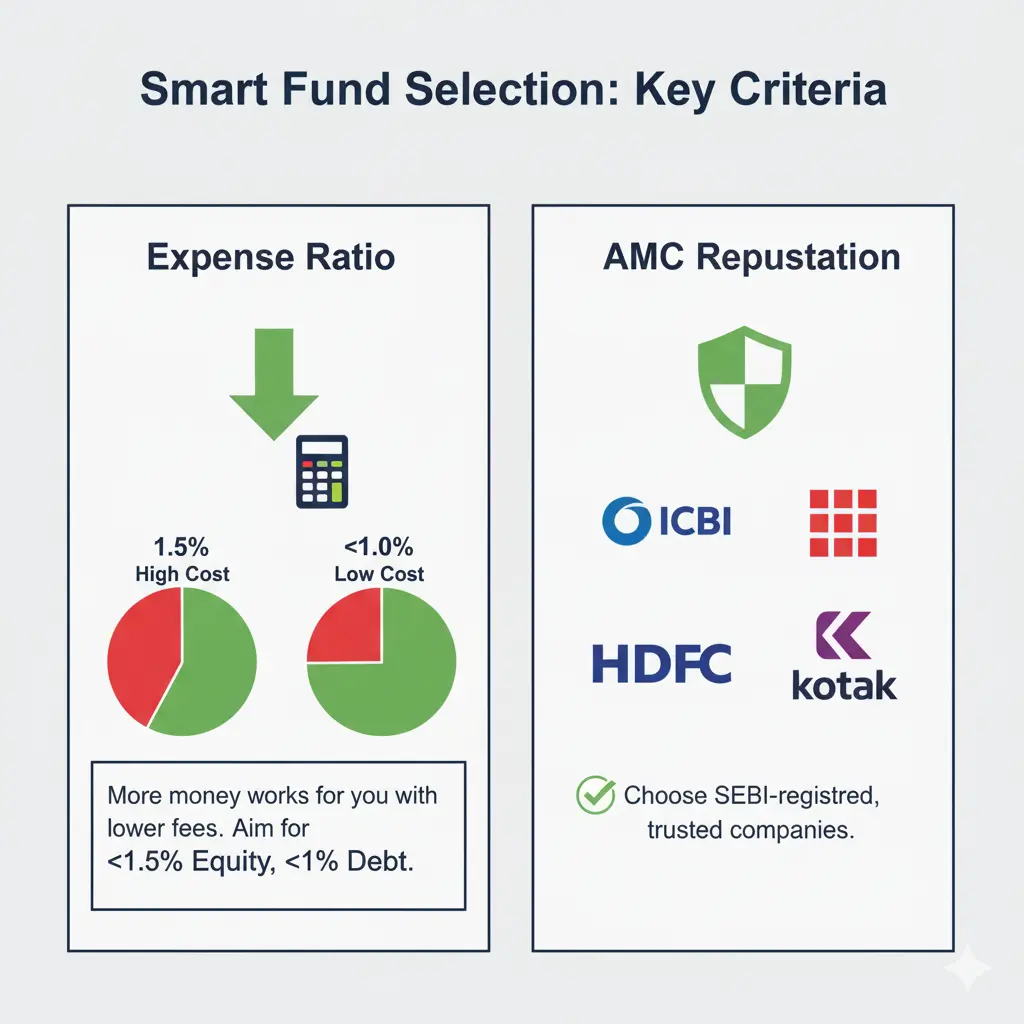
✅ Expense Ratio
-
Equity funds: <1.25%
-
Debt funds: <0.75%
-
Index funds: <0.50%
✅ Fund Manager Experience
-
Managing similar funds for 3+ years
-
Consistent investment philosophy
✅ Fund House Reputation
-
Established AMCs (HDFC, SBI, ICICI, Axis, etc.)
-
Good customer service track record
How to Choose Mutual Fund Step by Step (The Practical Process)
Step 1: Start with Fund Category
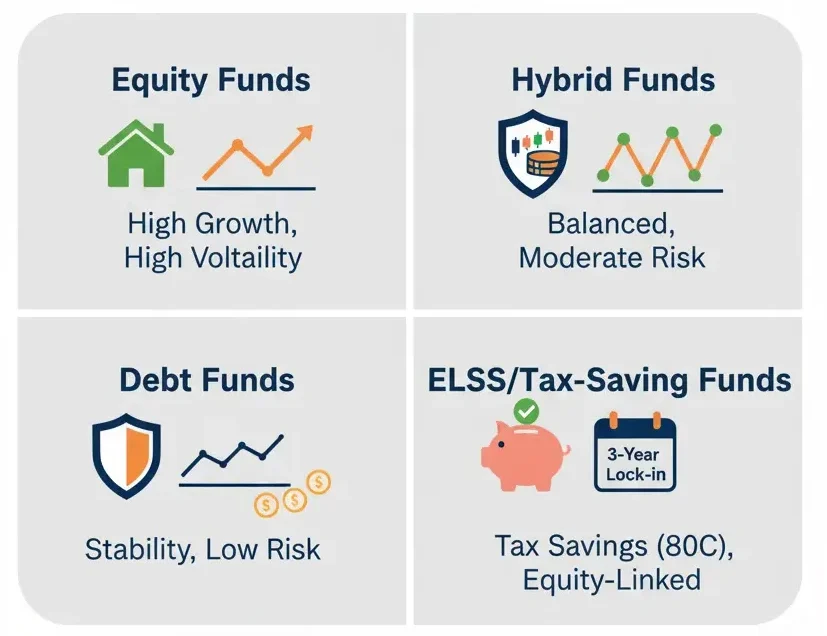
Based on your goal timeline:
1-3 years: Debt funds (liquid, short-term)
3-7 years: Hybrid funds (balanced, aggressive hybrid)
7+ years: Equity funds (large cap, flexi cap, mid cap)
Step 2: Shortlist 3-5 Funds
Use fund comparison websites:
Groww, ET Money, Value Research
Filter by category, 3-year returns, expense ratio
Step 3: Deep Dive Analysis
For each shortlisted fund, check:
Rolling returns (consistency over different periods)
Maximum drawdown (worst loss period)
Portfolio holdings (top stocks/sectors)
Step 4: Final Selection
Pick the fund that scores highest on:
Consistent performance ✓
Low expense ratio ✓
Experienced fund manager ✓
Good fund house ✓
Best Mutual Fund Categories for First Time Investors (2026 Edition)
1. Large Cap Funds (Safest Start)
Best for: Risk-averse beginners, 5+ year goals
Top Picks: ICICI Pru Bluechip, Axis Bluechip Fund
Expected Returns: 10-12% annually
Why Good for Beginners: Less volatile, invest in established companies
2. Flexi Cap Funds (Balanced Growth)
Best for: Moderate risk takers, 7+ year goals
Top Picks: Parag Parikh Flexi Cap, HDFC Flexi Cap
Expected Returns: 12-15% annually
Why Good: Professional diversification across market caps
3. Hybrid Funds (One-Stop Solution)
Best for: Conservative investors, 3-7 year goals
Top Picks: HDFC Balanced Advantage, ICICI Pru Equity & Debt
Expected Returns: 8-11% annually
Why Good: Built-in equity-debt balance, less volatile
4. ELSS Funds (Tax + Growth)
Best for: Tax-saving + wealth creation, 7+ year goals
Top Picks: Axis Long Term Equity, HDFC Tax Saver
Expected Returns: 11-14% annually
Why Good: ₹1.5 lakh tax deduction + growth potential
Mutual Fund Selection Criteria for Different Salary Ranges
₹20,000-40,000 Salary Range
Strategy: Start small, focus on tax-saving
ELSS funds for tax benefits
₹1,000-3,000 monthly SIP
Large cap + ELSS combination
₹40,000-80,000 Salary Range
Strategy: Balanced approach with growth focus
Flexi cap + Hybrid fund combination
₹3,000-8,000 monthly SIP
Add mid cap after 1-2 years
₹80,000+ Salary Range
Strategy: Aggressive growth with diversification
Multi-cap equity portfolio
₹8,000-15,000 monthly SIP
Include international funds after basics
Common First-Time Mutual Fund Selection Mistakes (Learn from Others)
1. Chasing Last Year’s Best Performers
My cousin Vikram picked Quant Small Cap Fund because it gave 49% returns in 2024. Then 2026 happened—his ₹36,000 became ₹28,000. Lesson: Consistency > peak performance.
2. Starting with Too Many Funds
Anjali, excited about investing, started SIPs in 8 different funds. Managing became a nightmare, performance tracking impossible. Sweet Spot: 2-3 funds maximum for beginners.
3. Ignoring Expense Ratios
₹5,000 monthly SIP for 10 years:
1% expense ratio = Total cost ₹31,000
2% expense ratio = Total cost ₹58,000
Difference: ₹27,000! Those decimals matter.
4. Stopping SIP During Market Falls
2020 crash scared many beginners. Those who stopped missed the 2021-22 recovery. Rule: Bad markets = cheaper units = better long-term returns.
Technology Tools to Simplify Your Selection
Free Fund Research Platforms:
Groww: Best for beginners, simple interface
ET Money: Detailed analysis, portfolio tracking
Value Research: In-depth fund research
MF Utility: Direct fund investments (lower costs)
Key Features to Use:
Fund comparison tools
SIP calculators
Portfolio analyzers
Goal-based investing
Tax Implications for First-Time Investors (The Boring but Important Stuff)
Equity Mutual Funds:
Short-term (< 1 year): 15% tax on gains
Long-term (> 1 year): 10% tax on gains above ₹1 lakh annually
Debt Mutual Funds:
All gains: As per income tax slab rates
No long-term benefit post-2023 budget changes
ELSS Funds:
₹1.5 lakh deduction under Section 80C
3-year lock-in period
Long-term capital gains tax applicable
Your First Mutual Fund Action Plan (Week-by-Week)
Week 1: Goal Setting
Define investment goal and timeline
Assess risk tolerance honestly
Decide monthly SIP amount (start small)
Week 2: Research Phase
Use fund research platforms
Shortlist 3-5 funds in your chosen category
Read fund fact sheets and portfolio details
Week 3: Final Selection
Apply the checklist criteria
Pick 1-2 funds maximum
Choose direct funds (lower expense ratio)
Week 4: Investment Setup
Complete KYC if not done
Set up SIP with auto-debit
Schedule quarterly reviews
When to Review and Modify Your Choice
Quarterly Check (Every 3 Months):
Performance vs. benchmark
Any major portfolio changes
Fund manager changes
Annual Review:
Compare with similar funds
Assess if goals/risk profile changed
Consider switching if consistently underperforming
Major Life Changes:
Salary increases → increase SIP
Marriage/kids → reassess risk levels
Goal achievement → rebalance portfolio
FAQs About Choosing Your First Mutual Fund
How to choose first mutual fund India if I have only ₹1,000 monthly?
Start with one large cap fund or hybrid fund. HDFC Balanced Advantage or ICICI Pru Bluechip are good options. Don’t spread ₹1,000 across multiple funds.What’s the best mutual fund for a complete beginner?
Flexi cap funds like Parag Parikh Flexi Cap or hybrid funds like HDFC Balanced Advantage. They provide diversification and professional management automatically.Should I choose regular or direct mutual funds?
Always choose direct funds—they have 0.5-1% lower expense ratios. Over 10 years, this saves ₹25,000-50,000 on a ₹5,000 monthly SIP.How many mutual funds should a beginner start with?
Maximum 2 funds. One equity (large cap/flexi cap) and one hybrid/debt based on your goals. Adding more creates complexity without much benefit.Can I change my mutual fund choice later?
Yes, but avoid frequent switching. Give your fund at least 2-3 years unless there’s a fundamental issue (fund manager change, consistent underperformance).What if I choose the wrong fund initially?
Don’t panic. Mutual fund investing is a long journey. You can switch funds, increase/decrease SIPs, or add new funds as you learn and grow.
Internal Links
SIP Calculator for Beginners India – Plan your SIP journey
Emergency Fund Calculator for Young Indians – Build safety first
Rupee Cost Averaging Explained Simply – Understand SIP magic
External References
SEBI Investor Education – Official regulatory guidance
AMFI Data – Industry statistics and fund information
Value Research – Independent fund analysis
Call-to-Action
Ready to Choose Your First Mutual Fund?
Don’t let analysis paralysis stop you from starting. The best mutual fund is the one you actually invest in consistently.
Questions about choosing your first fund? Drop them in comments below—I personally reply to every query and help you make the right choice for YOUR situation!