
Introduction
If you’ve searched for basic budgeting advice, you’ve run into the 50-30-20 rule: 50% of income to needs, 30% to wants, 20% to savings. It’s simple, memorable, and popular for good reason. But it was popularized in a US personal finance context, and a fair question — one we see often from readers, including a specific version asking exactly this about a ₹30,000/month salary — is whether the math actually holds up for a young Indian earner in a major city.
The Rule, As Originally Intended
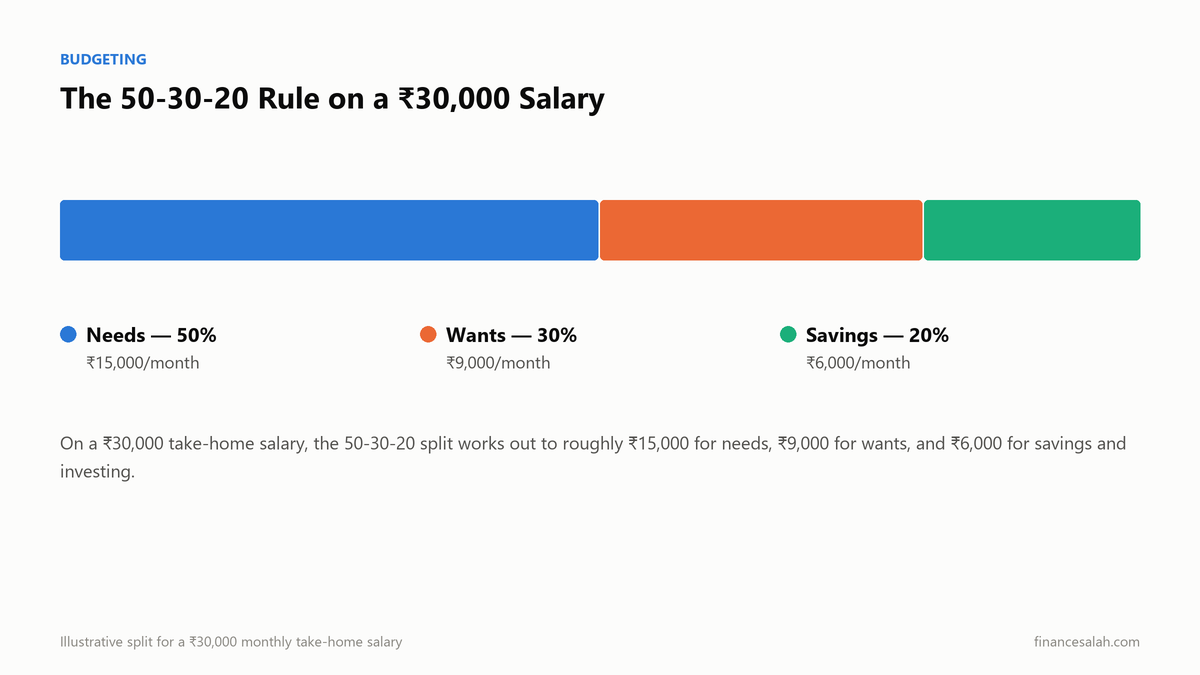
- 50% — Needs: rent, groceries, utilities, EMIs, insurance, transport to work — the non-negotiable cost of living.
- 30% — Wants: dining out, entertainment, shopping, subscriptions, travel — everything that improves your life but isn’t essential.
- 20% — Savings/Debt payoff: emergency fund contributions, investments, extra debt payments beyond minimums.
On paper, for ₹30,000/month: ₹15,000 needs, ₹9,000 wants, ₹6,000 savings.
Where This Breaks Down for Many Young Indians
Rent alone can consume the entire “needs” bucket in a metro city. A single room or shared flat in Bangalore, Mumbai, Delhi, or Pune commonly runs ₹8,000–₹15,000/month even in a shared arrangement — before groceries, utilities, or commute are added. For someone earning ₹30,000/month in a metro, the 50% needs bucket (₹15,000) is often entirely consumed by rent alone, leaving nothing in that bucket for groceries or utilities, let alone matching the intended 30%/20% split for the rest.
This is the honest answer to “does it work at ₹30k”: in a metro city, rarely as designed. In a smaller city or town with lower rent, it’s considerably more realistic.
A More Honest Framework for Lower Incomes
Rather than forcing a rigid 50-30-20 split that doesn’t fit, adjust the sequence, not just the percentages:
1. Needs first, whatever the real percentage is
Track your actual essential costs for one month — rent, groceries, utilities, transport, minimum debt payments. This might genuinely be 65–75% of a ₹30,000 salary in a metro city, not 50%. That’s not a personal failing; it’s an honest starting point.
2. Savings before wants, even if small
Rather than “20% savings, whatever’s left,” flip the order: decide your savings amount first — even ₹1,000–₹2,000/month to start — and treat it as non-negotiable, transferred automatically on payday before you see the rest as spendable. This is sometimes called “paying yourself first,” covered in more detail in our guide on automatic savings.
3. Wants get whatever’s genuinely left
This might be a smaller percentage than the “ideal” 30% — and that’s fine. The goal isn’t to hit an arbitrary ratio; it’s to make sure needs are covered and savings actually happen before discretionary spending eats the difference.
A Realistic Example at ₹30,000/Month in a Metro City
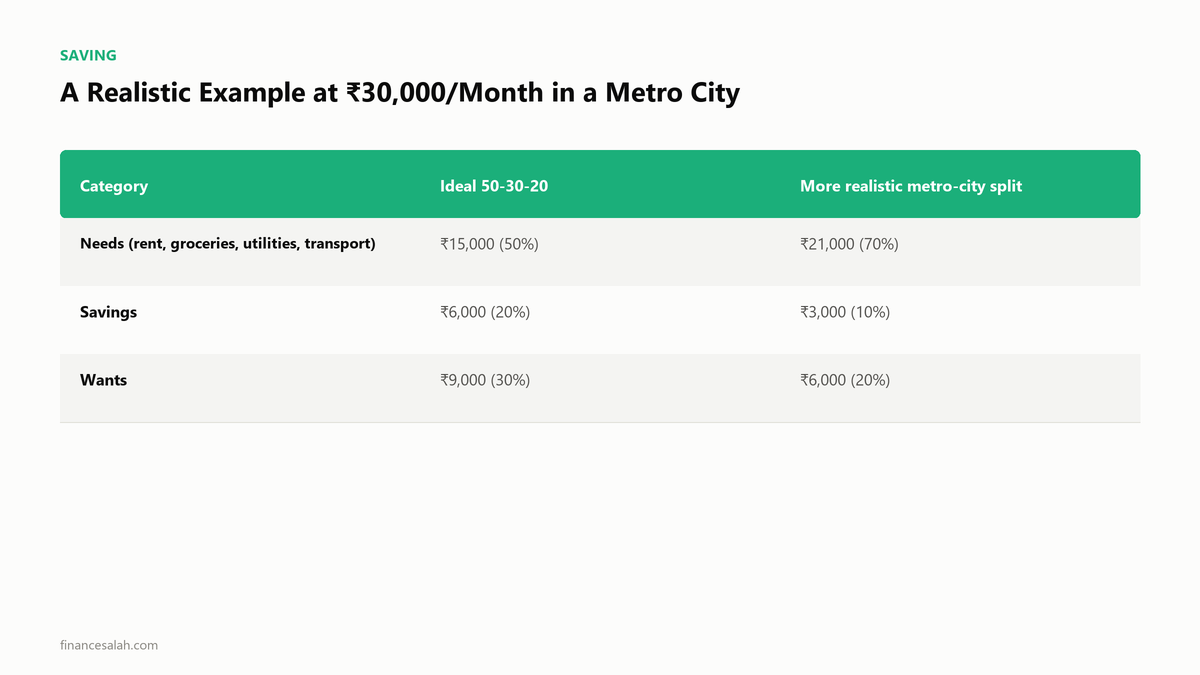
| Category | Ideal 50-30-20 | More realistic metro-city split |
|---|---|---|
| Needs (rent, groceries, utilities, transport) | ₹15,000 (50%) | ₹21,000 (70%) |
| Savings | ₹6,000 (20%) | ₹3,000 (10%) |
| Wants | ₹9,000 (30%) | ₹6,000 (20%) |
The savings percentage drops, but it doesn’t disappear — and a consistent ₹3,000/month is a real, working number, not an aspirational one that gets abandoned by week two of the month.
Where 50-30-20 Genuinely Does Work
- Smaller cities and towns, where rent is a much smaller fraction of a ₹30,000 salary
- Higher salary brackets (₹60,000+), where even metro rent is a smaller percentage of total income, leaving more realistic room for the intended split
- Shared living situations that meaningfully cut the rent component below typical metro averages
The rule is a genuinely useful starting template, not a law — the version of it that actually helps is the one you adjust to your real numbers, not the one you abandon because the textbook percentages don’t fit your rent.
Frequently Asked Questions
Q: What if my needs already exceed 50% of my salary — should I still try to save 20%?
A: Save what’s realistically left after true needs are covered, even if it’s less than 20% — a consistent smaller percentage beats an aspirational 20% that never actually happens because the “needs” math didn’t add up in the first place.
Q: Should EMIs count as “needs” or “savings” in this framework?
A: Loan/EMI payments are generally counted as needs (they’re a fixed, non-negotiable obligation), separate from voluntary savings and investments, which fall in the savings bucket.
Q: Is the 50-30-20 rule still useful if I can’t hit the exact percentages?
A: Yes — its real value is the three-bucket thinking (needs, wants, savings) rather than the specific numbers. Adjusting the percentages to your real cost of living while keeping the three-way split is the practical version of this rule.
Q: How much should I actually be saving every month on a lower salary?
A: This depends heavily on your specific expenses and city — see our detailed guide on how much you should save every month in India by salary bracket for a more granular breakdown than a single flat percentage can offer.
Conclusion
The 50-30-20 rule is a useful mental model, not a rigid formula — and for many young Indians in metro cities on a ₹30,000 salary, the “needs” bucket alone can consume what the rule allocates to needs and savings combined. The version that actually works: track your real needs honestly, decide your savings amount first and automate it, and let “wants” be whatever’s genuinely left — even if that means a 70-10-20 or 70-20-10 split instead of the textbook 50-30-20.
Related Reading
- Automatic Savings: How to Save Money Without Thinking About It
- How Much Should I Save Every Month in India (By Salary Bracket)
- Emergency Fund Calculator for Young Indians
This article is for general educational purposes and does not constitute personalized financial advice. Rent and cost-of-living figures cited are illustrative and vary significantly by city and locality.