
Introduction
Most people who “struggle to save” don’t have a spending problem — they have a sequencing problem. They pay rent, bills, and everyday expenses first, and try to save whatever’s left at the end of the month. There’s almost always nothing left, not because they’re bad with money, but because spending naturally expands to fill whatever’s available. The fix isn’t more willpower — it’s flipping the order entirely.
The Core Idea: Pay Yourself First
Instead of “spend, then save what’s left,” the rule is: save first, automatically, on the day your salary arrives — then spend from what remains. This isn’t a minor tweak; it fundamentally changes the psychology. Money that’s already moved out of your spending account isn’t “available” to be tempted by, so it simply isn’t spent — no daily willpower required.
How to Actually Set This Up in India
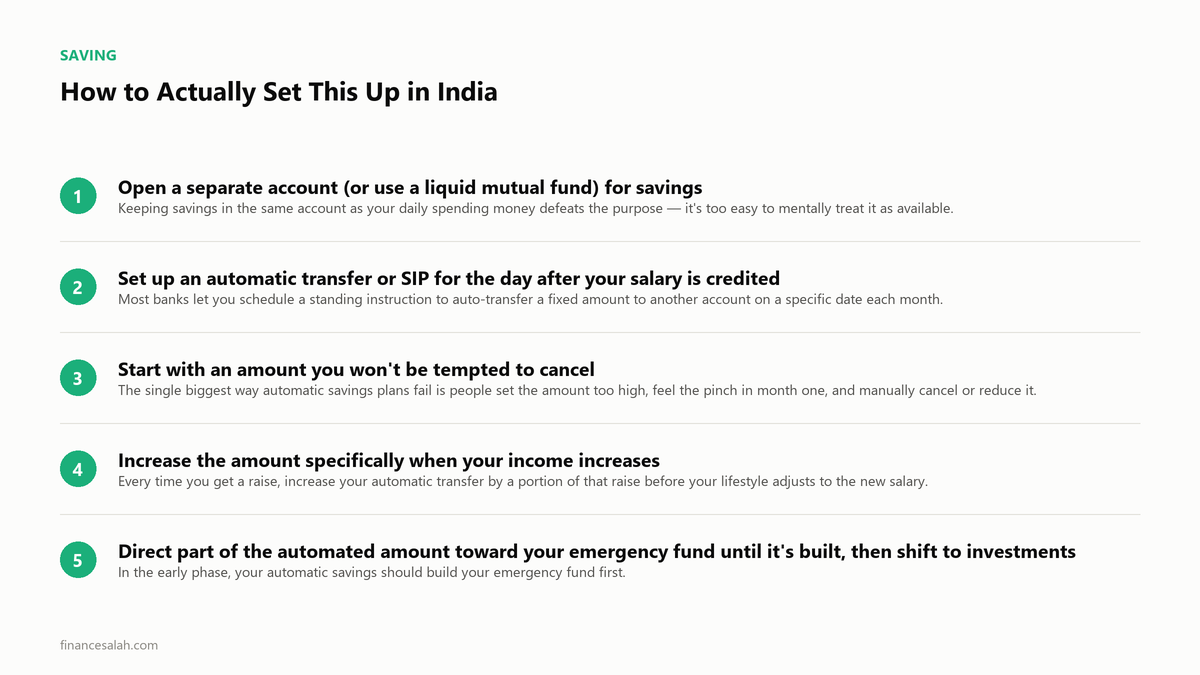
Step 1: Open a separate account (or use a liquid mutual fund) for savings
Keeping savings in the same account as your daily spending money defeats the purpose — it’s too easy to mentally treat it as available. A separate savings account, or better, a liquid mutual fund (which is slightly less instantly accessible via UPI, adding a small helpful friction), works better for this specific purpose.
Step 2: Set up an automatic transfer or SIP for the day after your salary is credited
Most banks let you schedule a standing instruction to auto-transfer a fixed amount to another account on a specific date each month. For investments, a SIP (Systematic Investment Plan) auto-debits on a chosen date directly into a mutual fund. Either mechanism works — the key is that it happens without you manually initiating it each month.
Step 3: Start with an amount you won’t be tempted to cancel
The single biggest way automatic savings plans fail is people set the amount too high, feel the pinch in month one, and manually cancel or reduce it. Start smaller than feels ambitious — even ₹1,000–₹2,000/month is a real, working system. You can always increase the amount later; it’s much harder to restart a canceled habit than to scale up a small working one.
Step 4: Increase the amount specifically when your income increases
Every time you get a raise, increase your automatic transfer by a portion of that raise before your lifestyle adjusts to the new salary. This single habit prevents “lifestyle inflation” from quietly consuming every future raise — see our detailed breakdown of how much to save by salary bracket for target ranges as your income grows.
Step 5: Direct part of the automated amount toward your emergency fund until it’s built, then shift to investments
In the early phase, your automatic savings should build your emergency fund first. Once that’s adequately sized for your expenses, redirect the same automated amount into SIP investments instead — the habit doesn’t change, only the destination.
Why This Works Better Than “Trying Harder” to Save
Behavioral finance research consistently shows that decisions requiring active willpower fail more often than decisions removed from willpower entirely. Manually deciding to transfer money to savings at the end of each month competes with dozens of other decisions and temptations throughout that month. An automatic transfer on day one removes the decision entirely — there’s nothing to resist because the money is already gone from your “spendable” mental account before you’ve had a chance to consider spending it.
This is also why “I’ll save whatever’s left” so reliably produces near-zero savings, regardless of income level — Parkinson’s Law applied to money: spending expands to consume all available funds, almost regardless of how much is available.
Common Mistakes When Setting This Up
Automating an amount that’s too aggressive. This causes bounced auto-debits, overdraft fees, or a canceled standing instruction within a few months — worse than not automating at all, since it often ends with a discouraged “automation doesn’t work for me” conclusion.
Keeping the savings account too easily accessible. If it’s linked to the same UPI app with one-tap transfers back to spending, the “automatic” system loses much of its behavioral benefit. Slightly more friction (a separate app, a fund that takes a day to redeem) is a feature, not a bug, for this specific purpose.
Forgetting to increase the amount over time. Automatic savings set once at ₹2,000/month and never revisited for three years, despite two raises in between, means your savings rate as a percentage of income has quietly fallen — revisit the amount at least once a year or with every raise.
Frequently Asked Questions
Q: Is a SIP or a recurring deposit (RD) better for automatic savings?
A: This depends on your goal and time horizon — an RD offers fixed, predictable returns similar to a fixed deposit, while a SIP into a mutual fund carries market-linked risk but historically higher long-term returns. For a comparison specific to this decision, see our guide on SIP vs RD.
Q: What if my income is variable (freelance/commission-based) — can I still automate savings?
A: Automating a fixed monthly amount is harder with variable income, but a common alternative is automating a fixed percentage of each payment received, transferred manually but immediately upon each payment rather than waiting for month-end.
Q: How do I stop myself from just transferring the automated savings back when I want to spend it?
A: Choosing a destination with slight friction (a separate bank not linked to your everyday UPI app, or a mutual fund with a 1-day redemption delay) is the most reliable practical answer — willpower alone tends to fail exactly at the moment it’s tested.
Q: Should the automatic amount go to savings or debt payoff if I have existing debt?
A: If you’re carrying high-interest debt without an emergency fund, see our guide on emergency fund vs paying off debt for the right sequencing — the automation method described here applies either way, only the destination changes.
Conclusion
Automatic savings works because it removes the one thing most save-more advice ignores: that saving “whatever’s left” almost always leaves nothing, not because of poor character, but because spending naturally expands to fill what’s available. Automate a modest amount on payday, increase it with every raise, and let the system do the work that willpower alone reliably fails to do.
Related Reading
- How Much Should I Save Every Month in India (By Salary Bracket)
- 50-30-20 Budget Rule for Indian Salaries: Does It Work at ₹30k?
- Emergency Fund Calculator for Young Indians
This article is for general educational purposes and does not constitute personalized financial advice.