
Introduction
If you’re 25 and someone has suggested you need life insurance, you’ve probably been pitched an endowment or “investment-cum-insurance” plan more often than a plain term plan — largely because these products carry higher commissions for the agent selling them. Understanding the actual difference between the two isn’t just academic; it’s the difference between adequate protection at a low cost and a plan that quietly underperforms on both insurance and investment fronts simultaneously.
What Term Insurance Actually Is
A term plan is pure life insurance: you pay a premium, and if you pass away during the policy term, your nominee receives the sum assured. If you outlive the term, you get nothing back — there’s no maturity payout, no “return of premium” (unless you specifically pick a more expensive return-of-premium variant, discussed below).
This sounds like a downside until you see the actual cost difference: term insurance is dramatically cheaper than any plan that also promises a payout on survival, because you’re paying purely for risk coverage, with no investment component bundled in.
What an Endowment Plan Actually Is
An endowment plan combines a smaller amount of life insurance with a savings/investment component. Part of your premium goes toward the insurance cover, part toward an invested corpus that pays out at maturity (or on death, whichever comes first). This is marketed as “insurance that also gives your money back” — which sounds appealing, but the mechanics matter more than the pitch.
Why the Comparison Is Usually Lopsided
The core problem with endowment plans isn’t that they’re a scam — it’s that bundling insurance and investment into one product usually makes both parts worse than buying them separately.
- The insurance cover is typically much smaller for the same premium, compared to a term plan — often a fraction of the coverage you’d get from term insurance at the same cost.
- The investment returns are typically modest, often comparable to or below what a simple debt mutual fund or PPF would deliver, once you account for the built-in insurance cost and distribution commissions embedded in the premium.
- Buying term insurance + investing the difference separately (in a mutual fund, PPF, or similar) usually outperforms an endowment plan on both fronts — more coverage for less money, and better investment growth on the separate invested amount.
This is why the near-universal advice from independent financial advisors (as opposed to insurance agents, who earn higher commissions on endowment products) is: “buy term, invest the rest” — separately.
Why a 25-Year-Old Specifically Should Prioritize Term Insurance
- Term insurance is cheapest when you’re youngest and healthiest. Premiums are locked in largely based on your age and health at purchase — buying at 25 vs. 35 for the same coverage can mean a meaningfully lower premium for the entire policy term.
- If you have any dependents relying on your income (parents, a spouse, children) even partially, term insurance replaces that income if you’re not there to provide it — this is the actual purpose of life insurance, and it’s most efficiently delivered by a term plan.
- If you have no dependents yet, the case for life insurance at all is weaker — you might reasonably wait until you do, though many people lock in a term plan early specifically to benefit from the lower premium at a younger age, since the cost difference of waiting a few years is usually small relative to the multi-decade coverage period.
When Does an Endowment (or Similar) Plan Make Sense?
To be fair to the product category: some individuals prioritize guaranteed, low-risk maturity value with zero market exposure, and are willing to accept lower overall returns for that certainty and forced savings discipline (an endowment plan’s fixed premium schedule can function as a savings-discipline tool for someone who wouldn’t otherwise invest consistently). This is a legitimate, if usually more expensive, preference — just go in with clear eyes about the trade-off rather than believing it’s simultaneously the best insurance and best investment option available.
A Side-by-Side Comparison
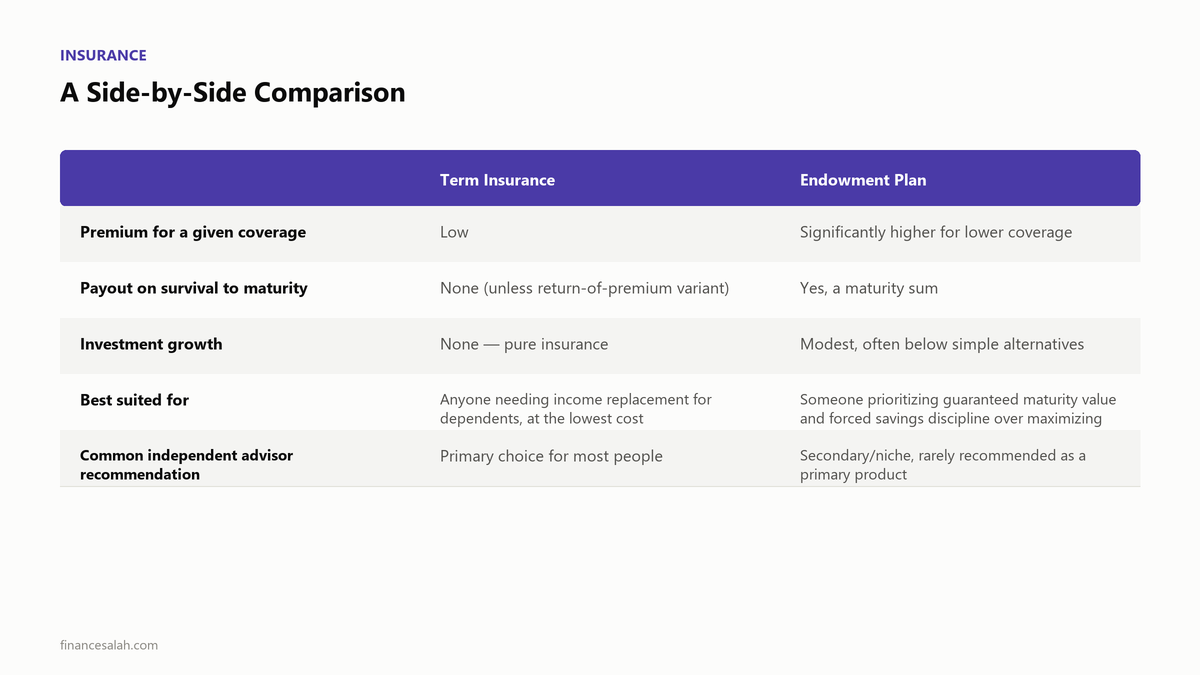
| Term Insurance | Endowment Plan | |
|---|---|---|
| Premium for a given coverage | Low | Significantly higher for lower coverage |
| Payout on survival to maturity | None (unless return-of-premium variant) | Yes, a maturity sum |
| Investment growth | None — pure insurance | Modest, often below simple alternatives |
| Best suited for | Anyone needing income replacement for dependents, at the lowest cost | Someone prioritizing guaranteed maturity value and forced savings discipline over maximizing returns |
| Common independent advisor recommendation | Primary choice for most people | Secondary/niche, rarely recommended as a primary product |
How Much Term Insurance Coverage Do You Actually Need?
This deserves its own detailed treatment — see our full guide on how much life insurance cover you actually need in India, which walks through the income-replacement calculation rather than a rule-of-thumb multiple.
Frequently Asked Questions
Q: Isn’t it wasteful to pay term insurance premiums for decades and get nothing back if I survive?
A: This is the most common objection, but it misunderstands the purpose — you’re not “wasting” the premium any more than you waste car insurance premiums by not crashing your car. You’re paying for protection against a specific risk (your dependents losing your income) for the years that risk exists, at the lowest possible cost, and investing the difference separately for growth.
Q: What is a “return of premium” term plan, and is it worth the extra cost?
A: This variant refunds your premiums if you survive the term, at a meaningfully higher premium than plain term insurance. For most people, investing the premium difference separately (in a mutual fund or similar) tends to outperform the built-in “return,” though the return-of-premium version does offer the psychological comfort of a guaranteed refund.
Q: Do I need life insurance at 25 if I have no dependents?
A: The case is weaker without dependents, but locking in a term plan while young and healthy (and therefore cheap) is a reasonable move if you expect to have dependents eventually — premiums rise with age and health changes over time.
Q: Should I surrender an existing endowment plan I already have to switch to term insurance?
A: This needs careful individual calculation — surrendering early can mean a significant loss relative to premiums already paid. It’s worth comparing the surrender value and remaining plan benefits against starting a term plan fresh, rather than assuming switching is automatically better once you’re already partway through an existing policy.
Conclusion
For most 25-year-olds, especially anyone with dependents relying even partially on their income, term insurance is the more efficient choice — significantly more coverage per rupee than an endowment plan, with any spare investment capacity better deployed separately in a mutual fund or similar vehicle. Endowment plans aren’t a scam, but they solve two problems (insurance and investment) simultaneously in a way that typically does both less efficiently than solving them separately.
Related Reading
- How Much Life Insurance Cover Do You Actually Need in India
- Health Insurance for Young Indians: Family Floater vs Individual
- How to Choose Your First Mutual Fund India
This article is for general educational purposes and does not constitute personalized financial or insurance advice. Consult a licensed insurance advisor for guidance specific to your situation before purchasing any policy.