
Introduction
The most common answer to “how much life insurance do I need” is a rule of thumb — “10x your annual salary” or “15x your salary” — repeated so often it’s treated as settled fact. It’s a reasonable starting estimate, but it ignores your actual dependents, debts, and existing assets, which means it can meaningfully overstate or understate what you actually need. Here’s the calculation behind the rule of thumb, so you can adjust it to your real numbers instead of guessing.

The Real Question Insurance Is Answering
Life insurance exists to replace the financial support your dependents would lose if you weren’t there to provide it — for the number of years they’d need that support. That’s it. It’s not about your own life’s “worth”; it’s a specific, calculable income-replacement and debt-clearing number.
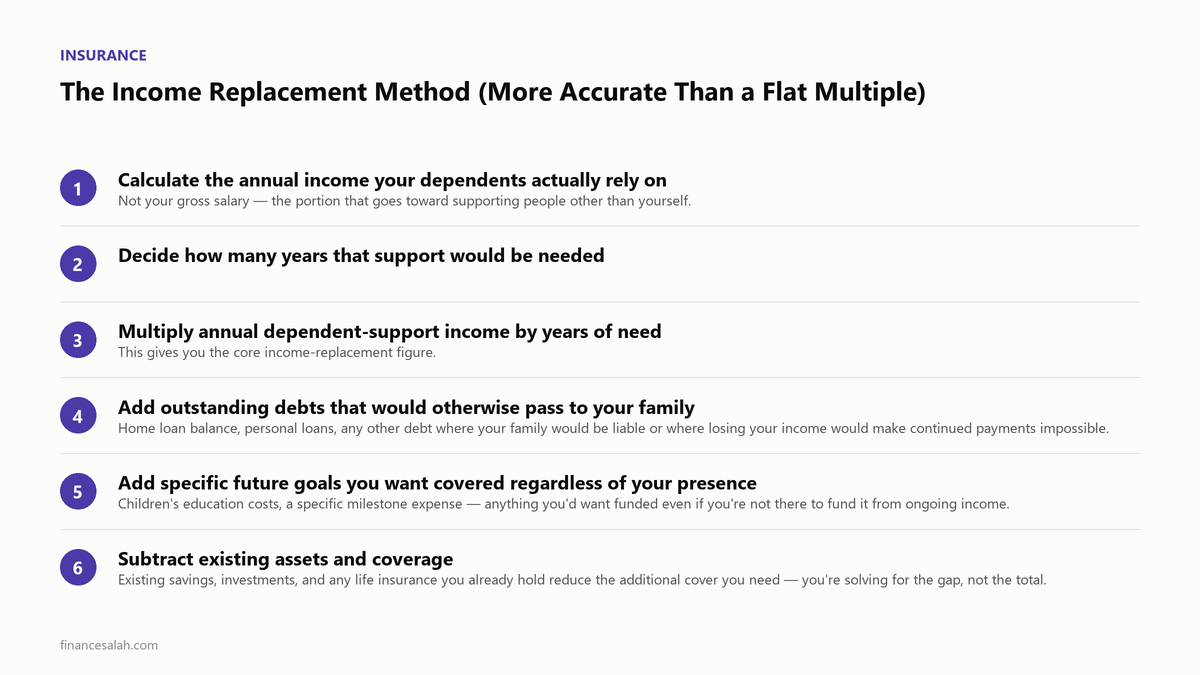
The Income Replacement Method (More Accurate Than a Flat Multiple)
Step 1: Calculate the annual income your dependents actually rely on
Not your gross salary — the portion that goes toward supporting people other than yourself. If you’re single with no dependents, this number may be genuinely small or zero (see the section below on when insurance matters less).
Step 2: Decide how many years that support would be needed
This depends on your specific situation:
– Young children: until they’re likely to be financially independent (commonly modeled as 15-20+ years)
– A spouse who could become self-sufficient over time: often 5-10 years, enough to adjust
– Aging parents dependent on you: their remaining likely dependency period
Step 3: Multiply annual dependent-support income by years of need
This gives you the core income-replacement figure.
Step 4: Add outstanding debts that would otherwise pass to your family
Home loan balance, personal loans, any other debt where your family would be liable or where losing your income would make continued payments impossible.
Step 5: Add specific future goals you want covered regardless of your presence
Children’s education costs, a specific milestone expense — anything you’d want funded even if you’re not there to fund it from ongoing income.
Step 6: Subtract existing assets and coverage
Existing savings, investments, and any life insurance you already hold reduce the additional cover you need — you’re solving for the gap, not the total.
Formula:
(Annual dependent-support income × years of need) + outstanding debts + specific future goals − existing assets and coverage = additional cover needed
A Worked Example
Consider someone earning ₹12 lakh/year, of which roughly ₹6 lakh/year supports a spouse and young child (the rest covers only their own living costs, which wouldn’t need replacing). They have a home loan with ₹40 lakh outstanding, want to ensure ₹15 lakh is available for their child’s future education, and currently hold ₹10 lakh in existing savings/investments plus a small existing ₹5 lakh insurance policy.
- Income replacement: ₹6,00,000/year × 15 years = ₹90,00,000
- Outstanding debt: ₹40,00,000
- Future goal (education): ₹15,00,000
- Subtotal: ₹1,45,00,000
- Less existing assets + coverage: ₹15,00,000
- Additional cover needed: approximately ₹1,30,00,000 (₹1.3 crore)
Compare this to a flat “10x annual salary” rule applied to the full ₹12 lakh salary: ₹1.2 crore — reasonably close in this example, but the two numbers diverge significantly for people whose salary doesn’t map cleanly to dependent support (e.g., someone with a much higher salary but few dependents would be oversold coverage by the flat multiple; someone with modest salary but substantial debt and multiple dependents could be undersold).
When Life Insurance Matters Less
If you have no dependents relying on your income and no debt that would burden anyone else after you, the core purpose of life insurance — replacing lost income for people who depend on it — doesn’t strongly apply yet. Many people in this situation still buy a modest term plan while young specifically to lock in a low premium for later (see our comparison of term insurance vs endowment plans), but the coverage amount calculation above is far less urgent without dependents or shared debt.
A Note on Calculating This Yourself vs. Using a Tool
The formula above is straightforward enough to work through with a calculator or spreadsheet in a few minutes using your own numbers — annual dependent-support income, years of need, outstanding debts, specific goals, and existing assets are all figures you already know. We’re working on a dedicated interactive version of this calculation for the site; until then, the step-by-step method above will get you a genuinely personalized number, which is more reliable than any flat multiple rule.
Frequently Asked Questions
Q: Is the “10-15x annual salary” rule of thumb wrong?
A: It’s not wrong so much as imprecise — it’s a reasonable rough estimate when you don’t have time to calculate the specifics, but it can meaningfully over- or under-state your actual need depending on how much of your salary supports dependents versus yourself, and how much debt or specific future goals you’re carrying.
Q: Should I include my spouse’s income when calculating how much cover I need?
A: Yes, indirectly — if your spouse earns enough to be largely self-sufficient, the years-of-need and total income-replacement figure should be lower than if they rely heavily on your combined household income.
Q: Does my employer’s group life insurance cover count toward what I need?
A: It should be counted as existing coverage in the formula (the “subtract existing assets and coverage” step), but be cautious about relying on it as your primary cover — group policies typically end when you leave the employer, and the coverage amount is often modest relative to a full income-replacement calculation.
Q: How often should I recalculate how much cover I need?
A: Revisit this after major life events — marriage, a child, a new home loan, a significant income change, or a dependent becoming self-sufficient — since each of these materially changes the inputs to the formula.
Conclusion
A flat “10x salary” rule is a reasonable starting point when you have no time to calculate further, but the real number depends on how much of your income supports dependents, how much debt would otherwise burden your family, and what specific future goals you want guaranteed regardless of your presence. Five minutes with the formula above gets you a number built for your actual life, not an average of everyone else’s.
Related Reading
- Term Insurance vs Endowment Plans: What Should a 25-Year-Old Buy?
- Health Insurance for Young Indians: Family Floater vs Individual
- Emergency Fund Calculator for Young Indians
This article is for general educational purposes and does not constitute personalized financial or insurance advice. Consult a licensed insurance advisor to determine coverage appropriate for your specific circumstances.