
Introduction
Every year, banks in India collect meaningful revenue from minimum-balance penalties — small, recurring charges on account holders who don’t maintain the required monthly average balance. A zero-balance account removes this risk entirely. So why doesn’t everyone just use one? Because the two account types trade off differently, and the “better” one depends on your actual banking pattern.
What a Regular Savings Account Requires
Most standard savings accounts require a Minimum Average Monthly Balance (MAB) — commonly ₹5,000 to ₹10,000 for metro/urban branches, sometimes lower in semi-urban or rural branches. Falling short of this average during a month typically triggers a penalty, commonly in the range of a few hundred rupees per instance, though this varies by bank and by how far short of the requirement you fall.
In exchange for maintaining this balance, regular accounts sometimes offer marginally better interest rates, additional free transactions, or bundled benefits (free chequebooks, better debit card variants) compared to a zero-balance account at the same bank.
What a Zero-Balance Account (BSBDA) Actually Is
A Basic Savings Bank Deposit Account (BSBDA), and similar zero-balance products offered under various bank-specific names, requires no minimum balance at all. You can let the balance drop to zero with no penalty. In exchange, some BSBDA-type accounts have limits on the number of free transactions per month, or restrictions on certain premium features (like unlimited free ATM withdrawals at other banks).
For most people whose primary use of a bank account is receiving salary and everyday spending, these transaction limits rarely bind in practice.
The Real Comparison: Penalty Risk vs. Marginal Perks
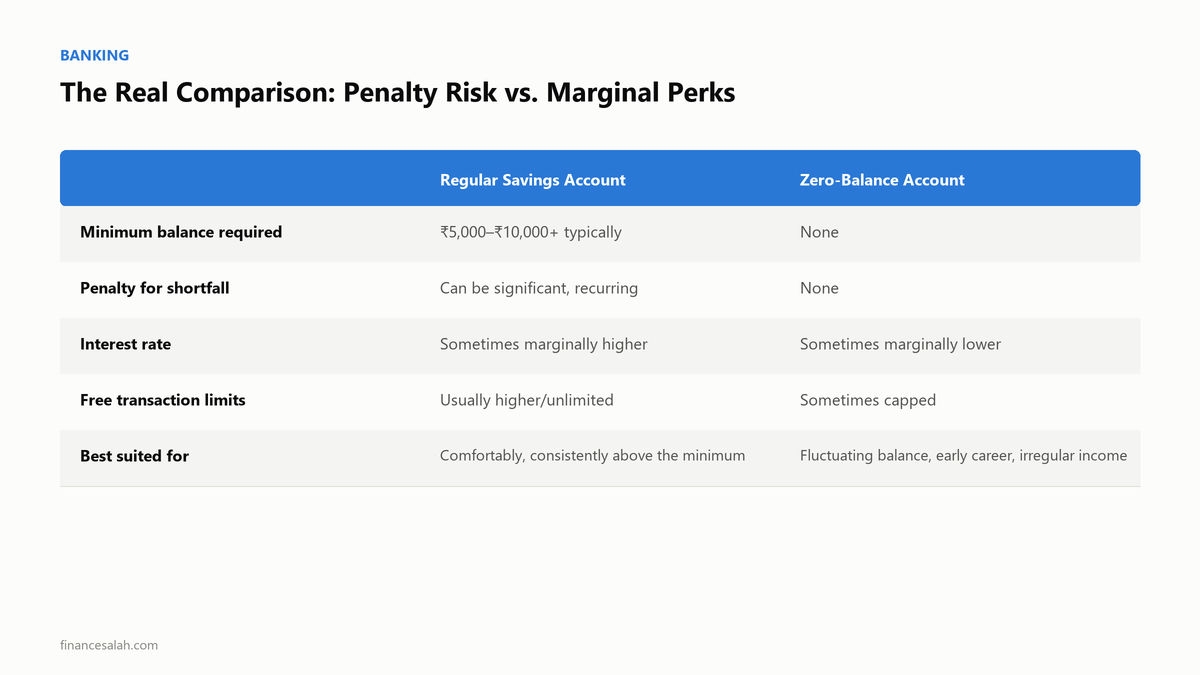
| Regular Savings Account | Zero-Balance Account | |
|---|---|---|
| Minimum balance required | ₹5,000–₹10,000+ typically | None |
| Penalty for shortfall | Can be significant, recurring | None |
| Interest rate | Sometimes marginally higher | Sometimes marginally lower |
| Free transaction limits | Usually higher/unlimited | Sometimes capped |
| Best suited for | Comfortably, consistently above the minimum | Fluctuating balance, early career, irregular income |
The math that matters: if you’re not consistently, comfortably above the minimum balance requirement every single month, the penalty risk on a regular account very likely outweighs any marginal interest-rate or perk advantage. A single missed-minimum penalty can easily exceed a year’s worth of the interest-rate difference between the two account types.
Who Should Choose Which
Choose a zero-balance account if:
– Your balance fluctuates significantly month to month (common in the first few years of a career, or with variable/freelance income)
– You’re a student or early-career professional without a large buffer
– You primarily use the account for salary receipt and everyday spending, not for maintaining a large standing balance
A regular account may make sense if:
– You comfortably and consistently maintain a balance well above the minimum requirement anyway
– The specific perks (premium debit card, unlimited free transactions, marginally better rate) meaningfully outweigh the account’s requirements for your usage pattern
A Quick Way to Decide
Look at your bank statement for the last 3-6 months. If your average balance ever dipped below what a regular account at your bank requires — even once — a zero-balance account would have avoided that penalty entirely, for no real downside in most typical usage patterns. If your balance never came close to dipping that low, the choice matters less either way.
Frequently Asked Questions
Q: Can I convert my existing regular savings account to a zero-balance account?
A: Many banks allow this conversion, though the process and any conditions (e.g., losing certain bundled features) vary by bank — it’s worth asking your bank directly rather than assuming, since some zero-balance conversions come with feature trade-offs specific to that bank’s product structure.
Q: Do zero-balance accounts have lower interest rates as a rule?
A: Not universally — some banks offer identical interest rates across both account types, others offer a marginally lower rate on zero-balance products. This varies enough by bank that it’s worth checking rather than assuming.
Q: Is there a limit to how many zero-balance accounts I can have across different banks?
A: There’s no fixed national limit, but each bank has its own KYC and account-opening requirements, and some restrict eligibility for their zero-balance product based on whether you already hold another account with them.
Q: Are zero-balance accounts only for low-income individuals?
A: No — while they were originally designed partly for financial inclusion purposes, they’re available to and genuinely useful for anyone whose balance fluctuates, including students, early-career professionals, and freelancers regardless of overall income level.
Conclusion
For most people whose bank balance isn’t reliably, comfortably above their bank’s minimum requirement every month, a zero-balance account removes a real and recurring penalty risk for little practical downside — the perks of a regular account rarely outweigh that risk unless you’re confidently and consistently above the minimum already.
Related Reading
- Best Savings Accounts in India for Young Professionals 2026
- How to Check Your CIBIL Score for Free in India
- How Much Should I Save Every Month in India (By Salary Bracket)
This article is for general educational purposes and does not constitute personalized financial advice. Account terms, fees, and requirements vary by bank and change over time — verify current terms directly with the bank.