
Table of Contents
- The Core Difference
- Side-by-Side Comparison
- Tax Treatment on Both
- When a Fixed Deposit Makes More Sense
- When a Recurring Deposit Makes More Sense
- FD Laddering: A Practical Strategy
- Common Mistakes
- Myth vs Fact
- Expert Tips
- Checklist
- FAQs
Introduction
Fixed deposits and recurring deposits both promise the same thing — safe, predictable, bank-backed returns — but they solve genuinely different savings problems. This guide compares them honestly so you can pick the right one for your actual situation, rather than defaulting to whichever one your bank’s app suggested first.
The Core Difference
A Fixed Deposit (FD) requires a lump sum invested upfront, locked in for a chosen tenure, earning a fixed interest rate for that entire period.
A Recurring Deposit (RD) lets you invest a fixed amount every month, building up a corpus over the chosen tenure, also earning a fixed interest rate — but calculated differently since each monthly installment earns interest for a different length of time.
The core question isn’t “which has better returns” in isolation — it’s “do you have a lump sum to invest now, or a consistent monthly amount to build up over time.”
Side-by-Side Comparison
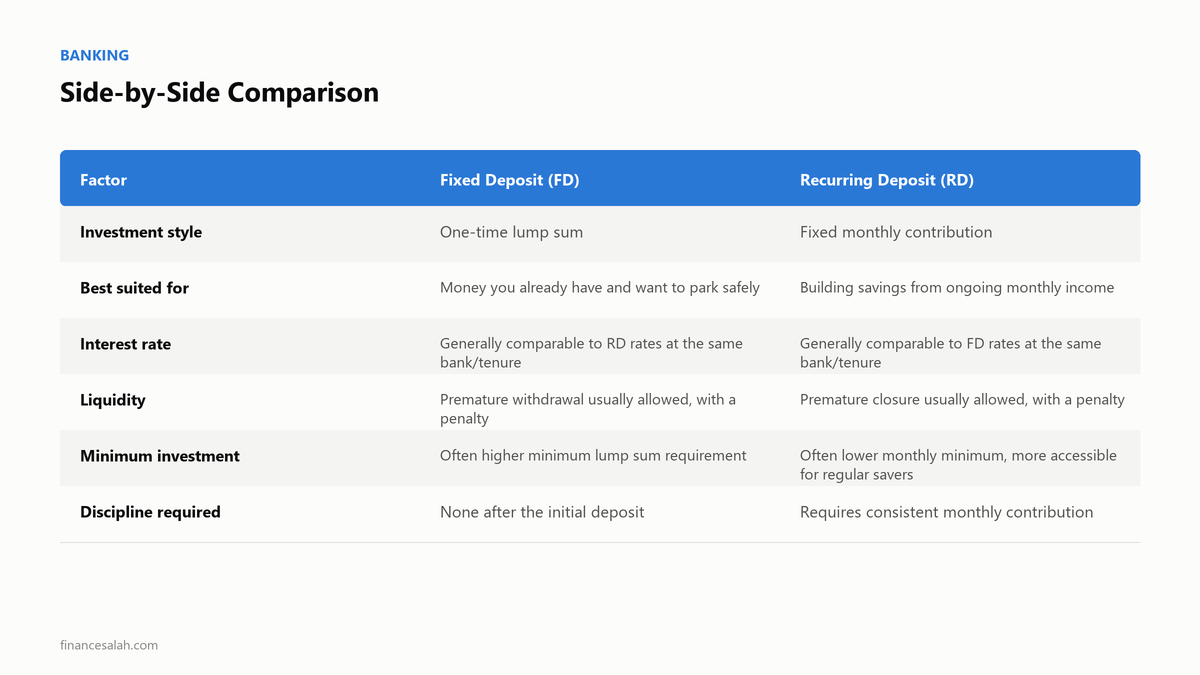
| Factor | Fixed Deposit (FD) | Recurring Deposit (RD) |
|---|---|---|
| Investment style | One-time lump sum | Fixed monthly contribution |
| Best suited for | Money you already have and want to park safely | Building savings from ongoing monthly income |
| Interest rate | Generally comparable to RD rates at the same bank/tenure | Generally comparable to FD rates at the same bank/tenure |
| Liquidity | Premature withdrawal usually allowed, with a penalty | Premature closure usually allowed, with a penalty |
| Minimum investment | Often higher minimum lump sum requirement | Often lower monthly minimum, more accessible for regular savers |
| Discipline required | None after the initial deposit | Requires consistent monthly contribution |
Interest rates for FDs and RDs at the same bank and tenure are typically similar or identical — the real decision driver is your savings pattern (lump sum vs monthly), not a meaningful rate difference between the two instrument types.
A real scenario that shows the decision isn’t about rate at all
Consider two colleagues who both wanted to save ₹1,20,000 over the next year. Rohan had just received a year-end bonus of the full amount in one payment — for him, a fixed deposit made obvious sense, since he already had the lump sum sitting in his account and simply needed a safe place to hold it. His colleague Sana had no such windfall, but was confident she could set aside ₹10,000 from her monthly salary reliably — for her, a recurring deposit matched her actual cash flow pattern far better than trying to save up the full amount in a savings account first before opening an FD. Both ended up with similar returns at maturity, at the same bank, because the rates genuinely were comparable — the entire decision came down to which format matched how the money actually arrived in their hands.
Tax Treatment on Both
- Interest earned on both FDs and RDs is fully taxable, added to your total income and taxed at your applicable income tax slab rate — neither instrument offers any special tax-exempt status on the interest itself.
- TDS (Tax Deducted at Source) applies if your interest income from a bank exceeds a specified threshold in a financial year (thresholds differ for regular versus senior citizen depositors, and are periodically revised) — always check the current threshold on the Income Tax Department’s portal.
- Tax-saving FDs (a specific FD variant with a mandatory 5-year lock-in) qualify for a Section 80C deduction on the invested amount, within the overall combined 80C limit — this specific benefit does not apply to regular FDs or to RDs.
When a Fixed Deposit Makes More Sense
- You’ve received a lump sum — a bonus, an inheritance, maturity proceeds from another investment — and want a safe place to park it for a defined period.
- You want to use FD laddering (explained below) as part of a broader liquidity and interest-rate management strategy.
- You’re building a portion of your emergency fund in a safe, interest-bearing instrument rather than a plain savings account.
- You want a specific, known maturity amount on a specific date, for a planned future expense.
When a Recurring Deposit Makes More Sense
- You don’t have a lump sum yet, but have consistent monthly income you want to save systematically.
- You want the discipline of a mandatory monthly commitment — an RD, like a SIP, builds a savings habit through structure rather than willpower alone.
- You’re saving toward a specific medium-term goal (a planned purchase, a trip, a specific expense 1-3 years out) where the safety and predictability of an RD suits the timeline better than market-linked options.
FD Laddering: A Practical Strategy
Instead of putting a large lump sum into a single FD with one maturity date, FD laddering splits it across multiple FDs with staggered maturity dates (for example, 1-year, 2-year, and 3-year FDs simultaneously). This provides:
- Regular liquidity access — a portion matures periodically, rather than the entire amount being locked until one single date.
- Some protection against interest rate risk — as each FD matures, you can reinvest at the then-current rate rather than being fully locked into one rate for the entire amount.
This is a reasonable strategy specifically for larger lump sums where you want both safety and periodic access, rather than a single all-or-nothing lock-in.
A worked example of laddering in practice
Suppose you have ₹3 lakh to deposit. Instead of putting the entire amount into a single 3-year FD, you could split it into three ₹1 lakh FDs with 1-year, 2-year, and 3-year tenures respectively. When the 1-year FD matures, you have access to that portion without breaking the other two — and you can choose to reinvest it in a fresh 3-year FD at whatever the current rate happens to be, effectively creating a rolling ladder that gives you a maturity (and a rate-refresh opportunity) every year going forward, while still capturing the generally higher rates that longer tenures often offer on the bulk of your money.
Pros and cons of FD laddering versus a single FD
| Pros of laddering | Cons of laddering |
|---|---|
| Regular access to a portion of your funds without breaking the whole deposit | Slightly more administrative tracking of multiple maturity dates |
| Reduces the risk of locking your entire amount into one rate right before rates rise | Marginally more paperwork when opening multiple FDs instead of one |
| Smooths out reinvestment risk over time rather than facing it all at once | Requires a large enough total amount to make splitting genuinely worthwhile |
Common Mistakes
- Assuming one instrument has meaningfully better returns than the other without checking the actual current rates at your specific bank — they’re often very similar.
- Not accounting for TDS on interest income, being surprised by a tax deduction on maturity or annual interest credit.
- Breaking a full FD prematurely for a partial need, when laddering into multiple smaller FDs from the start would have preserved more of the deposit at the original rate.
- Assuming a regular FD offers a tax deduction — only the specific 5-year lock-in tax-saving FD variant qualifies under Section 80C, not standard FDs or RDs.
- Missing a monthly RD installment, which can trigger a penalty depending on the bank’s specific policy — treat the RD commitment as seriously as any other fixed monthly obligation.
Myth vs Fact
| Myth | Fact |
|---|---|
| “Fixed deposits always offer better interest rates than recurring deposits.” | Rates for FDs and RDs at the same bank and tenure are typically similar — the meaningful difference is in how you contribute (lump sum vs monthly), not typically the rate. |
| “FD and RD interest is tax-free like some other savings instruments.” | Interest from both FDs and RDs is fully taxable at your income tax slab rate — there’s no special tax-exempt treatment on regular interest earned. |
| “All fixed deposits qualify for a Section 80C tax deduction.” | Only the specific 5-year lock-in tax-saving FD variant qualifies for 80C — regular FDs and RDs do not offer this deduction. |
| “Recurring deposits are only for people who can’t afford a lump sum FD.” | RDs are a legitimate, deliberate savings tool for building toward goals systematically from monthly income, regardless of whether a lump sum is available elsewhere. |
Expert Tips
- Compare actual current rates at 2-3 banks for both FD and RD at your specific tenure before assuming either is automatically better — rates do vary somewhat by institution.
- Use FD laddering for larger lump sums where you want both safety and periodic liquidity, rather than locking everything into one maturity date.
- Factor in TDS and your applicable tax slab when comparing FD/RD returns against other post-tax investment options.
- Treat your RD monthly contribution with the same seriousness as an EMI — missing installments can trigger penalties and undermines the entire purpose of the disciplined savings structure.
- Check if your bank offers a sweep-in facility linking your savings account to an FD — this can automatically move surplus balance into a higher-interest FD while keeping it accessible, combining some of the convenience of a savings account with FD-level returns.
- Ask specifically about interest payout frequency (monthly, quarterly, or cumulative at maturity) when opening an FD — this affects your cash flow and, in some cases, the effective compounding you receive.
Checklist
- [ ] Determine whether you have a lump sum (FD) or ongoing monthly savings capacity (RD)
- [ ] Compare current interest rates for both at 2-3 banks for your specific tenure
- [ ] Check the TDS threshold and how it applies to your total interest income
- [ ] Consider FD laddering if investing a larger lump sum
- [ ] Confirm premature withdrawal/closure penalties before committing
- [ ] Only expect a Section 80C deduction from the specific 5-year tax-saving FD variant
Frequently Asked Questions
Q: Which gives better returns, FD or RD?
A: Interest rates for FDs and RDs at the same bank and tenure are typically similar — the real difference is in contribution style (lump sum vs monthly), not usually a meaningful rate advantage for either.
Q: Is FD or RD interest taxable?
A: Yes — interest earned on both instruments is fully taxable at your applicable income tax slab rate, and TDS applies once your interest income crosses the specified annual threshold.
Q: Do all fixed deposits offer a tax deduction under Section 80C?
A: No — only the specific tax-saving FD variant, which has a mandatory 5-year lock-in, qualifies for a Section 80C deduction. Regular FDs and RDs do not offer this benefit.
Q: Can I withdraw my FD or RD before maturity?
A: Generally yes, for most FDs and RDs, though premature withdrawal or closure typically comes with a penalty (often a reduced interest rate) — always check your specific bank’s terms before committing.
Q: What is FD laddering?
A: It’s a strategy of splitting a lump sum across multiple FDs with staggered maturity dates, providing periodic liquidity access and some protection against being locked into a single interest rate for the entire amount.
Q: Can I open an FD or RD online without visiting a branch?
A: Yes — most banks now allow opening both FDs and RDs entirely through net banking or a mobile app, provided you already have an active account with that bank.
Q: What happens if I miss a monthly RD installment?
A: Most banks charge a small penalty for a missed or delayed installment, and repeated missed payments can affect the maturity value or, in some cases, lead to closure of the RD — check your specific bank’s policy on missed installments before starting.
Q: Is a senior citizen FD rate meaningfully different from a regular FD rate?
A: Yes, typically — most banks offer a modest additional interest rate premium for senior citizen depositors on FDs, though this doesn’t usually extend to RDs in the same way, so it’s worth checking both instruments separately if this applies to you.
Conclusion
Fixed deposits and recurring deposits aren’t really competing for the same job — an FD suits a lump sum you already have, while an RD suits building savings systematically from monthly income. Interest rates between the two are typically similar, so the right choice comes down to your actual savings pattern and goal timeline, not chasing a rate difference that usually doesn’t meaningfully exist.
Check your current savings pattern today — lump sum on hand or monthly capacity to build — and match it to the right instrument using this guide. FinanceSalah’s guide on UPI safety is a useful companion read for protecting the account these deposits are linked to, and our automatic savings guide covers how to make your RD contribution genuinely effortless every month.
Sources & Further Reading
- Reserve Bank of India — Deposit Rules and Guidelines — official banking deposit regulations
- Income Tax Department e-Filing Portal — TDS thresholds and Section 80C rules
Related Reading
- UPI Safety Tips India: Avoid Digital Payment Fraud
- NEFT vs RTGS vs IMPS: The Difference Explained
- Best Savings Accounts in India for Young Professionals 2026
- How Much Should I Save Every Month in India
- Automatic Savings: How to Pay Yourself First
- Section 80C vs New Tax Regime 2026
This article is for general educational purposes and does not constitute personalized financial advice. Interest rates, TDS thresholds, and tax rules change periodically and vary by bank — always verify current details with your bank and the official Income Tax portal before making decisions.