
Table of Contents
- What a Rider Actually Is
- Riders Generally Worth Considering
- Riders That Need More Scrutiny
- Rider vs Standalone Policy
- How to Decide Which Riders You Actually Need
- Common Mistakes
- Myth vs Fact
- Expert Tips
- Checklist
- FAQs
Introduction
Every insurance sales conversation eventually gets to the riders — critical illness, accidental death, waiver of premium, and half a dozen others, each with its own small additional premium. Some are genuinely valuable protection. Others exist mostly to increase the policy’s total premium without adding proportional value. This guide separates the two honestly, without an agent’s commission riding on the answer.

What a Rider Actually Is
A rider is an optional add-on to a base insurance policy (typically term life or health insurance) that extends coverage to a specific additional scenario, for an additional premium. Riders are generally cheaper than buying a completely separate standalone policy for the same protection, but they’re not automatically “worth it” just because they’re cheaper in isolation — the question is whether you need that specific protection at all.
Why riders exist as a product category at all
Insurers bundle riders into existing policies for a straightforward reason: it’s operationally cheaper for both parties to extend an existing underwritten policy with additional clauses than to underwrite and administer a completely separate policy from scratch. That efficiency is genuinely passed on to you as a lower cost compared to a standalone equivalent — the incentive to sell riders isn’t purely about extracting more premium, even though a poorly-chosen rider can certainly do that. Understanding this helps frame the rider conversation correctly: the product category itself is reasonable and often genuinely useful; the question is always which specific riders match your specific situation, not whether riders as a concept are a scam.
Riders Generally Worth Considering
- Critical illness rider — pays a lump sum on diagnosis of specified critical illnesses (heart attack, cancer, stroke, and others, per the specific policy’s list), independent of hospitalization costs. Given rising treatment costs and the reality that a serious illness often affects income (not just medical bills), this is one of the more consistently recommended riders by financial planners, especially for someone without a separate, adequate critical illness policy.
- Accidental death benefit rider — pays an additional sum assured if death occurs due to an accident, on top of the base term policy payout. Relatively low-cost for the additional protection it provides, particularly relevant if your occupation or lifestyle involves meaningful travel or physical risk.
- Waiver of premium rider — waives future premiums if the policyholder is diagnosed with a critical illness or total permanent disability, keeping the base policy active without further payment. This protects against the specific scenario of being unable to afford premiums exactly when the coverage matters most.
Riders That Need More Scrutiny
- Return of premium rider — refunds premiums paid if the policyholder survives the term (common on term insurance). This sounds appealing but significantly increases the premium — often enough that investing the difference separately could outperform the “refund,” depending on your own investment discipline and the specific numbers. Evaluate the actual cost difference carefully rather than assuming “getting money back” is automatically the better deal.
- Income benefit rider — pays out the claim as a series of installments rather than a lump sum. Whether this is useful depends entirely on your family’s ability to manage a lump sum versus a preference for structured income — neither is universally better, and it’s a preference question, not a pure value question.
- Multiple riders bundled by default — some policies bundle several riders together at a package rate. Check whether you’d actually choose each individual rider if offered separately, rather than accepting the bundle because it’s presented as the default.
Pros and cons of the riders that need more scrutiny
| Rider | Pro | Con |
|---|---|---|
| Return of premium | Feels psychologically reassuring, especially for buyers uncomfortable with “losing” premium if nothing happens | Meaningfully higher cost, and the “refund” doesn’t account for the time value of money you could have earned investing that difference |
| Income benefit | Provides structured, ongoing support rather than a single lump sum a family might mismanage | Less flexibility for large one-time expenses (medical bills, loan payoff) that a lump sum would cover immediately |
| Bundled packages | Administratively simple, one decision instead of several | Can include riders you wouldn’t have chosen individually, inflating cost for coverage that doesn’t match your actual risk profile |
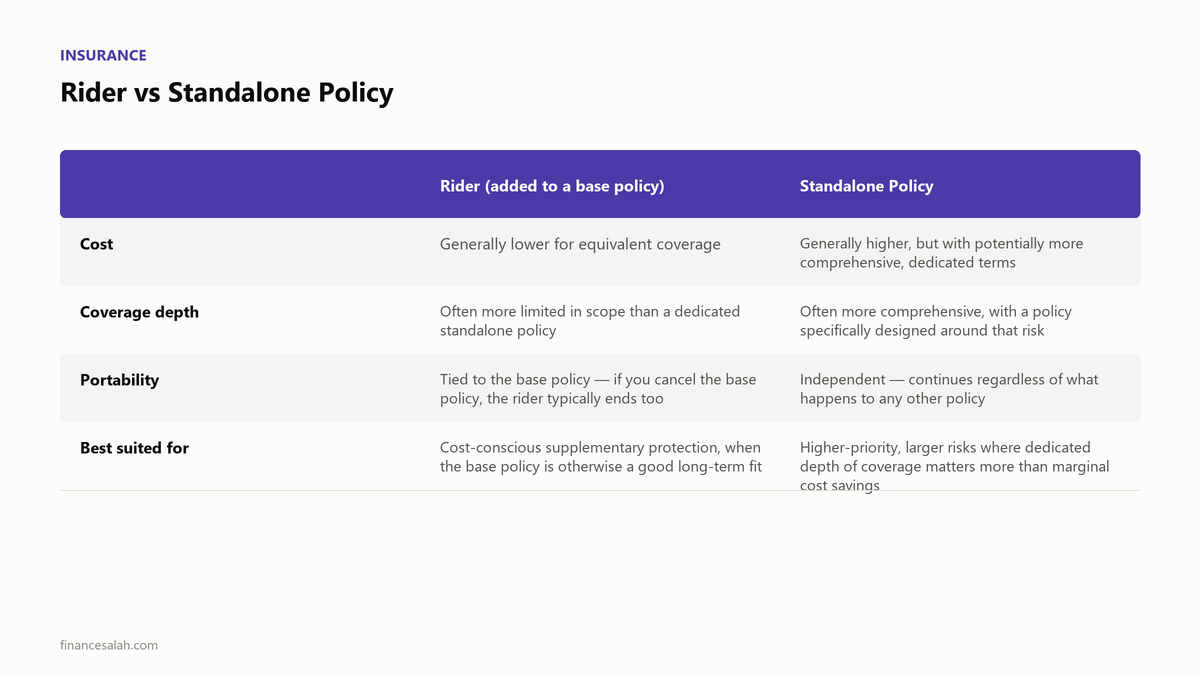
Rider vs Standalone Policy
| Rider (added to a base policy) | Standalone Policy | |
|---|---|---|
| Cost | Generally lower for equivalent coverage | Generally higher, but with potentially more comprehensive, dedicated terms |
| Coverage depth | Often more limited in scope than a dedicated standalone policy | Often more comprehensive, with a policy specifically designed around that risk |
| Portability | Tied to the base policy — if you cancel the base policy, the rider typically ends too | Independent — continues regardless of what happens to any other policy |
| Best suited for | Cost-conscious supplementary protection, when the base policy is otherwise a good long-term fit | Higher-priority, larger risks where dedicated depth of coverage matters more than marginal cost savings |
General guidance: for supplementary, moderate-priority protection, a rider is often the more cost-efficient choice. For a risk you consider high-priority and want maximum coverage depth on (for example, a comprehensive critical illness need), a dedicated standalone policy may be worth its higher cost.
A real comparison that shaped one family’s decision
Consider Arjun, 34, evaluating whether to add a critical illness rider to his existing term policy or buy a dedicated standalone critical illness policy instead. The rider was meaningfully cheaper and easy to add during his next renewal, but it capped the payout at a level below what he estimated a serious illness would actually cost his family, given his region’s private hospital rates and his own calculation of lost income during a lengthy treatment and recovery period. He ultimately chose a standalone policy specifically for critical illness, sized to genuinely cover a worst-case scenario, while keeping his existing term policy’s accidental death rider as-is, since that rider’s coverage level already matched what he considered adequate. His approach illustrates the core logic well: don’t evaluate riders as a single category to accept or reject — evaluate each one against how well its specific coverage level actually matches your real financial exposure to that risk.
How to Decide Which Riders You Actually Need
- Identify your actual risk profile — family medical history, occupation risk, existing dependents, and existing coverage gaps.
- Check whether you already have adequate coverage for that specific risk elsewhere — a separate critical illness policy might make a critical illness rider redundant, for instance.
- Compare the rider’s cost against a standalone policy for the same protection, if the risk is high-priority for you.
- Read the rider’s specific terms and exclusions — riders have their own conditions and exclusions, separate from the base policy’s terms, and are sometimes overlooked during the sales conversation.
- Reassess at each policy renewal or life stage change — your rider needs at 25 (single, no dependents) look very different at 35 (married, children, a mortgage).
Common Mistakes
- Adding every available rider “just in case” without evaluating whether each specific one matches an actual risk gap in your situation.
- Not reading a rider’s specific exclusions, assuming it has the same terms as the base policy.
- Choosing return of premium purely because “getting money back” sounds appealing, without comparing the actual cost difference against investing the premium difference separately.
- Letting an agent’s recommendation substitute for your own risk assessment — agents may have a genuine incentive to recommend more riders, given commission structures.
- Not reassessing riders at renewal, carrying add-ons that made sense years ago but no longer match your current life stage or existing coverage.
Myth vs Fact
| Myth | Fact |
|---|---|
| “More riders always mean better protection.” | More riders mean more premium — value depends entirely on whether each rider addresses a genuine gap in your specific coverage, not the total count of add-ons. |
| “A rider is always cheaper than a standalone policy for the same protection.” | Riders are often cheaper for the same nominal coverage, but standalone policies frequently offer more comprehensive terms — cost alone shouldn’t be the only comparison factor for a high-priority risk. |
| “Return of premium riders are a free bonus.” | They significantly increase the base premium — whether the “refund” is actually a good deal depends on comparing that added cost against investing the difference separately over the same period. |
| “Riders continue even if I cancel my base policy.” | Most riders are tied to the base policy and end if the base policy is cancelled or lapses — they aren’t independent, portable coverage. |
Expert Tips
- Prioritize riders that cover gaps you don’t have addressed elsewhere, rather than ones that sound comprehensive in isolation.
- Get the exact additional premium cost for each specific rider you’re considering, not a bundled “riders package” price, so you can evaluate each on its own merit.
- Revisit your rider selection at each major life event — marriage, children, a new mortgage, a career change — since your risk profile shifts meaningfully at each stage.
- If a rider significantly increases your premium, compare it directly against a standalone policy quote for the same specific protection before deciding.
- Ask your insurer directly what happens to each rider if you ever port your base policy to a different insurer — portability rules and how riders transfer (or don’t) vary and are worth understanding before you need to rely on it.
- Keep a simple one-page summary of what each rider on your policy actually covers and excludes — this becomes genuinely useful both for your own periodic review and for anyone in your family who might need to act on your policy someday.
Checklist
- [ ] List your actual risk gaps (family history, occupation, dependents, existing coverage)
- [ ] Check whether any rider you’re considering duplicates coverage you already have
- [ ] Get individual pricing for each rider, not just a bundled rate
- [ ] Read each rider’s specific exclusions separately from the base policy
- [ ] Compare high-priority risks against standalone policy costs, not just rider costs
- [ ] Reassess your riders at each renewal or major life event
Frequently Asked Questions
Q: What is an insurance rider?
A: A rider is an optional add-on to a base insurance policy (typically term life or health insurance) that extends coverage to a specific additional scenario — such as critical illness or accidental death — for an additional premium.
Q: Is a critical illness rider worth buying?
A: For many people without a separate, adequate critical illness policy, it’s considered one of the more consistently valuable riders, given rising treatment costs and the income impact a serious illness can have — though it’s still worth evaluating against your specific risk profile and existing coverage.
Q: Is return of premium rider a good deal?
A: It significantly increases your base premium in exchange for a refund if you survive the term — whether it’s genuinely a good deal depends on comparing that added cost against what you could earn by investing the premium difference separately, which varies by individual circumstances.
Q: Do riders continue if I cancel my base insurance policy?
A: Generally no — most riders are tied to the base policy and end automatically if the base policy is cancelled or lapses, since they aren’t independent, standalone coverage.
Q: Should I buy a rider or a standalone policy for the same protection?
A: Riders are often more cost-efficient for supplementary or moderate-priority protection, while a standalone policy may be worth its higher cost for a risk you consider high-priority and want more comprehensive, dedicated coverage for.
Q: Can I add riders to an existing policy, or only when I first buy it?
A: This depends on the insurer and policy type — some riders can only be added at the time of initial purchase, while others may be addable at renewal, subject to the insurer’s specific policy and, in some cases, fresh underwriting requirements.
Q: Do riders require separate medical underwriting from the base policy?
A: Some riders, particularly critical illness or disability-related ones, may require additional health disclosures or underwriting beyond what the base policy required — always check the specific rider’s application requirements.
Q: Is it common for insurance agents to push riders that aren’t necessary?
A: Given typical commission structures tied to premium value, there can be a genuine incentive for agents to recommend more riders than a specific customer needs — this is exactly why independently evaluating your own risk gaps, rather than relying solely on a recommendation, matters.
Conclusion
Insurance riders aren’t universally good or bad — they’re additional premium in exchange for additional, specific protection, and whether that trade is worth it depends entirely on your actual risk gaps, not how comprehensive the rider sounds in a sales pitch. Evaluate each rider individually against your real situation, check for overlap with coverage you already have, and don’t let “more riders” substitute for an actual risk assessment.
Review your current policy’s riders against this guide today, and check whether any are genuinely addressing a gap versus adding cost without matching value. FinanceSalah’s guide on why insurance claims get rejected is a useful companion read to make sure whatever coverage you do choose actually pays out when needed, and our comparison of term insurance versus endowment plans covers the base-policy decision this entire rider discussion builds on top of.
Sources & Further Reading
- IRDAI — Insurance Regulatory and Development Authority of India — official rider and policy disclosure regulations
Related Reading
- Why Insurance Claims Get Rejected in India
- Two-Wheeler Insurance Guide India: What’s Covered, What’s Not
- Term Insurance vs Endowment Plans: What Should a 25-Year-Old Buy?
- How Much Life Insurance Cover Do You Actually Need in India?
- Health Insurance for Young Indians: Family Floater vs Individual
- How Much Should I Save Every Month in India
This article is for general educational purposes and does not constitute personalized insurance advice. Rider availability, terms, exclusions, and pricing vary by insurer and policy — always read the specific rider terms and consult a licensed insurance advisor before purchasing.