
Table of Contents
- Is Two-Wheeler Insurance Actually Mandatory?
- Third-Party vs Comprehensive: The Core Decision
- What Comprehensive Insurance Actually Covers
- What’s Excluded — Read This Before You Need It
- Add-On Covers Worth Considering
- Understanding IDV and No Claim Bonus
- Common Mistakes
- Myth vs Fact
- Expert Tips
- Checklist
- FAQs
Introduction
Most two-wheeler owners in India renew their insurance every year without really reading what it covers — until they need to file a claim and discover a gap they didn’t know existed. This guide walks through exactly what standard two-wheeler insurance covers, what it doesn’t, and which add-ons are genuinely worth the extra premium versus which ones you can skip.
Is Two-Wheeler Insurance Actually Mandatory?
Yes — under the Motor Vehicles Act, at minimum a third-party liability insurance policy is legally mandatory for every registered two-wheeler in India, regardless of the vehicle’s age or usage. Riding without valid third-party insurance is a legal offense with penalties, separate from any financial risk you’re taking on.
What third-party insurance alone does NOT cover: any damage to your own vehicle. It only covers your legal liability toward third parties (their vehicle, property, or injury) if you’re at fault in an accident.
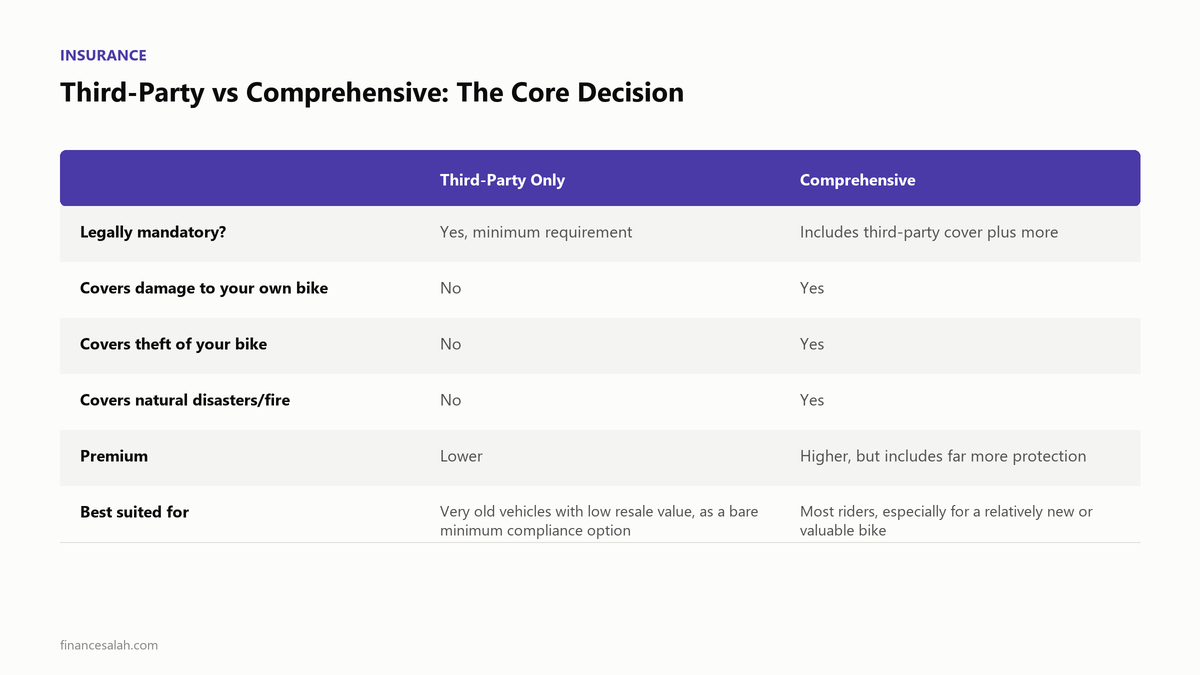
Third-Party vs Comprehensive: The Core Decision
| Third-Party Only | Comprehensive | |
|---|---|---|
| Legally mandatory? | Yes, minimum requirement | Includes third-party cover plus more |
| Covers damage to your own bike | No | Yes |
| Covers theft of your bike | No | Yes |
| Covers natural disasters/fire | No | Yes |
| Premium | Lower | Higher, but includes far more protection |
| Best suited for | Very old vehicles with low resale value, as a bare minimum compliance option | Most riders, especially for a relatively new or valuable bike |
For most two-wheeler owners, comprehensive insurance is the more sensible choice — the additional premium is usually modest relative to the protection gained, especially for a bike that’s still worth meaningfully repairing or replacing.
A real cost comparison that changed one rider’s mind
Vikram had ridden his scooter on a bare third-party-only policy for three years, reasoning that comprehensive cover felt like an unnecessary expense for a vehicle he didn’t consider particularly valuable. Then a parking-lot fall cracked his scooter’s front panel and damaged the headlight assembly — a repair that, out of pocket, cost him more than what four years of comprehensive premium upgrade would have added up to. His third-party-only policy covered none of it, since the damage was entirely to his own vehicle. He switched to comprehensive at his very next renewal, and his experience is a common one: the “savings” from skipping comprehensive cover often evaporate the very first time something actually happens to the bike itself, which is precisely the scenario third-party-only insurance was never designed to protect against.
What Comprehensive Insurance Actually Covers
- Own Damage (OD) cover — damage to your bike from accidents, collisions, or falls.
- Theft — if your bike is stolen and not recovered.
- Fire and explosion damage.
- Natural disasters — flood, earthquake, cyclone, and similar events, subject to policy terms.
- Man-made events — riots, strikes, malicious damage (subject to specific policy wording).
- Third-party liability — the mandatory component, covering your liability to others, bundled within comprehensive cover.
- Personal Accident (PA) cover — for the rider’s own injury or death, which is a mandatory component alongside standalone or comprehensive policies for the vehicle owner-driver, per current regulations.
What’s Excluded — Read This Before You Need It
- Riding without a valid driving license — a claim can be denied if the rider wasn’t legally licensed to ride at the time of the incident.
- Riding under the influence of alcohol or drugs — a standard, near-universal exclusion across all motor insurance policies.
- Normal wear and tear — mechanical breakdown or general depreciation isn’t a covered “damage” event.
- Consequential damages — losses that result indirectly from an initial incident, subject to specific policy wording.
- Using the vehicle outside its registered purpose — for instance, using a personal vehicle for commercial purposes not declared to the insurer.
- Damage during racing or illegal activities.
Always read your specific policy’s exclusions section directly — the general categories above are common across the industry, but exact wording and specific exclusions vary by insurer and policy.
Why exclusions exist in the first place
None of these exclusions are arbitrary — each one exists to prevent the policy from covering situations that involve either illegal conduct (riding without a license, under the influence) or predictable, non-insurable wear rather than a genuine unexpected loss (normal depreciation of parts over time). Understanding the logic behind exclusions, rather than just memorizing the list, makes it much easier to predict whether a specific situation you’re worried about would actually be covered — if it involves something illegal or entirely predictable rather than accidental, it’s a reasonable bet that it falls outside standard coverage regardless of the exact policy wording.
Add-On Covers Worth Considering
| Add-on | What it covers | Worth it for |
|---|---|---|
| Zero depreciation cover | Removes the standard depreciation deduction on parts during a claim, so you get closer to full replacement cost | Newer bikes, where depreciation deductions would otherwise be significant |
| Engine protection cover | Covers engine damage from water ingression or oil leakage — often excluded under standard policies | Riders in flood-prone areas or regions with heavy monsoon riding |
| Roadside assistance | Covers breakdown support — towing, minor repairs, fuel delivery | Riders who commute long distances or through areas with limited nearby service centers |
| Return to invoice cover | In case of total loss/theft, covers the gap between IDV payout and the original invoice value | Newer bikes, where the difference between IDV and invoice price can be substantial |
| Consumables cover | Covers small parts (nuts, bolts, engine oil, etc.) normally excluded from standard claims | Riders wanting fewer out-of-pocket costs during a claim |
Not every add-on is worth it for every rider — match the add-ons to your actual bike’s age, value, and riding conditions rather than adding every available option by default.
Pros and cons of loading up on add-ons
| Pros of adding relevant covers | Cons of adding every available cover |
|---|---|
| Meaningfully reduces out-of-pocket cost during an actual claim | Increases your annual premium, sometimes substantially if stacked together |
| Fills specific gaps standard policies genuinely leave open (engine water damage, depreciation deductions) | Some add-ons overlap in coverage, making one redundant if you already have the other |
| Provides real peace of mind for riders in higher-risk conditions (monsoon-heavy cities, long commutes) | Add-ons on an older, lower-value bike may cost more over time than they’d ever realistically pay out |
Understanding IDV and No Claim Bonus
- IDV (Insured Declared Value) — the maximum sum insured, representing your bike’s current market value (factoring in age-based depreciation). This is what you’d receive in case of total loss or theft, so it directly affects both your premium and your payout ceiling.
- No Claim Bonus (NCB) — a discount on your premium for each claim-free year, which can accumulate meaningfully over several years. Making a small claim can reset or reduce your NCB, so for very minor damage, it’s worth calculating whether the claim amount actually exceeds the NCB discount you’d lose.
How NCB actually accumulates over time
NCB typically starts at a modest percentage discount after your first claim-free year and increases with each subsequent claim-free renewal, up to a maximum cap after several consecutive years — this is worth understanding as a genuine long-term asset attached to your driving record, not just a one-time renewal detail. Many riders don’t realize that this accumulated NCB is often transferable if you sell your current bike and buy a new one, provided you inform the new insurer and provide proof of your NCB status from the previous policy — letting your policy lapse, or switching insurers without carrying this proof over, can mean losing a discount you spent years building.
Common Mistakes
- Choosing the cheapest premium without checking IDV — an unrealistically low IDV lowers your premium but also caps your potential payout well below your bike’s actual value.
- Not reading the exclusions list before an accident happens — many riders discover coverage gaps only when filing a claim, when it’s too late to address them.
- Filing a claim for very minor damage without checking the NCB tradeoff, sometimes losing more in future premium discounts than the claim itself was worth.
- Letting the policy lapse, even briefly, which can mean starting the No Claim Bonus accumulation over from zero.
- Not updating the insurer about registered vehicle usage changes (e.g., starting to use a personal bike for delivery/commercial purposes), which can void coverage if undisclosed.
Myth vs Fact
| Myth | Fact |
|---|---|
| “Third-party insurance is enough since it’s legally mandatory.” | Third-party insurance only covers your liability to others — it provides zero coverage for damage to or theft of your own bike. |
| “A lower premium always means a better deal.” | A lower premium is often tied to a lower IDV or fewer covered scenarios — compare coverage scope and IDV together, not premium alone. |
| “My No Claim Bonus is lost forever if I file even one claim.” | NCB typically resets to zero after a claim, but it accumulates again with subsequent claim-free years — it’s not permanently forfeited, though it does start over. |
| “Zero depreciation cover isn’t necessary for an older bike.” | It’s often genuinely less valuable for an older bike (where the bike’s overall value is already low), but essential to at least evaluate for newer bikes where depreciation deductions can be substantial. |
Expert Tips
- Set your IDV to reflect a realistic current market value, not the lowest option offered purely to reduce premium — this directly determines your protection ceiling.
- Evaluate add-ons based on your bike’s age and your actual riding conditions, not a blanket “add everything” or “add nothing” approach.
- Renew before your policy lapses, even by a day, to protect your accumulated No Claim Bonus and maintain continuous coverage.
- Photograph your bike’s condition at renewal time as a simple, low-effort record that can help during a future claim dispute.
- Compare quotes across at least 2-3 insurers at renewal time, rather than auto-renewing with the same insurer by default — premiums and available add-ons can vary meaningfully.
- Declare any modifications or accessories to your insurer explicitly, rather than assuming they’re automatically covered under a standard policy.
Checklist
- [ ] Confirm you have at least mandatory third-party coverage, ideally comprehensive
- [ ] Check your policy’s IDV reflects a realistic current value
- [ ] Read the exclusions section of your specific policy
- [ ] Evaluate zero depreciation, engine protection, and roadside assistance add-ons based on your bike’s age and use
- [ ] Understand your current No Claim Bonus status before deciding to file a minor claim
- [ ] Renew before expiry to avoid lapsing coverage and losing NCB continuity
- [ ] Update your insurer if your vehicle’s usage pattern changes
Frequently Asked Questions
Q: Is comprehensive insurance mandatory for two-wheelers in India?
A: No — only third-party liability insurance is legally mandatory under the Motor Vehicles Act. Comprehensive insurance is optional but recommended, since it additionally covers damage to and theft of your own vehicle.
Q: What does IDV mean in two-wheeler insurance?
A: IDV (Insured Declared Value) is the maximum amount you’d receive in case of total loss or theft, representing your bike’s current market value after age-based depreciation — it directly affects both your premium and your payout ceiling.
Q: Will my insurance claim be rejected if I don’t have a valid license?
A: Yes, generally — riding without a valid driving license at the time of an incident is a standard exclusion across nearly all motor insurance policies, and can result in a denied claim.
Q: Is zero depreciation cover worth it for an old bike?
A: It’s often less valuable for an older bike where the overall vehicle value and potential claim amounts are already low, but it’s genuinely worth considering for newer bikes where standard depreciation deductions during a claim can be substantial.
Q: Does filing a small claim affect my No Claim Bonus?
A: Yes — filing a claim typically resets your No Claim Bonus for that policy year, so for very minor damage, it’s worth checking whether the claim amount actually exceeds the discount you’d lose.
Q: Can I transfer my No Claim Bonus to a new bike?
A: Yes, generally — your accumulated NCB is typically tied to your driving record, not the specific vehicle, so it can usually be transferred to a new policy when you sell your bike and buy another, provided you inform the new insurer and furnish proof of your NCB from the previous policy.
Q: What happens if I don’t renew my two-wheeler insurance on time?
A: Riding without valid insurance is a legal offense, and letting a comprehensive policy lapse can also reset your accumulated No Claim Bonus and, in some cases, require a fresh inspection of the vehicle before a new policy is issued.
Q: Does two-wheeler insurance cover accessories like a custom exhaust or paint job?
A: Generally not under a standard policy — non-standard accessories and modifications often need to be specifically declared and separately insured, since standard coverage is typically based on the vehicle’s factory specifications.
Conclusion
Two-wheeler insurance is one of those things most people renew on autopilot without reading closely — until a claim reveals a gap. Understanding the real difference between third-party and comprehensive cover, what’s excluded, and which add-ons genuinely match your bike and riding conditions turns your policy from a legal formality into actual, useful protection.
Before your next renewal, pull out your current policy and check its IDV and exclusions list against what’s covered in this guide. FinanceSalah’s guide on why insurance claims get rejected is a useful companion read if you want to avoid surprises at claim time, and our breakdown of which insurance riders are actually worth buying applies the same evaluation logic to health and life policies.
Sources & Further Reading
- IRDAI — Insurance Regulatory and Development Authority of India — official motor insurance regulations and consumer guidance
- Ministry of Road Transport and Highways — Motor Vehicles Act provisions on mandatory insurance
Related Reading
- Why Insurance Claims Get Rejected in India
- Insurance Riders Explained: Which Are Actually Worth It in India
- Health Insurance for Young Indians: Family Floater vs Individual
- Term Insurance vs Endowment Plans: What Should a 25-Year-Old Buy?
- How Much Life Insurance Cover Do You Actually Need in India?
- How to Check Your CIBIL Score for Free in India
This article is for general educational purposes and does not constitute personalized insurance advice. Coverage terms, exclusions, and regulations vary by insurer and change over time — always read your specific policy document carefully and consult your insurer for details relevant to your situation.