
Introduction
If your employer provides health insurance, it’s tempting to assume you’re covered and move on — but employer group policies typically end the day you leave the job, and relying solely on them leaves a real gap. When you do look at buying your own health cover, the first real decision isn’t which insurer or plan — it’s structural: a family floater (one sum insured shared across family members) or individual plans (separate sum insured per person). The two behave very differently in practice.
How a Family Floater Works
One policy, one total sum insured (say ₹10 lakh), shared across everyone included — commonly you, your spouse, and children. Any family member can claim from the shared pool, up to the full sum insured, in a given policy year. Premiums are typically lower than buying separate individual policies with the same sum insured for each person, since the insurer is pricing the combined risk rather than the worst-case scenario for every individual simultaneously.
The catch: if one family member has a large claim in a given year, the remaining sum insured for everyone else in that policy year shrinks accordingly. Two significant hospitalizations for two different family members in the same year could exhaust a floater that would have been sufficient for either person individually.
How Individual Plans Work
Each person has their own separate sum insured — your spouse’s claims never reduce your available coverage, and vice versa. This is inherently more robust in a bad year (multiple family members needing significant care simultaneously), but it costs more in total premium for equivalent coverage per person, since you’re essentially buying the “worst case” scenario coverage for each individual rather than pooling the risk.
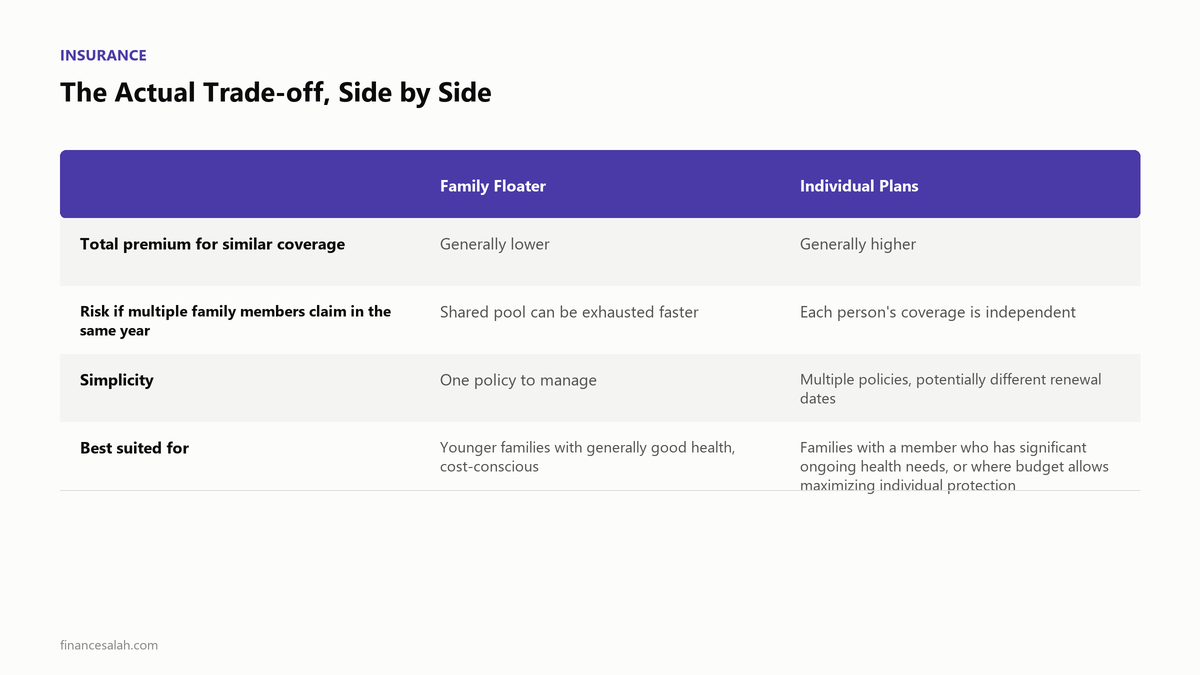
The Actual Trade-off, Side by Side
| Family Floater | Individual Plans | |
|---|---|---|
| Total premium for similar coverage | Generally lower | Generally higher |
| Risk if multiple family members claim in the same year | Shared pool can be exhausted faster | Each person’s coverage is independent |
| Simplicity | One policy to manage | Multiple policies, potentially different renewal dates |
| Best suited for | Younger families with generally good health, cost-conscious | Families with a member who has significant ongoing health needs, or where budget allows maximizing individual protection |
What Actually Matters More Than Floater vs. Individual
1. Buy health insurance while young and healthy, regardless of structure. Premiums are priced on age and health at the time of purchase (and renewal), and pre-existing condition waiting periods (commonly 2-4 years for many conditions) start counting from your first policy purchase — the earlier you buy, the sooner that waiting period clears, and the lower your locked-in starting premium tends to be.
2. Check the sum insured is realistic for your city’s actual hospital costs, not just a round number that sounds sufficient. A serious hospitalization in a metro city can run into several lakhs quickly — a ₹3-5 lakh sum insured that felt adequate a few years ago may be genuinely insufficient today given rising medical inflation (commonly cited around 12-15% annually in India, well above general inflation).
3. A top-up or super top-up plan can extend either structure affordably. Rather than buying a very large base sum insured (expensive), many people buy a moderate base cover plus an affordable top-up plan that kicks in above a specified threshold — this can meaningfully increase your effective coverage ceiling without a proportional premium increase.
4. Check the list of network hospitals and claim settlement process, not just the premium. A cheaper plan with a poor network in your actual city, or a historically slow/difficult claims process, can cost you far more in stress and out-of-pocket costs during an actual emergency than the premium difference would suggest.
A Reasonable Default for Most Young Indian Families
For a young, generally healthy family (say, a couple in their late 20s-30s with young children), a family floater with an adequate sum insured (commonly ₹10-25 lakh depending on your city and risk tolerance) plus a super top-up plan is a commonly recommended, cost-efficient starting structure. As family members age, or if someone develops an ongoing health condition, it’s worth revisiting whether splitting into individual plans (at least for that member) makes more sense — this isn’t a one-time decision, it’s one to reassess every few years as circumstances change.
Frequently Asked Questions
Q: Is my employer’s group health insurance enough on its own?
A: For most people, no — it typically ends when you leave the job, may have a lower sum insured than you’d choose independently, and doesn’t build any personal claim history or waiting-period credit that carries over. A personal policy alongside employer coverage is generally recommended.
Q: Can I switch from a family floater to individual plans later without losing benefits?
A: Most insurers allow “portability” that preserves your accumulated waiting period credit when switching plans (even between insurers), but always confirm this specifically with the insurer before switching, since terms and continuity benefits vary by policy and provider.
Q: Does a family floater cover parents/in-laws too?
A: This varies by insurer and specific plan — many floater plans are structured for self, spouse, and children, with parents typically requiring a separate policy (often priced differently due to age-related risk). Check the specific plan’s eligible member definitions before assuming coverage extends to parents.
Q: How much does medical inflation actually affect my coverage need over time?
A: Given medical costs in India have historically risen well above general inflation, a sum insured that feels adequate today may not be sufficient in 5-10 years without periodic review and possible upgrade — this is a key reason to revisit your health insurance coverage periodically rather than treating it as a one-time purchase.
Conclusion
For most young, healthy Indian families, a family floater plan (paired with an affordable super top-up) offers the best balance of cost and coverage — but the structural choice matters less than buying adequate coverage early, before waiting periods and rising premiums make it more expensive, and revisiting the sum insured periodically as medical costs and family health needs change.
Related Reading
- Term Insurance vs Endowment Plans: What Should a 25-Year-Old Buy?
- How Much Life Insurance Cover Do You Actually Need in India
- Emergency Fund Calculator for Young Indians
This article is for general educational purposes and does not constitute personalized financial or insurance advice. Consult a licensed insurance advisor to determine the right structure and sum insured for your specific family situation.