
Introduction
Having “no credit score” isn’t a bad credit score — it’s an absent one, and it puts you in the same starting position as everyone else who’s never taken a loan or held a credit card. The confusing part is that most advice about credit scores assumes you already have one and are trying to improve it. Building one from zero is a different, more specific process, and getting the order of operations right in year one saves years of unnecessary friction later.
What CIBIL Score Actually Measures
Your CIBIL score (300–900) is a statistical summary of how you’ve handled credit products — not how much money you have, not your salary, not your savings. If you’ve never held a loan or credit card, CIBIL has literally no data to score, which usually shows up as “-1” or “NA” rather than a low number. This distinction matters: a beginner with no history is not being penalized — they simply haven’t started the process yet.
The Five Factors, and Which Ones Matter Most for a Beginner
- Payment history (~35% weight) — the single biggest factor. Every on-time or missed payment across every credit product you hold gets recorded.
- Credit utilization (~30% weight) — how much of your available credit limit you’re using, on average, each month. Below 30% is considered healthy; below 10% is considered excellent.
- Length of credit history (~15% weight) — how long your oldest active account has existed. This is exactly why starting early matters — there’s no way to accelerate this one except time.
- Credit mix (~10% weight) — a mix of secured (car/home loan) and unsecured (credit card, personal loan) credit is viewed favorably, though this matters far more once you already have some history, not in year one.
- New credit inquiries (~10% weight) — every time you apply for a loan or card, a “hard inquiry” is logged. Too many in a short window signals risk-seeking behavior to lenders, even if every application was approved.
For someone starting from zero, factors 1 and 2 do almost all the work in year one. Everything else compounds later.
The Realistic Starting Path
Step 1: Get one credit product — a secured credit card if you have no income proof, a regular card if you do
See our guides on first credit cards for beginners and student cards with no income proof for the specific mechanics. One product is enough to start; you don’t need multiple cards or a loan simultaneously.
Step 2: Use it lightly and predictably
Put one or two recurring, small expenses on it — a phone bill, a subscription, groceries — nothing you wouldn’t have spent anyway. The goal in month one isn’t rewards optimization; it’s generating a clean, boring repayment record.
Step 3: Pay the full statement balance every single month, before the due date
Not the minimum due — the full amount. See the section below on why this specific habit matters more than any other single action.
Step 4: Keep utilization low even if you’re confident you’ll pay in full
Even if you always pay the full bill, using 80% of your limit every month can still show as high utilization on the date your statement is generated (the bureau doesn’t know you paid it off — it reports the balance as of the statement date). Aim to keep your spend under 30% of your limit if possible.
Step 5: Wait. Six months is the earliest a meaningful score typically forms; 12 months gives you a genuinely usable one.
This is the part people underestimate — there’s no legitimate way to build 12 months of history in 3 months. Patience here is not optional, it’s structural.
Common Myths That Actually Slow Beginners Down
Myth: “Apply for multiple cards to build history faster.”
Reality: each application is a hard inquiry, and multiple inquiries close together lowers your score and signals risk to lenders — the opposite of the intended effect.
Myth: “Carrying a small balance month-to-month helps your score more than paying in full.”
Reality: this is false and costs you real interest for no benefit. CIBIL doesn’t reward carried balances — it rewards on-time payment and low utilization. Paying in full every month is strictly better for your score and your wallet.
Myth: “Checking your own CIBIL score hurts it.”
Reality: checking your own score is a “soft inquiry” and has zero impact. Only lender-initiated “hard inquiries” (when you apply for credit) have any effect. See our guide on checking your CIBIL score for free.
Myth: “You need a loan, not just a credit card, to build a real score.”
Reality: a single, well-managed credit card is entirely sufficient to build a solid score over 12–24 months. A loan can diversify your credit mix later, but it’s not a prerequisite.
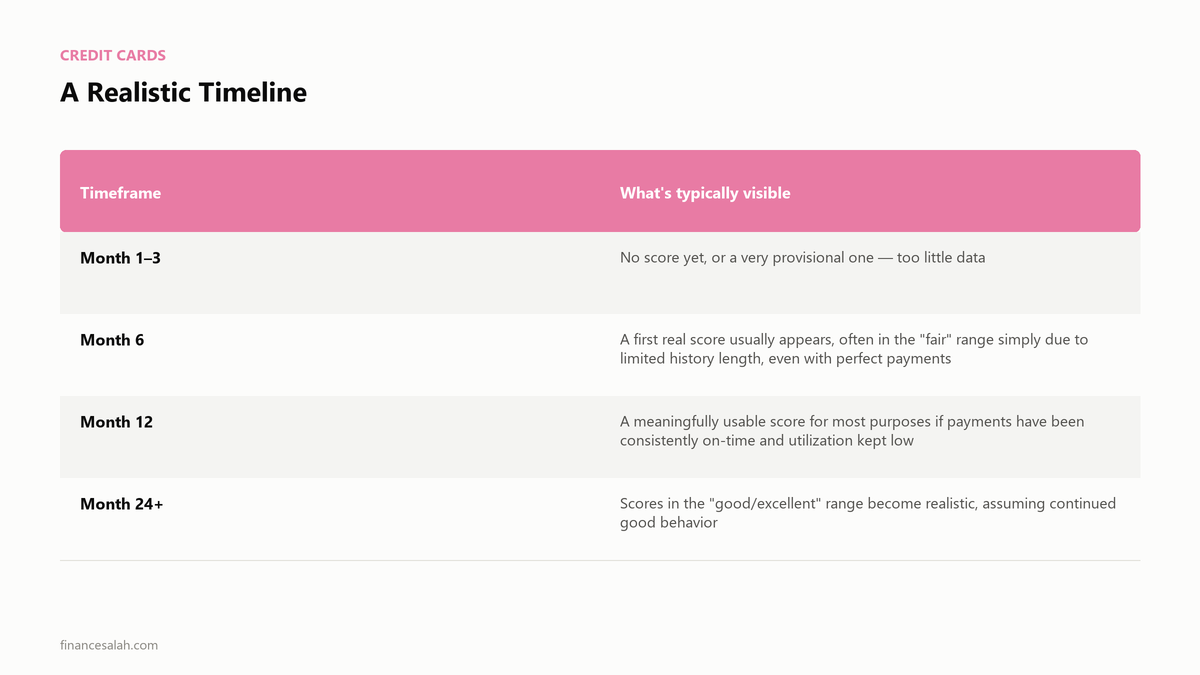
A Realistic Timeline
| Timeframe | What’s typically visible |
|---|---|
| Month 1–3 | No score yet, or a very provisional one — too little data |
| Month 6 | A first real score usually appears, often in the “fair” range simply due to limited history length, even with perfect payments |
| Month 12 | A meaningfully usable score for most purposes if payments have been consistently on-time and utilization kept low |
| Month 24+ | Scores in the “good/excellent” range become realistic, assuming continued good behavior |
Frequently Asked Questions
Q: What’s a good CIBIL score for a beginner to aim for in year one?
A: Anything in the 700+ range within the first year is a strong outcome given limited history length. Don’t be discouraged if it’s not yet 750+ — that typically comes with more time, not more effort.
Q: Does paying utility bills or rent on time help build credit score in India?
A: Not directly in most cases — CIBIL primarily tracks formal credit products (loans, credit cards), not utility or rent payments, unless specifically reported through a formal rent-reporting scheme, which isn’t yet standard practice in India.
Q: I have no credit history — will banks reject my loan application outright?
A: Not necessarily, but you may face a higher interest rate, lower approved amount, or a request for a guarantor/co-applicant, since the bank has no track record to assess risk against. This is exactly why building some history first, even with a small credit card, improves your terms later.
Q: Can a joint account or being an add-on cardholder help build my own credit history?
A: This varies by bank and product — some add-on card usage is reported under the primary holder only, some contributes to the add-on holder’s file too. Worth confirming directly with the specific bank rather than assuming either way.
Conclusion
Building a credit score from zero isn’t about clever tricks — it’s about getting one credit product, using it lightly and predictably, paying the full bill every month without exception, and giving it the 6–12 months it structurally needs to become real data. There’s no way to compress that timeline, only ways to waste it with unnecessary hard inquiries or carried balances.
Related Reading
- Best Credit Cards for Beginners in India 2026
- How to Check Your CIBIL Score for Free in India
- Credit Card vs Debit Card: What Should Young Indians Use First?
This article is for general educational purposes and does not constitute personalized financial advice. Credit scoring criteria and weightings are illustrative and may vary by credit bureau and over time.