
Introduction
“I’m a student, I have no income proof — can I even get a credit card?” is one of the most common questions in Indian personal finance forums, and the honest answer is: yes, but not the way most people assume. Banks aren’t going to hand a regular unsecured credit card to someone with no income history. But there are two well-established paths that get real students a real credit card — one building genuine credit history from year one of college, rather than waiting until their first job.
Path 1: The Secured Credit Card (Against a Fixed Deposit)
This is the most reliable, bank-approved route, and it works regardless of your income situation.
How it works: You (or a parent) open a fixed deposit — commonly ₹10,000 to ₹25,000, though some banks accept lower amounts specifically for student cards. The bank issues a credit card with a credit limit typically 80–100% of the FD value. The FD continues earning interest as normal; it’s simply held as collateral. If you default, the bank can recover dues from the FD — which is exactly why banks don’t need income proof for this product.
Why this is genuinely good, not just a workaround: A secured card reports to CIBIL exactly like any other credit card. Every on-time payment builds real credit history. By the time you graduate and apply for your first “real” unsecured card or even a car/home loan years later, you’ll already have 2–4 years of credit history — a meaningful head start most of your peers won’t have.
What to check before opening one:
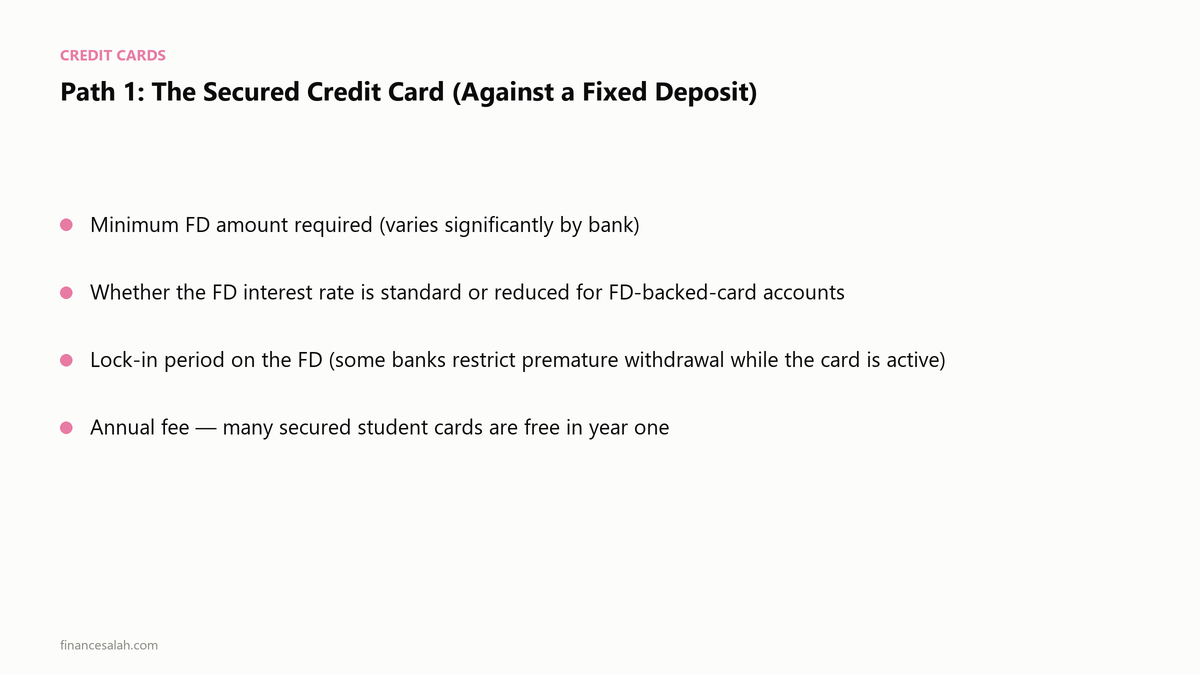
– Minimum FD amount required (varies significantly by bank)
– Whether the FD interest rate is standard or reduced for FD-backed-card accounts
– Lock-in period on the FD (some banks restrict premature withdrawal while the card is active)
– Annual fee — many secured student cards are free in year one
Path 2: Add-On (Supplementary) Cards
If a parent or guardian already has a credit card in good standing, most banks let them add you as an add-on cardholder. You get your own physical card and can use it independently, but the bill goes to the primary cardholder (your parent), who’s fully liable for the dues.
The upside: no FD needed, no income proof, immediate access, and — depending on the bank — the spending/payment history may start contributing to your own credit profile once you have independent income and can be converted to a primary card.
The catch: an add-on card’s usage is entirely governed by the primary cardholder’s trust and the credit limit they’re comfortable sharing. It’s a good stepping stone for learning card discipline, but it isn’t the same as building your own independent credit file — check with the specific bank whether add-on card usage is reported under your own name in your credit bureau report, since this varies.
What Real Student Cards Usually Look Like
Several banks specifically market cards to students and young professionals, typically with:
– Low or ₹0 joining/annual fee
– A modest FD requirement (or none, for select co-branded student cards tied to a university/institute)
– Cashback or discounts skewed toward student spending categories: food delivery, OTT subscriptions, online shopping, movie tickets
– Lower credit limits (₹5,000–₹20,000) — this is appropriate, not a downgrade; a smaller limit is actually safer while you’re learning to manage one
The Discipline That Matters More Than Which Card You Pick
For a student specifically, three habits determine whether a first card helps or hurts:
- Never spend beyond what you can repay from pocket money/stipend/parental allowance within the same month. A credit card is not a substitute for income you don’t have yet.
- Set a personal spending cap well below your actual credit limit — e.g., if your limit is ₹15,000, treat ₹5,000 as your real ceiling. This keeps utilization low (good for your score) and keeps the bill always payable in full.
- Never use a credit card for cash withdrawal. Cash advances on credit cards carry their own (usually higher) interest rate that starts accruing immediately, with no interest-free period — this is one of the costliest mistakes a student can make with a card.
Frequently Asked Questions
Q: Can a college student with zero income get an unsecured credit card in India?
A: Rarely, from major banks, without either income proof or a guarantor. A secured (FD-backed) card or an add-on card are the realistic, reliable paths.
Q: Does a secured credit card affect my credit score differently than a regular one?
A: No — it’s reported to CIBIL/credit bureaus the same way. The “secured” label only affects how the bank manages its risk; it doesn’t create a lesser credit history from the bureau’s perspective.
Q: What happens to my secured credit card when I graduate and get a job?
A: You can typically apply to convert it to an unsecured card once you have income proof, and release the FD — or simply keep it as-is and apply for an additional unsecured card using your new salary slip alongside the credit history you’ve already built.
Q: Is an add-on card better than a secured card for a student?
A: They serve different goals. An add-on card is easier to get immediately with no FD, but ties your spending to a parent’s trust and limit. A secured card is more independent and reliably builds your own credit file. If you can afford the FD, the secured card is usually the stronger long-term choice.
Q: Can international students in India get a credit card?
A: This is significantly harder without local income, a local guarantor, or an NRE/NRO account with sufficient balance — policies vary widely by bank and are worth confirming directly, as this is a narrower case than most domestic student scenarios.
Conclusion
A student’s first credit card should be chosen for the credit history it builds, not the rewards it offers — a secured card against a modest FD is usually the most reliable, bank-friendly route, and the discipline you build managing a small limit well is worth more than any cashback percentage.
Related Reading
- Best Credit Cards for Beginners in India 2026
- How to Build Credit Score in India With No Credit History
- Credit Card vs Debit Card: What Should Young Indians Use First?
This article is for general educational purposes and does not constitute personalized financial advice. Eligibility criteria and FD requirements vary by bank and change over time — verify current terms directly with the issuing bank.