
Introduction
Your first credit card is one of the most consequential financial products you’ll ever apply for — not because of what it lets you buy, but because of the credit history it starts building from day one. Used well, it becomes the foundation of your CIBIL score, your ability to get a home loan at a good interest rate years from now, and even things landlords and employers sometimes check. Used poorly, it becomes the fastest way a 23-year-old can end up in debt.
This guide isn’t a ranked list of “best cards” with affiliate links — card offers change constantly, and by the time you read this, today’s best joining bonus might be gone. Instead, this is what actually matters when you’re choosing your first credit card in India: the card types that suit beginners, the specific features to check, and the mistakes that trip up almost everyone in their first year.
Who Actually Qualifies for a First Credit Card?
Banks assess three things for a first-time applicant:
- Income — salaried applicants typically need ₹15,000–₹25,000/month minimum for an entry-level card, though this varies significantly by bank and city.
- Credit history — if you have none (common for anyone under 25), some banks will still issue a card based on income alone; others want at least a starter product first.
- Existing relationship with the bank — having a savings account with the same bank for 6+ months often smooths approval, since the bank already has your salary-credit history.
If you have zero income proof (a student, or early-career with irregular income), a secured credit card — backed by a fixed deposit — is usually the actual starting point. More on that in our dedicated guide to student credit cards with no income proof.
The Three Credit Card Types That Actually Suit a First-Timer
1. Basic/Entry-Level Cards (lowest annual fee, or lifetime free)
These typically offer modest cashback (1–2%) on everyday spends — groceries, fuel, utility bills — with a low or waived annual fee. For a first card, a lifetime free or first-year-free card is usually the right call: you’re not yet sure how you’ll use a credit card, so it makes little sense to pay ₹500–₹1,000/year to find out.
2. Secured Cards (against a Fixed Deposit)
If you don’t have income proof or a credit history, a secured card lets you open an FD (often ₹10,000–₹25,000) and get a card with a credit limit tied to that FD. The FD keeps earning interest, and the card behaves exactly like a normal credit card for building credit history. This is the most reliable path for students, freelancers, and anyone with irregular income.
3. Cashback/Fuel Co-Branded Cards
If you already have a clear, predictable spending pattern — say, you commute by car and buy fuel weekly — a fuel co-branded card with fee waivers on fuel surcharge can offer real, immediate value. These aren’t ideal as your only card long-term, but they’re a reasonable second card once your first year of credit history is established.
What to avoid as a first card: premium travel or lounge-access cards with high annual fees (₹2,000+) — the value of these cards is in perks you won’t fully use until your spending is higher, and a first-year fee waiver often disguises a steep renewal fee in year two that catches people off guard.
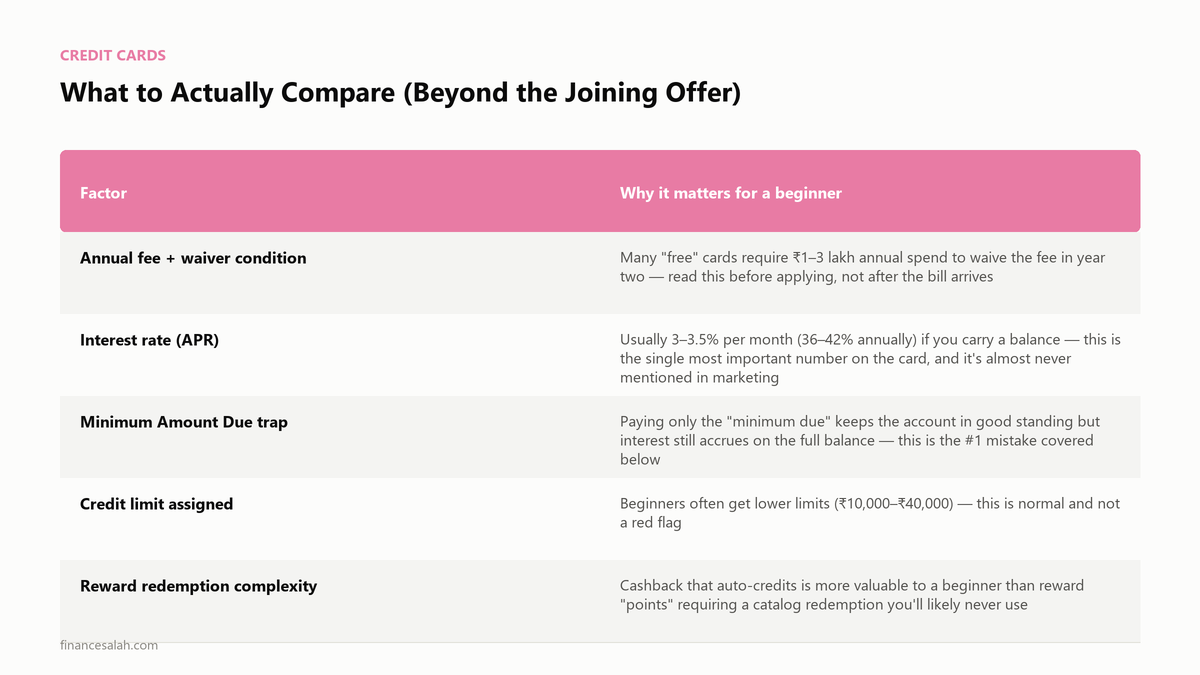
What to Actually Compare (Beyond the Joining Offer)
| Factor | Why it matters for a beginner |
|---|---|
| Annual fee + waiver condition | Many “free” cards require ₹1–3 lakh annual spend to waive the fee in year two — read this before applying, not after the bill arrives |
| Interest rate (APR) | Usually 3–3.5% per month (36–42% annually) if you carry a balance — this is the single most important number on the card, and it’s almost never mentioned in marketing |
| Minimum Amount Due trap | Paying only the “minimum due” keeps the account in good standing but interest still accrues on the full balance — this is the #1 mistake covered below |
| Credit limit assigned | Beginners often get lower limits (₹10,000–₹40,000) — this is normal and not a red flag |
| Reward redemption complexity | Cashback that auto-credits is more valuable to a beginner than reward “points” requiring a catalog redemption you’ll likely never use |
The Beginner Mistake That Costs the Most: Paying Only the Minimum Due
This is worth its own section because it’s the single most expensive misunderstanding first-time cardholders have.
Your credit card statement shows two numbers: Total Amount Due and Minimum Amount Due (usually ~5% of the total). Paying only the minimum keeps your account “current” — no late payment reported — but here’s what actually happens: interest starts accruing on the entire outstanding balance from the transaction date, not just the unpaid portion, and it compounds monthly. A ₹20,000 bill paid at the minimum can take years to clear and cost multiples of the original amount in interest, at rates that are often higher than even a personal loan.
The rule for a beginner: treat your credit card exactly like a debit card. Only spend what you can pay in full by the due date. If you can’t do that consistently in month one, the card isn’t the problem — it’s a signal to build the emergency fund first before adding another payment obligation.
How a First Credit Card Actually Builds Your Credit Score
Three factors matter most in your first year:
- On-time payment history (the single biggest factor) — set up autopay for at least the minimum due as a safety net, but pay in full manually before that.
- Credit utilization — the percentage of your limit you use each month. Keeping this under 30% (ideally under 10%) signals responsible use, even if you pay in full every month.
- Length of credit history — this is exactly why your first card matters: closing it in year two to “upgrade” resets part of your credit age. Consider keeping your first card open (even unused) once you get a better one later.
For the full mechanics of how this translates into an actual CIBIL number, see our guide on how to build credit score in India with no credit history.
Frequently Asked Questions
Q: What is the minimum salary needed for a credit card in India?
A: It varies by bank and card, but entry-level cards commonly start at ₹15,000–₹25,000/month for salaried applicants. Some banks issue cards to those with lower or no verifiable income through secured (FD-backed) cards instead.
Q: Should my first credit card be a private bank card or a public sector bank card?
A: Both work fine for building credit history — the CIBIL bureau doesn’t care which bank issued the card. What matters more is the fee structure and whether you’ll actually use the card’s specific benefits (cashback category, fuel surcharge waiver, etc.).
Q: Will applying for multiple credit cards at once hurt my credit score?
A: Yes — each application triggers a “hard inquiry” on your credit report, and multiple inquiries in a short window can lower your score and make banks more cautious about approving you. Apply for one card, use it responsibly for 6–12 months, then consider a second.
Q: Is a credit card with no annual fee always better for a beginner?
A: Usually yes, unless a fee-based card offers a benefit you’re certain to use (like airport lounge access if you travel monthly). For a first card, “free and simple” beats “premium and unused” almost every time.
Q: How long before my first credit card meaningfully improves my CIBIL score?
A: Typically 6–12 months of on-time payments and low utilization before you see a solid score forming. CIBIL scores need a track record — there’s no shortcut to that first year.
Conclusion
Your first credit card should be boring, not exciting. Skip the premium perks, skip the highest joining bonus, and pick a low/no-fee card you’ll actually pay in full every month. Everything else — better cards, higher limits, real rewards — compounds naturally from that foundation over the next 1–2 years.
Related Reading
- Best Credit Cards for Students in India (No Income Proof)
- Credit Card vs Debit Card: What Should Young Indians Use First?
- How to Build Credit Score in India With No Credit History
- Emergency Fund Calculator for Young Indians
This article is for general educational purposes and does not constitute personalized financial advice. Card terms, fees, and eligibility criteria vary by bank and change over time — always verify current details directly with the issuing bank before applying.