
Introduction
If you already have a savings account, you already have a debit card. So the real question isn’t “which one should I get” — it’s “should I also get a credit card, or is debit enough?” This gets asked constantly by people in their early 20s starting their first job, and the honest answer is more nuanced than either “credit cards are dangerous, avoid them” or “you need a credit card to build credit” — both of which are half-true.
The Fundamental Difference (Beyond the Obvious)
A debit card spends money you already have. A credit card spends the bank’s money, which you repay — interest-free if you pay in full by the due date, expensively if you don’t. That’s the mechanic everyone knows. The part that actually matters for your financial life is this:
Debit card usage does nothing for your credit score. Credit card usage — done right — builds it. Your CIBIL score, which affects your ability to get a home loan, car loan, or even a good personal loan rate years from now, is built almost entirely from credit products: credit cards and loans. A debit card, no matter how responsibly used for a decade, contributes zero credit history.
This is the single biggest reason financial advisors recommend getting a credit card early — not for the rewards, but because credit history takes years to build, and starting at 22 instead of 28 gives you a meaningfully longer track record when you eventually need a loan.
Where Debit Cards Are Still Better
- Zero risk of debt. You cannot spend money you don’t have. For anyone who knows they struggle with spending discipline, this is a legitimate, honest reason to stay debit-only for now.
- No interest, no fees, no due dates to track. Simplicity has real value, especially early in your financial life when you’re managing many new things at once.
- No temptation of a credit limit. A ₹50,000 credit limit can feel like available money it isn’t. A debit card physically cannot let you overspend beyond your balance (barring an overdraft facility, which is its own separate product).
Where Credit Cards Are Actually Better (Beyond Rewards)
- Builds credit history, as above — the single biggest long-term financial reason.
- Purchase protection and dispute rights are typically stronger on credit cards — if a merchant doesn’t deliver or a transaction is fraudulent, credit card chargebacks are generally easier to dispute than debit card ones, since it’s the bank’s money on the line, not yours directly.
- Interest-free credit period (typically 18–50 days depending on when in the billing cycle you spend) means your money keeps earning interest in your savings/liquid fund an extra few weeks before the bill is due — a small but real benefit if you’re disciplined about paying in full.
- Emergency buffer without touching savings. If a genuine emergency hits before payday, a credit card gives you a short-term buffer without dipping into your emergency fund — provided you can clear the bill by the due date.
The Honest Answer: It’s Not Either/Or
The realistic, common-sense approach most financial educators recommend for young Indians:
- Keep your debit card as your default for daily spending you’re not tracking closely — small cash-like purchases, ATM withdrawals, UPI payments.
- Get one credit card early, specifically to start building credit history, but use it deliberately — for planned purchases you were going to make anyway, always paid in full.
- Don’t use the credit card as a signal that you can spend more than your debit card allows. The discipline is the same either way; the credit card just adds a repayment step and a credit-history benefit on top.
This is exactly why the “which is better” framing is slightly wrong — the actual skill is spending the same amount regardless of which card is in your hand, and letting the credit card exist purely to build your financial track record on autopilot.
A Quick Comparison
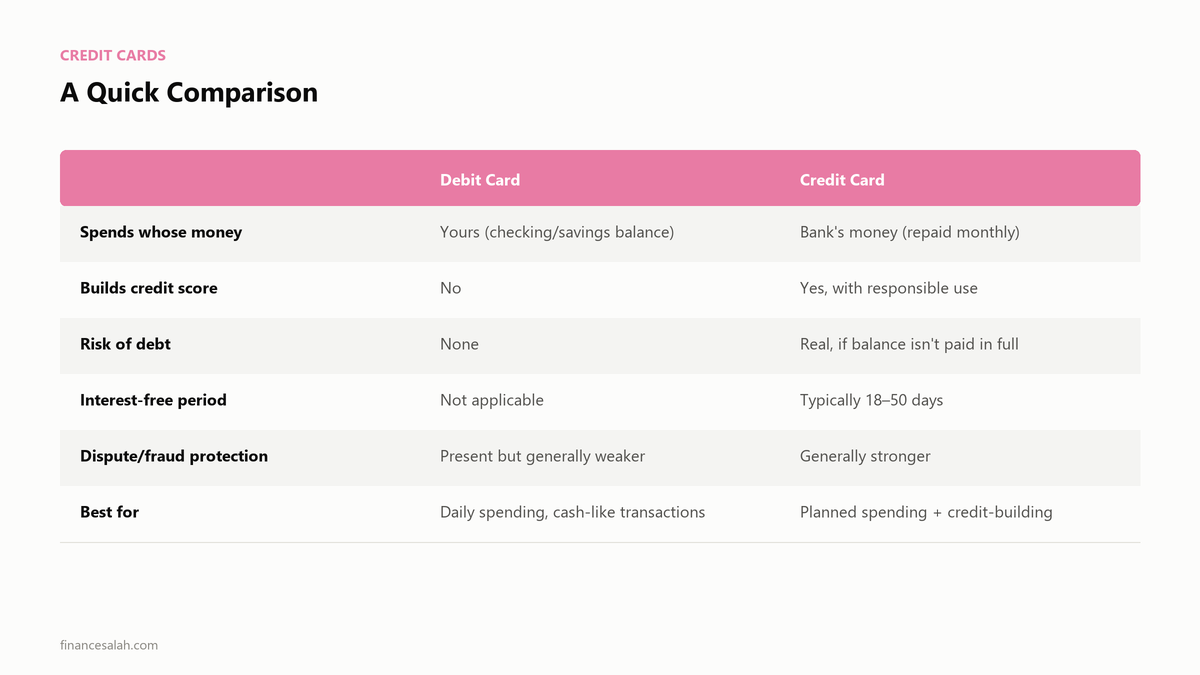
| Debit Card | Credit Card | |
|---|---|---|
| Spends whose money | Yours (checking/savings balance) | Bank’s money (repaid monthly) |
| Builds credit score | No | Yes, with responsible use |
| Risk of debt | None | Real, if balance isn’t paid in full |
| Interest-free period | Not applicable | Typically 18–50 days |
| Dispute/fraud protection | Present but generally weaker | Generally stronger |
| Best for | Daily spending, cash-like transactions | Planned spending + credit-building |
Frequently Asked Questions
Q: If I never plan to take a loan, do I still need a credit card?
A: Even if you don’t plan on a loan today, life circumstances change — a future home purchase, a business need, or simply better terms on any future credit product all benefit from having history. It’s cheap insurance to start early even if you’re unsure you’ll need it.
Q: Is it true that having a credit card and not using it hurts your credit score?
A: An unused card doesn’t actively hurt you, but it also doesn’t build history — the bureau needs to see activity and repayment behavior to score you. Light, regular use (even one small bill paid in full monthly) is what actually builds the score.
Q: Can I just use my debit card for everything and get a credit card later, say at 28?
A: You can, but you’re giving up years of potential credit history for no real benefit — the “risk” of a credit card is entirely about discipline, not the product itself. Starting earlier with strict discipline is generally better than starting later with the same discipline.
Q: Which should a student use — debit or credit?
A: Debit by default for daily spending; a secured credit card (see our student credit card guide) if you want to start building credit history during college years.
Conclusion
Debit and credit cards aren’t rivals — they solve different problems. Debit protects you from overspending; credit, used correctly, quietly builds the financial track record you’ll need for every major loan in your future. The smart move for most young Indians is both: debit as your daily default, one credit card used deliberately and paid in full every month.
Related Reading
- Best Credit Cards for Beginners in India 2026
- How to Build Credit Score in India With No Credit History
- How to Check Your CIBIL Score for Free in India
This article is for general educational purposes and does not constitute personalized financial advice.