
Table of Contents
- What HRA Actually Is
- The Three-Way Minimum Formula
- A Worked Example
- Documents You Need
- HRA Under the New Tax Regime
- Special Situations
- Common Mistakes
- Myth vs Fact
- Expert Tips
- Checklist
- FAQs
Introduction
HRA (House Rent Allowance) exemption is one of the most common tax-saving components on a salaried Indian’s payslip, and also one of the most misunderstood — most people either don’t claim the full amount they’re entitled to, or make a documentation mistake that draws unwanted scrutiny. This guide walks through exactly how the calculation works, what you need to actually claim it, and the situations that confuse people most.
What HRA Actually Is
House Rent Allowance (HRA) is a salary component many employers pay to help cover housing costs. Under the Income Tax Act (Section 10(13A), read with Rule 2A), a portion of the HRA you receive can be exempt from tax if you’re actually paying rent — the exemption isn’t automatic just because HRA appears on your payslip; it depends on your actual rent paid and a specific formula.
The Three-Way Minimum Formula
The exempt HRA amount is the lowest of these three figures:
- Actual HRA received from your employer.
- Rent paid minus 10% of (basic salary + dearness allowance, if applicable).
- 50% of basic salary + DA if you live in a metro city (Delhi, Mumbai, Kolkata, Chennai), or 40% if you live in a non-metro city.
Whichever of these three numbers is smallest is the amount actually exempt from tax — the remaining HRA (if any) is added to your taxable salary.
Why the formula is structured this way
Each of the three components exists to prevent a different kind of over-claiming. Capping the exemption at “actual HRA received” prevents claiming more than your employer actually paid you for housing. Capping it at “rent paid minus 10% of basic+DA” ensures the exemption is tied to genuine rent expense, not just your salary structure, and the 10% deduction reflects the assumption that a baseline portion of income would go toward housing regardless of your HRA component. Capping it at 40-50% of basic+DA prevents the exemption from becoming disproportionately large relative to your overall compensation, with the higher metro-city percentage acknowledging genuinely higher rents in those specific cities. Understanding the logic behind each cap, rather than just memorizing the formula, makes it much easier to predict your own exemption before running the actual numbers.
A Worked Example
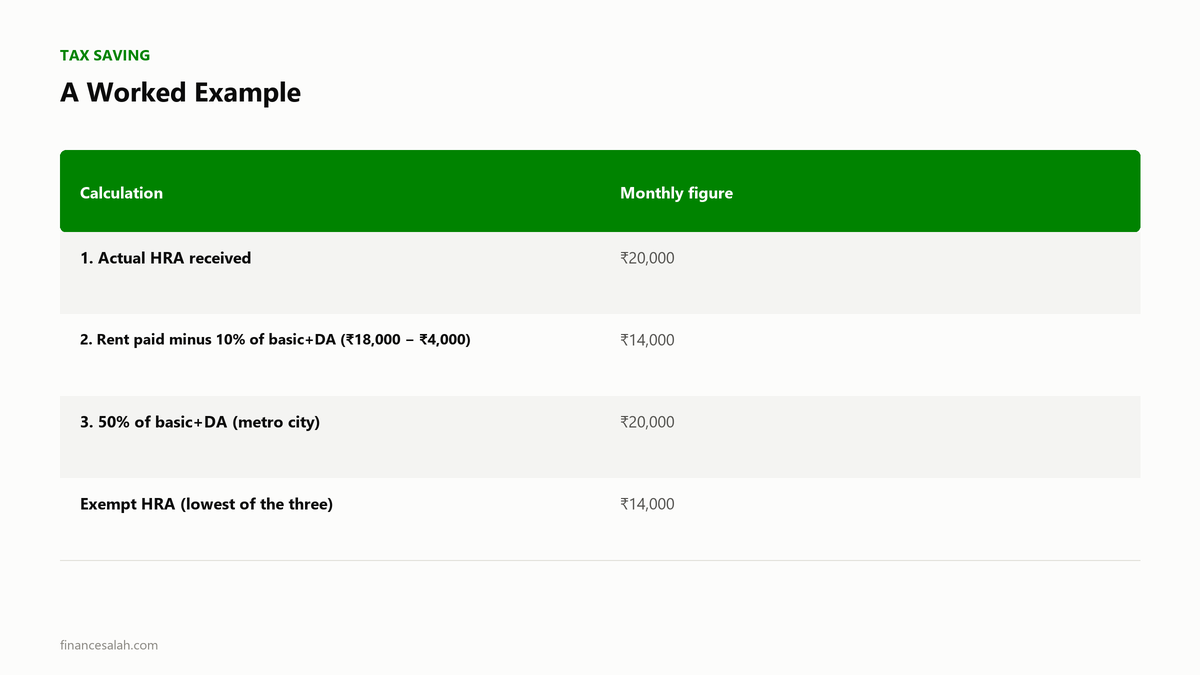
Consider a salaried employee in a metro city with: Basic salary + DA = ₹40,000/month, HRA received = ₹20,000/month, actual rent paid = ₹18,000/month.
| Calculation | Monthly figure |
|---|---|
| 1. Actual HRA received | ₹20,000 |
| 2. Rent paid minus 10% of basic+DA (₹18,000 − ₹4,000) | ₹14,000 |
| 3. 50% of basic+DA (metro city) | ₹20,000 |
| Exempt HRA (lowest of the three) | ₹14,000 |
In this example, ₹14,000/month is exempt from tax, and the remaining ₹6,000/month of HRA received becomes part of taxable income. This illustrates why simply comparing “HRA received” to “rent paid” in isolation, without applying the full three-way formula, often leads people to miscalculate their actual exemption.
The same example, but in a non-metro city
Now imagine the identical numbers, but the employee lives in a non-metro city, where the third component uses 40% instead of 50%. The 40% of basic+DA calculation becomes ₹16,000, still higher than the ₹14,000 figure from the rent-based calculation, so the exempt amount remains ₹14,000 in this specific case — the city classification didn’t change the outcome here because the rent-based calculation was already the lowest of the three. This is worth noting specifically because many people assume the metro-vs-non-metro distinction always changes their exemption meaningfully, when in practice it only matters when that particular calculation is the binding constraint among the three.
Pros and cons of how the formula rewards different behaviors
| Behavior | How the formula responds |
|---|---|
| Paying rent close to or above what your 40-50% cap allows | You capture close to the maximum exemption your salary structure supports |
| Paying modest rent relative to your salary | Your exemption is capped by the rent-based calculation, meaning higher rent (if genuine) directly increases your exemption up to the ceiling |
| Living in a metro city | You get a higher percentage-based ceiling (50% vs 40%), reflecting generally higher metro rents |
Documents You Need
| Document | When required |
|---|---|
| Rent receipts | Generally required to support the HRA claim, especially for employer verification |
| Landlord’s PAN | Required if annual rent paid exceeds a specified threshold (commonly ₹1 lakh per year, verify current threshold) |
| Rental agreement | Not always mandatory but strongly recommended, especially for larger claims or if questioned during assessment |
| Form 12BB | A declaration form submitted to your employer for TDS purposes, summarizing your HRA and other claimed deductions |
Always retain rent payment proof (bank transfer records, receipts) even beyond what your employer requires for TDS purposes, since the Income Tax Department can independently verify claims during assessment.
A real filing mistake that cost one employee unnecessary stress
Rakesh submitted rent receipts to his employer for TDS purposes but paid his rent partly in cash and never kept his own copy of the bank transfer records for the portion he did pay digitally. When his return was selected for a routine assessment review two years later, he struggled to reconstruct proof of the exact rent paid for that specific year, since his employer’s records only reflected what was declared at the time, not independently verifiable transaction proof. He eventually resolved it by tracking down old bank statements, but the process took weeks of unnecessary stress that simply keeping his own organized folder of rent payment proof from the start would have avoided entirely. His experience underscores a specific point worth repeating: what you submit to your employer and what you personally retain as your own proof are not the same thing, and only the latter genuinely protects you years later.
HRA Under the New Tax Regime
This is a critical, frequently misunderstood point: the HRA exemption is generally NOT available under the new (concessional) tax regime, which removes most exemptions and deductions in exchange for lower slab rates. If you’re paying meaningful rent and would benefit significantly from the HRA exemption, this is one of the specific factors that should weigh into your old vs new tax regime decision — see our detailed comparison of Section 80C vs the new tax regime for the broader decision framework, since HRA is one piece of that larger calculation, not the only factor.
Always verify the current rule on the official Income Tax portal before finalizing your regime choice for a given year, as specific provisions are periodically reviewed in the Union Budget.
Special Situations
- Living with parents and paying them rent: This can be a legitimate HRA claim if the arrangement is genuine — a proper rent agreement, actual bank transfers (not just a paper arrangement), and the parent declaring the rental income in their own tax return. This has been scrutinized by tax authorities in specific cases, so genuine, well-documented arrangements matter more than ever here.
- No HRA component in your salary, but you pay rent: You may be able to claim a deduction under Section 80GG instead, subject to specific conditions and a different calculation — this is a separate provision from HRA exemption under Section 10(13A).
- Self-employed individuals: HRA exemption under Section 10(13A) applies specifically to salaried employees receiving HRA as a salary component — self-employed individuals paying rent would generally look at Section 80GG instead, subject to its own eligibility conditions.
- Rent paid to a spouse: Generally not accepted as a valid HRA claim by tax authorities, given the specific relationship and lack of genuine independent transaction — this is a commonly attempted but risky claim.
Common Mistakes
- Not retaining rent payment proof beyond what’s submitted to the employer, leaving no backup if independently verified later.
- Claiming rent paid to a spouse, which is generally not accepted as a valid, independent transaction for HRA purposes.
- Not providing landlord PAN when annual rent exceeds the threshold, leading to the claim being disallowed or requiring additional follow-up.
- Assuming HRA exemption is automatically available under the new tax regime, without checking current rules before choosing a regime.
- Comparing only “HRA received vs rent paid” instead of applying the full three-way minimum formula, leading to an inaccurate self-estimate of the actual exemption.
Myth vs Fact
| Myth | Fact |
|---|---|
| “My entire HRA amount is automatically tax-exempt if I pay rent.” | The exempt amount is the LOWEST of three specific calculations (actual HRA, rent paid minus 10% of basic+DA, and 40-50% of basic+DA) — not simply the full HRA received. |
| “I can claim HRA exemption under the new tax regime too.” | The HRA exemption is generally not available under the new (concessional) tax regime — always verify current rules before choosing your regime for the year. |
| “Paying rent to my spouse is a valid HRA claim.” | This is generally not accepted by tax authorities as a valid, independent rental transaction, given the specific relationship involved. |
| “I don’t need to keep rent receipts if my employer didn’t ask for them.” | The Income Tax Department can independently verify HRA claims during assessment — retaining proof of actual rent payment is worth doing regardless of what your employer specifically required. |
Expert Tips
- Calculate your exact exempt HRA using the three-way formula yourself, rather than assuming your full HRA or full rent paid is automatically exempt.
- Keep bank transfer records for rent payments, not just receipts, as stronger, more independently verifiable proof.
- If living with parents and genuinely paying rent, ensure the arrangement is documented and your parent declares the rental income — this protects both of you if the claim is ever reviewed.
- Factor HRA into your old vs new tax regime comparison explicitly, especially if you pay significant rent, since this is one of the more impactful exemptions that differs between the two regimes.
Checklist
- [ ] Calculate your exempt HRA using the full three-way minimum formula
- [ ] Collect rent receipts and retain bank transfer proof of rent payments
- [ ] Provide landlord PAN if annual rent exceeds the applicable threshold
- [ ] Submit Form 12BB to your employer with accurate HRA details
- [ ] Confirm current HRA exemption rules under your chosen tax regime
- [ ] If living with parents, ensure the rent arrangement is genuine and properly documented
Frequently Asked Questions
Q: How is HRA exemption calculated in India?
A: The exempt amount is the lowest of three figures — actual HRA received, rent paid minus 10% of basic salary plus DA, and 40-50% of basic salary plus DA (50% for metro cities, 40% for non-metro) — not simply the full HRA or full rent paid.
Q: Is HRA exemption available under the new tax regime?
A: Generally no — the HRA exemption is typically not available under the new (concessional) tax regime, which removes most exemptions in exchange for lower slab rates. Always verify current rules before finalizing your regime choice.
Q: Can I claim HRA exemption for rent paid to my parents?
A: Yes, if the arrangement is genuine — with a proper rent agreement, actual bank transfers, and your parent declaring the rental income in their own tax return. This has faced specific scrutiny, so documentation matters significantly.
Q: Do I need my landlord’s PAN to claim HRA exemption?
A: Yes, if your annual rent paid exceeds a specified threshold (commonly cited as ₹1 lakh per year, though this should be verified for the current rule) — without it, the claim may be disallowed or require additional follow-up.
Q: Can self-employed individuals claim HRA exemption?
A: No — HRA exemption under Section 10(13A) applies specifically to salaried employees receiving HRA as part of their salary. Self-employed individuals paying rent may instead look at a deduction under Section 80GG, subject to its own conditions.
Q: What counts as a “metro city” for the 50% HRA calculation?
A: This typically refers to Delhi, Mumbai, Kolkata, and Chennai specifically for HRA exemption purposes — other major Indian cities, even large ones, generally fall under the 40% non-metro category unless specifically classified otherwise under current rules.
Q: Can I claim HRA exemption if I own a house in the same city I work in but live in a rented place?
A: This can be more complex and is often scrutinized more closely by tax authorities, since owning a house in the same city can raise questions about the genuine necessity of the rental arrangement — always ensure the arrangement is genuine and well-documented if this applies to you.
Q: What if my rent changes partway through the financial year?
A: The HRA exemption calculation should reflect your actual rent paid for each relevant period, meaning a mid-year rent change generally requires recalculating the exemption for each period separately rather than applying one figure to the entire year.
Conclusion
HRA exemption genuinely reduces tax for salaried employees who pay rent, but the actual exempt amount almost never equals your full HRA received — it’s determined by the lowest of three specific calculations, and it’s generally unavailable if you choose the new tax regime. Calculating it correctly, keeping proper documentation, and factoring it explicitly into your regime decision protects both your tax savings and your ability to defend the claim if reviewed.
Calculate your actual exempt HRA using the three-way formula this week, and compare it against your total tax picture using FinanceSalah’s guide on Section 80C vs the new tax regime, and our explainer on why your take-home salary is less than your CTC rounds out the bigger picture of how these payslip components fit together.
Sources & Further Reading
- Income Tax Department e-Filing Portal — official Section 10(13A), Rule 2A, and Section 80GG provisions
- Central Board of Direct Taxes (CBDT) — official circulars and clarifications on HRA claims
Related Reading
- Section 80C vs New Tax Regime 2026
- Why Is My Take-Home Salary Less? TDS Explained
- How to Claim Income Tax Refund in India: Step by Step
- Financial Mistakes Freshers Make With Their First Salary
- Freelance Income Tax in India for Beginners
- How Much Should I Save Every Month in India
This article is for general educational purposes and does not constitute personalized tax advice. Tax rules, thresholds, and regime provisions change periodically — always verify current rules on the official Income Tax e-filing portal or with a qualified Chartered Accountant before filing.