
Table of Contents
- CTC vs Take-Home: The Core Confusion
- Everything That Gets Deducted
- How TDS on Salary Is Actually Calculated
- A Worked Example
- How to Legitimately Reduce Your TDS
- What to Do If Too Much TDS Was Deducted
- Common Mistakes
- Myth vs Fact
- Expert Tips
- Checklist
- FAQs
Introduction
You accepted an offer at a certain CTC, felt good about the number, and then your first payslip showed something meaningfully lower landing in your bank account. This gap confuses and frustrates almost every first-time salaried employee in India, and it’s rarely explained clearly during onboarding. This guide breaks down exactly where the difference goes.
CTC vs Take-Home: The Core Confusion
CTC (Cost to Company) is the total amount your employer spends on you annually — it includes your actual take-home components, plus things that never touch your bank account directly: the employer’s own PF contribution, gratuity provisioning, insurance premiums the company pays on your behalf, and other benefits.
Take-home (or in-hand) salary is what actually lands in your bank account after all deductions — TDS, employee PF contribution, professional tax, and any other applicable deductions.
The gap between the two is real, expected, and not a sign anything went wrong — it’s simply that CTC was never meant to represent your monthly take-home figure in the first place, even though it’s often presented that way during offer discussions.
A real story that captures the confusion
Sameer accepted his first job offer at a ₹9 lakh CTC, mentally dividing that by 12 to estimate a monthly figure of ₹75,000 — a number that shaped his rent budget and lifestyle plans before he’d received a single payslip. His actual take-home came in closer to ₹58,000, a gap that felt jarring enough that he initially called HR assuming a payroll error. There wasn’t one. His CTC had included the employer’s PF contribution, a gratuity provision he wouldn’t see for years, and health insurance premiums the company paid directly to the insurer — none of which were ever going to appear in his bank account monthly, regardless of how the offer letter presented the number. His experience is genuinely common precisely because offer letters rarely break this down clearly at the moment it matters most: before you’ve already committed to a rent agreement based on the wrong number.
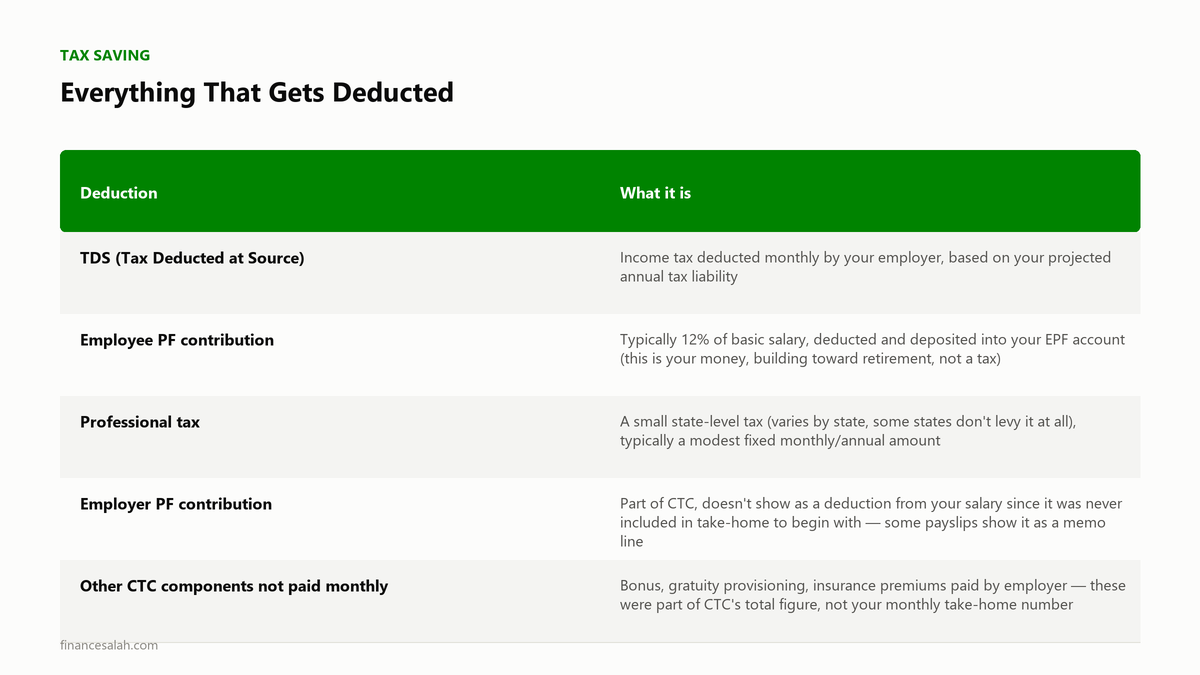
Everything That Gets Deducted
| Deduction | What it is |
|---|---|
| TDS (Tax Deducted at Source) | Income tax deducted monthly by your employer, based on your projected annual tax liability |
| Employee PF contribution | Typically 12% of basic salary, deducted and deposited into your EPF account (this is your money, building toward retirement, not a tax) |
| Professional tax | A small state-level tax (varies by state, some states don’t levy it at all), typically a modest fixed monthly/annual amount |
| Employer PF contribution | Part of CTC, doesn’t show as a deduction from your salary since it was never included in take-home to begin with — some payslips show it as a memo line |
| Other CTC components not paid monthly | Bonus, gratuity provisioning, insurance premiums paid by employer — these were part of CTC’s total figure, not your monthly take-home number |
How TDS on Salary Is Actually Calculated
Your employer estimates your total annual taxable income (salary, minus eligible exemptions/deductions you’ve declared), calculates the total tax liability for the year based on applicable slab rates for your chosen regime, and then divides that annual tax liability across the remaining months of the financial year, deducting a portion each month as TDS.
This is why TDS amounts can change month to month — if your declared investments/deductions change, if you receive a bonus (which increases that month’s TDS proportionally), or if your salary structure changes mid-year, your employer recalculates and adjusts your monthly TDS accordingly.
Pros and cons of the monthly-deduction TDS system
| Pros | Cons |
|---|---|
| Spreads your tax liability evenly across the year rather than one large year-end payment | Can feel opaque, since the exact monthly figure isn’t always intuitively explained on the payslip |
| Reduces the risk of a large, unexpected tax bill at filing time | Over-deduction (if declarations are incomplete) ties up your money until a refund is processed months later |
| Automatically adjusts as your income or declarations change during the year | A bonus month can create a jarring TDS spike, since the system proportionally recalculates the annual estimate |
Why a bonus month often triggers a TDS shock
When you receive a bonus, your employer’s system doesn’t simply tax that specific payment in isolation — it recalculates your entire projected annual income including the bonus, determines your revised total tax liability, and then deducts a disproportionately larger TDS that month to keep the full year’s tax collection on track by year-end. This is exactly why a bonus month’s take-home often feels smaller relative to the bonus amount than expected — it’s not a special “bonus tax,” it’s the same income tax system catching up all at once for a payment that changed your annual income estimate significantly.
A Worked Example
Illustrative example only — actual figures depend on the specific regime, current slab rates, and individual deductions, all of which should be verified using the official Income Tax portal’s calculator for your specific situation.
| Component | Illustrative monthly figure |
|---|---|
| Gross monthly salary | ₹80,000 |
| Employee PF deduction (≈12% of basic, illustrative) | -₹4,800 |
| Professional tax (varies by state) | -₹200 |
| TDS (varies significantly based on regime, deductions, total annual income) | -₹8,000 (illustrative only) |
| Approximate take-home | ≈₹67,000 |
The TDS figure varies the most and depends entirely on your specific tax regime choice, declared deductions, and total annual income — this table illustrates the categories of deduction, not a number you should assume applies to your own salary.
How to Legitimately Reduce Your TDS
- Declare eligible deductions and exemptions to your employer at the start of the financial year (Section 80C investments, HRA if applicable, home loan interest, etc.) — see our guide on Section 80C vs the new tax regime and HRA exemption for the specific mechanics.
- Submit proof of these declarations before your employer’s specified deadline (commonly in the last quarter of the financial year) — undeclared or unproven deductions get excluded from the TDS calculation, even if you’re genuinely eligible.
- Choose the tax regime (old vs new) that’s actually more beneficial for your specific deduction profile — this directly affects your monthly TDS, not just your year-end filing.
- Update your declarations if your situation changes mid-year (new home loan, new investments) rather than waiting until the next financial year.
What to Do If Too Much TDS Was Deducted
If your actual tax liability for the year, after filing your return, turns out to be lower than the total TDS deducted, you’re entitled to a refund — see our guide on how to claim your income tax refund for the complete process. This is common when deductions weren’t fully declared/proven to the employer during the year but are later claimed correctly in the actual tax return.
Common Mistakes
- Not declaring eligible deductions to the employer early in the financial year, leading to higher-than-necessary TDS throughout the year, even if you’ll eventually get a refund.
- Missing the proof submission deadline for declared investments, causing the employer to exclude them from the TDS calculation despite the initial declaration.
- Confusing CTC with take-home during salary negotiations, leading to unrealistic expectations about monthly cash flow.
- Not checking Form 16 against actual TDS deposited (verifiable via Form 26AS/AIS) at year-end, potentially missing a discrepancy.
- Choosing a tax regime without actually calculating which one is more beneficial for your specific deduction profile, defaulting to whichever option feels more familiar.
Myth vs Fact
| Myth | Fact |
|---|---|
| “My CTC is what I should expect to see in my bank account every month.” | CTC includes several components (employer PF contribution, gratuity provisioning, benefits) that never appear as monthly take-home pay — the two figures are fundamentally different by design. |
| “TDS is an extra tax on top of my actual income tax liability.” | TDS is simply income tax collected in advance, monthly, rather than in one lump sum at year-end — it’s not an additional tax, and any excess is refundable after filing. |
| “There’s nothing I can do to reduce my monthly TDS.” | Declaring and proving eligible deductions/exemptions to your employer, and choosing the more beneficial tax regime for your situation, directly reduces monthly TDS, not just your year-end tax outcome. |
| “Employee PF contribution is a tax, like TDS.” | EPF is your own money being set aside for retirement, not a tax — it continues earning interest and remains yours, unlike tax paid to the government. |
Expert Tips
- Declare your planned tax-saving investments to your employer as early in the financial year as possible, rather than waiting until the deadline, so your monthly TDS reflects a more accurate, lower figure throughout the year.
- Actually calculate old vs new regime for your specific numbers rather than assuming one is universally better — the right choice depends heavily on how much you’re able to claim in deductions.
- Cross-check Form 16 against Form 26AS/AIS annually, to catch any mismatch between what was deducted and what was actually deposited with the government.
- If you switch jobs mid-year, inform your new employer of your prior salary and TDS already deducted, since this affects accurate TDS calculation for the remainder of the year and helps avoid under- or over-deduction.
Checklist
- [ ] Understand your CTC breakdown, not just the total headline figure, at offer stage
- [ ] Declare eligible deductions/exemptions to your employer early in the financial year
- [ ] Submit proof of declared investments before your employer’s deadline
- [ ] Calculate old vs new tax regime for your specific deduction profile
- [ ] Cross-check Form 16 against Form 26AS/AIS at year-end
- [ ] File your ITR to claim any refund if excess TDS was deducted
Frequently Asked Questions
Q: Why is my take-home salary less than my CTC?
A: CTC includes components that never appear as monthly take-home pay — employer PF contribution, gratuity provisioning, and other benefits — while take-home reflects only what actually lands in your account after deductions like TDS, employee PF, and professional tax.
Q: How is TDS calculated on my salary?
A: Your employer estimates your total annual taxable income and tax liability based on your chosen regime and declared deductions, then divides that liability across the remaining months of the financial year as monthly TDS.
Q: Can I reduce my monthly TDS?
A: Yes — declaring and providing proof of eligible deductions/exemptions to your employer, and choosing the more beneficial tax regime for your specific situation, both directly reduce your calculated monthly TDS.
Q: What happens if too much TDS was deducted from my salary?
A: You can claim a refund for the excess amount when filing your income tax return — this is common if deductions weren’t fully declared to your employer during the year but are claimed correctly in your actual filing.
Q: Is EPF deduction the same as TDS?
A: No — EPF is your own retirement savings being set aside monthly (typically around 12% of basic salary), continuing to earn interest and remaining your money, while TDS is income tax collected on behalf of the government.
Q: Why does my TDS spike so much in the month I receive a bonus?
A: Your employer recalculates your entire projected annual income including the bonus, then deducts a proportionally larger TDS that month to keep the full year’s estimated tax collection on track — it’s not a separate “bonus tax,” just the standard system catching up.
Q: Does professional tax apply in every state in India?
A: No — professional tax is a state-level levy, and not every state imposes it; the specific amount and whether it applies at all depends on your state of employment, so check your specific state’s rules if you’re unsure why this deduction does or doesn’t appear on your payslip.
Q: What is Form 16 and how does it relate to TDS?
A: Form 16 is an annual certificate your employer issues summarizing your salary, deductions, and the total TDS deposited with the government on your behalf — it’s the primary document used to cross-check accuracy and file your income tax return.
Conclusion
The gap between your offered CTC and your actual take-home pay isn’t a mistake or something to be suspicious of — it’s simply how salary structures work in India, with TDS, PF, and other deductions all serving different, legitimate purposes. Understanding each component, declaring your eligible deductions early and with proper proof, and choosing the right tax regime for your situation gives you real, direct control over your monthly take-home figure, not just your year-end tax outcome.
Check your latest payslip against this guide today, and confirm you’ve declared all your eligible deductions to your employer for this financial year. FinanceSalah’s guide on claiming your income tax refund is the natural next step if you suspect excess TDS was deducted, and our HRA exemption explainer covers one of the most impactful deductions worth declaring accurately if you pay rent.
Sources & Further Reading
- Income Tax Department e-Filing Portal — official TDS rules and slab rates
- EPFO — Employees’ Provident Fund Organisation — official EPF contribution rules
Related Reading
- How HRA Exemption Works: Save Tax on Rent in India
- Section 80C vs New Tax Regime 2026
- How to Claim Income Tax Refund in India: Step by Step
- Financial Mistakes Freshers Make With Their First Salary
- How Much to Save From Your First Salary in India (Age 22)
- How to Negotiate a Salary Hike in India After Your Appraisal
This article is for general educational purposes and does not constitute personalized tax advice. TDS calculations, slab rates, and deduction rules change periodically — always verify current details on the official Income Tax e-filing portal or consult a qualified Chartered Accountant.