
Introduction
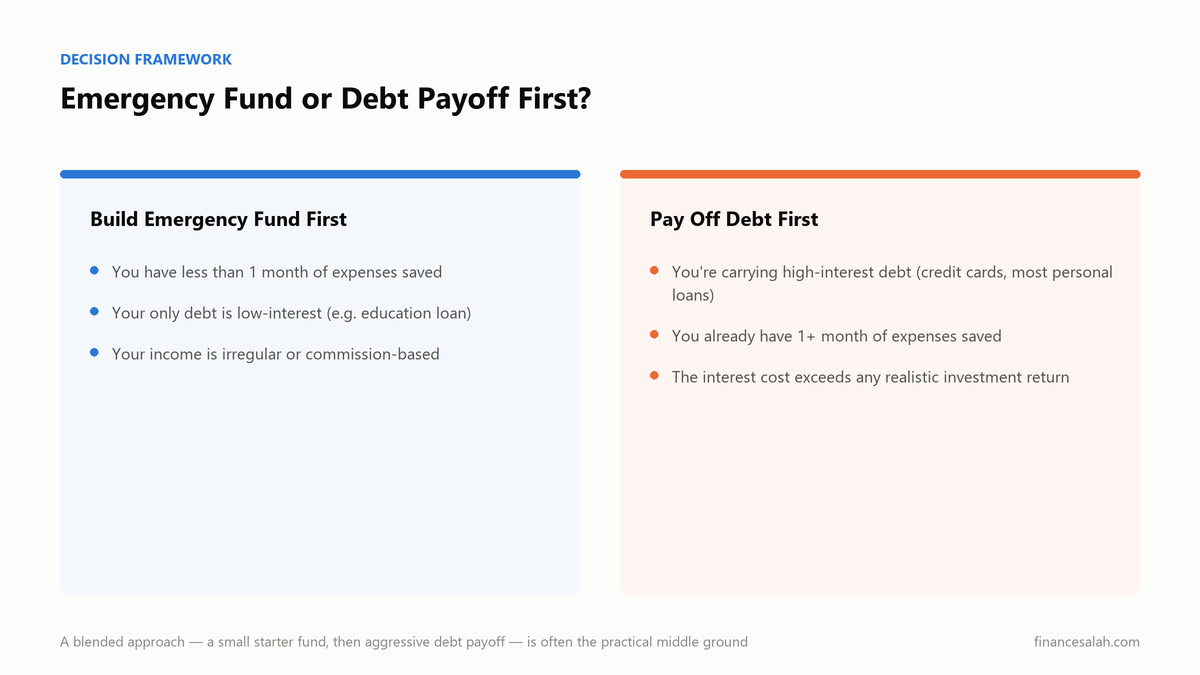
This is one of the most common tensions in personal finance, and both sides have a genuinely good argument: paying off debt (especially credit card debt at 36%+ interest) saves you more money than almost any savings account could earn. But having zero emergency fund means the next unexpected expense — a medical bill, a job gap — goes straight back onto the same credit card you’re trying to pay off, undoing your progress. The honest answer isn’t “always debt first” or “always savings first” — it’s a specific sequence that respects both.
The Case for Paying Off Debt First
Credit card interest at 36–42% annually is a guaranteed cost — you know exactly how much it’s costing you every month it exists. Compare that to a savings account or liquid fund earning roughly 6–7%. Mathematically, every rupee that goes toward high-interest debt instead of savings is earning you a guaranteed 30%+ “return” in interest avoided — a return no legitimate savings product can match. This is the strongest argument for debt-first: the math clearly favors debt payoff over saving, when the debt in question is high-interest.
The Case for an Emergency Fund First
Here’s the practical problem with debt-first, all-in: if you have zero savings and a genuine emergency hits — a medical expense, a sudden job loss — while you’re mid-payoff, you have nowhere to draw from except more debt, usually on the same high-interest credit card you were trying to eliminate. This is exactly how people get stuck in a debt cycle that never actually shrinks: every few months, an emergency undoes months of payoff progress.
This is the real argument for savings-first (or at least savings-alongside): it’s not that saving earns a better return than debt payoff avoids — it’s that having zero buffer makes new debt almost inevitable, which defeats the entire purpose of the payoff plan.
The Practical Answer: A Small Starter Fund First, Then Debt-Aggressive, Then a Full Fund
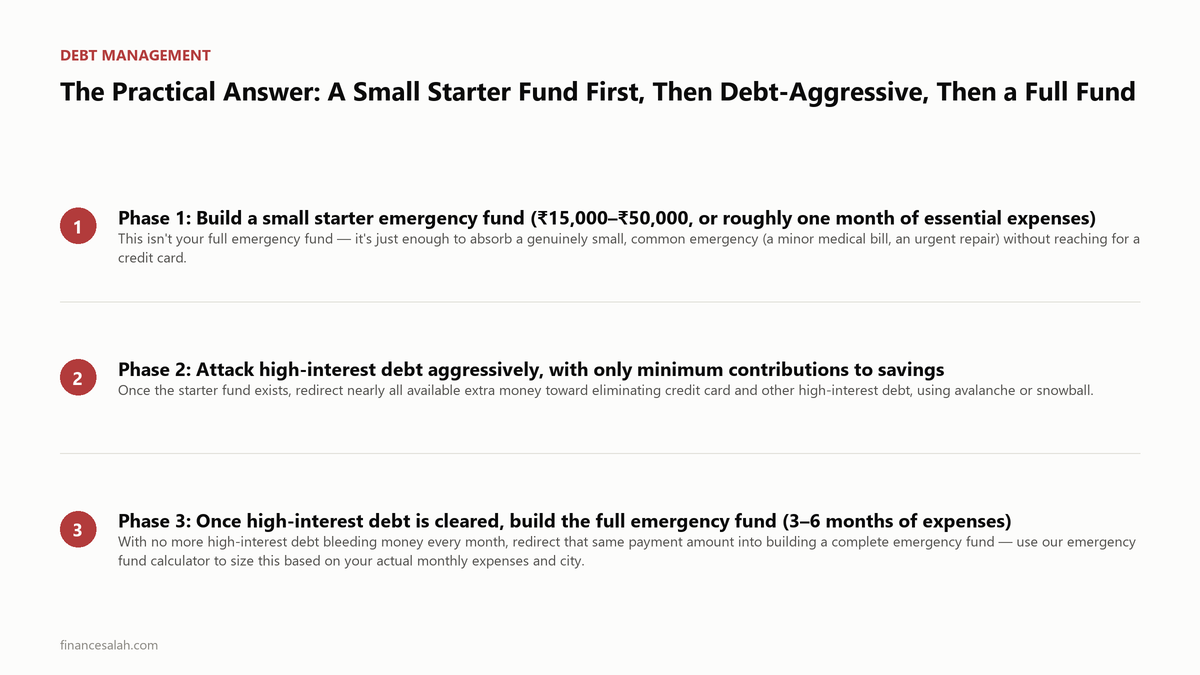
This is the sequence most financial educators converge on, and it resolves the tension without ignoring either argument:
Phase 1: Build a small starter emergency fund (₹15,000–₹50,000, or roughly one month of essential expenses)
This isn’t your full emergency fund — it’s just enough to absorb a genuinely small, common emergency (a minor medical bill, an urgent repair) without reaching for a credit card. This phase should be quick — weeks, not months — since the amount is deliberately modest.
Phase 2: Attack high-interest debt aggressively, with only minimum contributions to savings
Once the starter fund exists, redirect nearly all available extra money toward eliminating credit card and other high-interest debt, using avalanche or snowball. This is the phase where the 36%+ guaranteed “return” of debt payoff dominates the math, and it should take priority.
Phase 3: Once high-interest debt is cleared, build the full emergency fund (3–6 months of expenses)
With no more high-interest debt bleeding money every month, redirect that same payment amount into building a complete emergency fund — use our emergency fund calculator to size this based on your actual monthly expenses and city.
Why this sequence works: it protects you from the single biggest risk of debt-first (an emergency forcing you back into debt) while still respecting the math that high-interest debt should be attacked aggressively once that thin protective layer exists.
What Doesn’t Change This Sequence
Lower-interest debt (like a home loan or an education loan under ~10%) shouldn’t necessarily jump ahead of building your full emergency fund — the interest saved by prepaying a low-rate loan is often smaller than the security (and even the modest returns) of a properly-sized emergency fund. This framework applies most strongly to high-interest debt (credit cards, most personal loans) specifically because the “return” from paying it off is so large it dominates the comparison. For low-interest debt, the calculation is closer, and reasonable people land on different answers.
Frequently Asked Questions
Q: Isn’t it wasteful to keep money in a low-interest savings account while carrying high-interest debt?
A: For your starter fund (Phase 1), yes it technically “costs” you the interest-rate gap — but this is the price of insurance against being forced back into debt by an emergency, and it’s a small, temporary amount by design specifically to minimize that cost.
Q: How big should the starter emergency fund be before I switch to debt-aggressive mode?
A: Commonly ₹15,000–₹50,000 or roughly one month’s essential expenses, whichever your situation calls for — enough to cover a genuinely common small emergency, not a full 3–6 month buffer. See our emergency fund mistakes guide for sizing pitfalls to avoid.
Q: What if I get a bonus or windfall while mid-payoff — savings or debt?
A: If your starter fund is already in place and you’re in the debt-aggressive phase, a windfall should generally go toward the high-interest debt, since that’s where the guaranteed “return” is highest at this stage.
Q: Does this framework change if I have a stable government or highly secure job?
A: Job security can reasonably shift how large a starter fund you need before moving to debt-aggressive mode — but it rarely eliminates the need for one entirely, since emergencies aren’t limited to job loss.
Conclusion
Debt-first and savings-first are both incomplete answers on their own. The practical sequence — a small starter fund, then aggressive high-interest debt payoff, then a full emergency fund — respects both the math (high-interest debt costs more than savings earns) and the reality (zero savings makes new debt almost inevitable during a payoff plan). Pick the sequence over picking a side.
Related Reading
- Emergency Fund Calculator for Young Indians
- 7 Emergency Fund Mistakes Young Indians Make
- Debt Snowball vs Debt Avalanche: Which Works Better for Indians?
- How to Get Out of Credit Card Debt in India: Step-by-Step
This article is for general educational purposes and does not constitute personalized financial advice.