

What is SIP Investment Plan? The Life-Changing Investment Secret
Picture this: It’s 2018, and my friend Priya, a 24-year-old software developer earning ₹40,000 monthly, asks me, “Bhai, what is SIP investment plan? Everyone’s talking about it, but I don’t get it.”
Fast forward to 2026—that same Priya just bought her dream house in Gurgaon, thanks to her ₹5,000 monthly SIP that grew to over ₹8 lakh! The magic ingredient? Understanding what is SIP in mutual fund and starting small.
SIP full form is Systematic Investment Plan—basically, it’s like your monthly mobile recharge, but instead of getting talk time, you get units of mutual funds that can multiply your money over time.
If you’re asking “SIP kya hota hai” or “systematic investment plan explained” in simple terms, you’ve landed at the right place. By the end of this guide, you’ll not only understand SIP completely but also know exactly how to start your wealth-building journey today.
SIP Meaning in Hindi: सिस्टेमेटिक इन्वेस्टमेंट प्लान क्या है?
Let me break down SIP meaning in Hindi in the simplest way possible:
SIP (सिप) मतलब है: हर महीने एक निश्चित राशि म्यूचुअल फंड में निवेश करना।
Think of it like this:
-
जैसे आप हर महीने ₹500 बचत खाते में डालते हैं
-
वैसे ही आप हर महीने ₹500 म्यूचुअल फंड में डाल सकते हैं
-
फर्क यह है कि बचत खाते में 3-4% ब्याज मिलता है, SIP में 10-15% रिटर्न मिल सकता है
Real Example: मेरी बहन ने 2020 में ₹2,000 महीना SIP शुरू की थी। आज 2026 में उसके ₹1.2 लाख के निवेश की वैल्यू ₹2.1 लाख है!

Before Starting SIP: Calculate Your Emergency Fund
Before starting your SIP journey, ensure you have a financial safety net in place: Calculate and build your emergency fund.
Your emergency fund = the foundation. SIP = the wealth builder.
Use our free Emergency Fund Calculator to know your exact requirement:
💰 Calculate Your Emergency Fund →
Most young Indians aged 22-30 need ₹90,000 to ₹2,40,000 emergency fund before starting SIP
Once ready, start your SIP and build wealth systematically!
SIP vs Fixed Deposit (Simple Comparison):
| Factor | SIP | Fixed Deposit |
|---|---|---|
| Monthly Investment | ₹1,000 | ₹12,000 (annually) |
| Expected Returns | 10-15% | 5-7% |
| Risk Level | Moderate | Very Low |
| Lock-in | None (flexible) | Yes (penalty for early withdrawal) |
| Tax Benefits | Available (ELSS) | Limited |
What is SIP in Mutual Fund? (Step-by-Step Breakdown)
What is SIP in mutual fund is like having a personal money manager who buys stocks for you automatically. Here’s how it works:
The SIP Magic Formula:
Step 1: You Choose Amount & Fund
-
Decide monthly amount (₹500, ₹1,000, ₹5,000—your choice)
-
Pick a mutual fund (like choosing a cricket team)
-
Set auto-debit date (1st, 7th, 15th of every month)
Step 2: Auto-Pilot Investing Starts
-
Money gets deducted automatically from your bank
-
Fund manager uses your money to buy shares
-
You get “units” of the mutual fund scheme
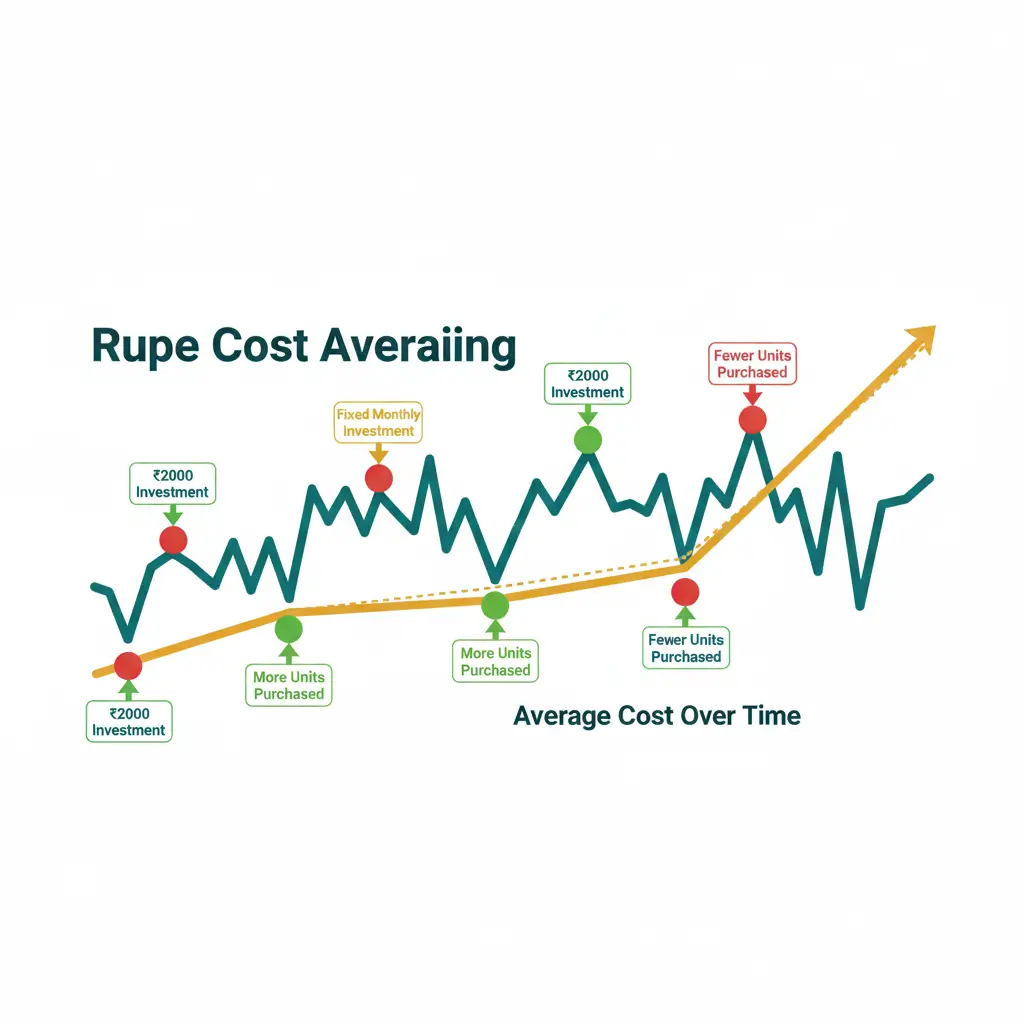
Step 3: Rupee Cost Averaging Works
-
Some months: Market high → You buy fewer units
-
Some months: Market low → You buy more units
-
Over time: Your average cost becomes reasonable
Step 4: Compounding Creates Magic
-
Your units grow in value as companies perform well
-
Dividends get reinvested automatically
-
Small amounts become large wealth over years
Real SIP Journey Example:
Ravi’s SIP Story (₹3,000 monthly for 5 years):
| Year | Monthly SIP | Total Invested | Current Value | Growth |
|---|---|---|---|---|
| 2020 | ₹3,000 | ₹36,000 | ₹38,500 | ₹2,500 |
| 2021 | ₹3,000 | ₹72,000 | ₹89,200 | ₹17,200 |
| 2022 | ₹3,000 | ₹1,08,000 | ₹1,15,800 | ₹7,800 |
| 2023 | ₹3,000 | ₹1,44,000 | ₹1,78,400 | ₹34,400 |
| 2024 | ₹3,000 | ₹1,80,000 | ₹2,42,100 | ₹62,100 |
Total Journey: ₹1.8 lakh invested → ₹2.42 lakh value = ₹62,100 profit!
How Does SIP Work in Mutual Fund? (The Mechanics Explained)
Understanding how does SIP work in mutual fund is like understanding how your smartphone automatically updates apps. Here’s the technical magic simplified:
The NAV (Net Asset Value) Concept:
Every mutual fund has a daily price called NAV—think of it like a stock price.
Example:
-
Day 1: HDFC Top 100 Fund NAV = ₹50
-
Your ₹5,000 SIP buys: 100 units (₹5,000 ÷ ₹50)
-
Day 30: NAV drops to ₹40 (market down)
-
Your ₹5,000 SIP buys: 125 units (₹5,000 ÷ ₹40)
-
Day 60: NAV rises to ₹60 (market up)
-
Your ₹5,000 SIP buys: 83.33 units (₹5,000 ÷ ₹60)
Total: You own 308.33 units with average cost of ₹48.65 per unit (instead of ₹50!)
Why This is Brilliant:
-
Market falls: You buy more units (like shopping in sale season)
-
Market rises: You buy fewer units (avoid expensive purchases)
-
Long-term: You average out market volatility automatically
Compounding Power Demonstration:
Let’s see what happens to Meera’s ₹2,000 monthly SIP:
Year 1: ₹24,000 invested → ₹26,400 value
Year 5: ₹1,20,000 invested → ₹1,68,200 value
Year 10: ₹2,40,000 invested → ₹4,58,600 value
Year 15: ₹3,60,000 invested → ₹9,86,400 value
Year 20: ₹4,80,000 invested → ₹19,67,200 value
The Magic: Last 5 years generate more returns than first 15 years combined!

Types of SIP Investment Plans (Find Your Perfect Match)
Not all SIPs are the same! Here are different types to match your needs:
1. Regular SIP (Most Popular)
Best for: Beginners, consistent investors
How it works: Fixed amount every month
Example: ₹3,000 on 7th of every month
My recommendation: Start here if you’re new
2. Top-Up SIP (Step-Up SIP)
Best for: Growing income professionals
How it works: Increase SIP amount annually by fixed %
Example: Start with ₹3,000, increase by 10% yearly
Year 1: ₹3,000 → Year 2: ₹3,300 → Year 3: ₹3,630
3. Flexible SIP
Best for: Variable income earners (freelancers, business owners)
How it works: Change amount monthly based on cash flow
Example: Jan ₹5,000, Feb ₹2,000, Mar ₹8,000
Perfect for: Irregular income patterns
4. Trigger SIP
Best for: Market-savvy investors
How it works: Starts when market reaches certain level
Example: Start SIP when Sensex falls below 50,000
Risk: Requires market timing skills
5. Perpetual SIP
Best for: Long-term wealth builders
How it works: No end date, continues till you stop
Example: Start at 25, let it run till retirement
Advantage: Maximum compounding benefit
6. SIP with Insurance
Best for: Risk-averse families
How it works: SIP + life insurance combined
Example: ₹5,000 SIP + ₹10 lakh life cover
Note: Usually more expensive than separate products
Our next guide will walk you through it: How to choose your first mutual fund.
Systematic Investment Plan Benefits (Why SIP Beats Everything Else)
Here are systematic investment plan benefits that make it superior to other investment options:
1. Rupee Cost Averaging (The Automatic Advantage)
Without SIP: You try to time the market (usually fail)
With SIP: Market timing happens automatically
Real Example from 2020 COVID Crash:
-
Lump sum investor (₹1 lakh in Jan 2020): Lost 30% initially
-
SIP investor (₹10,000 monthly): Benefited from low prices Mar-May
-
Result: SIP investor had better returns by Dec 2020
2. Power of Compounding (8th Wonder of the World)
Einstein called compound interest the 8th wonder—here’s why:
₹5,000 Monthly SIP at 12% Annual Return:
-
5 years: ₹3 lakh invested → ₹4.17 lakh value
-
10 years: ₹6 lakh invested → ₹11.61 lakh value
-
15 years: ₹9 lakh invested → ₹25.04 lakh value
-
20 years: ₹12 lakh invested → ₹49.96 lakh value
The Magic: In year 20, you’re earning ₹5+ lakh annually just from growth!
3. Financial Discipline (Automated Wealth Building)
Before SIP: “I’ll invest leftover money” (Usually nothing left)
After SIP: “Investment happens first, expenses adjust automatically”
Psychological Benefit: You don’t “feel” the ₹2,000-5,000 monthly deduction, but you definitely feel the ₹10-20 lakh corpus later!
4. Flexibility That Traditional Investments Lack
| Feature | SIP | Fixed Deposit | PPF | Real Estate |
|---|---|---|---|---|
| Start Amount | ₹500 | ₹1,000 | ₹500 | ₹10+ lakh |
| Stop Anytime | Yes | Penalty | No | Difficult |
| Increase Amount | Yes | No | Limited | No |
| Expected Returns | 10-15% | 5-7% | 7-8% | 8-12% |
| Liquidity | High | Medium | Low | Very Low |
5. Tax Benefits (Government Incentives)
ELSS SIP Benefits:
-
Save up to ₹46,800 tax annually (₹1.5 lakh deduction at 30% tax)
-
Lock-in only 3 years (vs 15 years PPF)
-
Better returns than tax-saving FDs
Long-term Capital Gains: Only 10% tax on profits above ₹1 lakh annually
Best SIP Plans for Beginners India 2026
Based on track record and beginner suitability, here are my top recommendations:
Large Cap Funds (Safest Start)
1. HDFC Top 100 Fund
-
Risk Level: Low-Medium
-
5-year return: 11.2% annually
-
Why good for beginners: Invests in top 100 companies
-
Minimum SIP: ₹1,000
2. ICICI Pru Bluechip Fund
-
Risk Level: Low-Medium
-
5-year return: 10.8% annually
-
Why good: Consistent performer, experienced fund management
-
Minimum SIP: ₹1,000
Flexi Cap Funds (Balanced Growth)
3. Parag Parikh Flexi Cap Fund
-
Risk Level: Medium
-
5-year return: 13.8% annually
-
Special feature: International diversification (US stocks too)
-
Minimum SIP: ₹1,000
4. HDFC Flexi Cap Fund
-
Risk Level: Medium
-
5-year return: 12.1% annually
-
Why good: Professional allocation across market caps
-
Minimum SIP: ₹1,000
Tax Saving ELSS Funds
5. Axis Long Term Equity Fund
-
Risk Level: Medium-High
-
5-year return: 14.2% annually
-
Tax benefit: ₹1.5 lakh deduction under 80C
-
Lock-in: 3 years only
Index Funds (Set and Forget)
6. UTI Nifty Index Fund
-
Risk Level: Medium
-
Expense ratio: 0.10% (very low)
-
Returns: Match market performance (10-12% historically)
-
Perfect for: Lazy investors who want market returns
How to Start SIP Investment (Step-by-Step Guide)
Ready to start? Here’s your complete action plan:
Step 1: Financial Health Check
-
Build emergency fund first (Use our Emergency Fund Calculator)
-
Pay off high-interest debt (credit cards, personal loans)
-
Ensure stable income for next 12+ months
Step 2: Choose Your SIP Amount
Use the 30-20-50 rule:
-
30% for needs (rent, food, bills)
-
20% for SIP investments
-
50% for wants and other expenses
Salary-based SIP suggestions:
-
₹25,000 salary: ₹2,000-3,000 SIP
-
₹50,000 salary: ₹5,000-8,000 SIP
-
₹1,00,000 salary: ₹15,000-20,000 SIP
Step 3: Select Your Platform
Best SIP platforms for beginners:
-
Groww: User-friendly, great for beginners
-
Zerodha Coin: Direct funds (lower expense ratio)
-
ET Money: Good research and tracking tools
-
Bank Apps: Convenient but limited fund options
Step 4: Pick Your Funds
Beginner Portfolio (Start with 2-3 funds max):
-
50% Large Cap fund (stability)
-
30% Flexi Cap fund (growth)
-
20% ELSS fund (tax saving)
Step 5: Set Up Auto-Debit
-
Choose date after your salary credit (5th-10th usually good)
-
Enable auto-debit to avoid missed investments
-
Set up SMS alerts for confirmations
Step 6: Track and Review
-
Check portfolio monthly (don’t panic over short-term fluctuations)
-
Review and rebalance annually
-
Increase SIP amount with salary increments
SIP Investment Mistakes to Avoid (Learn From Others’ Pain)
Mistake #1: Starting with Too Many Funds
Wrong: My friend Suresh started with 12 different SIPs
Right: Start with 2-3 funds, understand them well first
Why: Diversification doesn’t mean complexity
Mistake #2: Stopping SIP During Market Falls
2020 Example: Many stopped SIPs during COVID crash
Result: They missed buying units at 30-40% discount
Lesson: Market falls = shopping at discount prices
Mistake #3: Chasing Last Year’s Best Performers
Wrong: Investing in funds that gave 40% returns last year
Right: Look for consistent 5+ year track record
Reality: Past performance ≠ Future results
Mistake #4: Not Increasing SIP with Salary Growth
Problem: ₹2,000 SIP at ₹30K salary = 6.7%
**Same ₹2,000 SIP at ₹60K salary = 3.3%
Solution: Step-up SIP by 10-15% annually
Mistake #5: Ignoring Expense Ratios
Impact: 1% vs 2% expense ratio = ₹2+ lakh difference over 20 years
Check: Always choose direct funds (lower expense)
Tools: Compare expense ratios before investing
SIP vs Other Investment Options (Complete Comparison)
SIP vs Fixed Deposit
| Factor | SIP | Fixed Deposit |
|---|---|---|
| Returns | 10-15% potential | 5-7% guaranteed |
| Risk | Market-linked | Almost nil |
| Liquidity | Good (except ELSS) | Poor (penalty) |
| Tax Treatment | LTCG friendly | Fully taxable |
| Inflation Beating | Yes | Usually no |
| Best For | Wealth creation | Capital preservation |
SIP vs PPF
| Factor | SIP (ELSS) | PPF |
|---|---|---|
| Tax Deduction | ₹1.5 lakh | ₹1.5 lakh |
| Lock-in Period | 3 years | 15 years |
| Returns | 10-15% potential | 7-8% guaranteed |
| Maximum Investment | No limit | ₹1.5 lakh annually |
| Flexibility | High | Low |
| Risk | Market-linked | Government backed |
SIP vs Real Estate
| Factor | SIP | Real Estate |
|---|---|---|
| Entry Amount | ₹500 monthly | ₹20+ lakh |
| Liquidity | High | Very low |
| Returns | 10-15% potential | 8-12% potential |
| Maintenance | None | High (repairs, taxes) |
| Diversification | Automatic | Single asset |
| Transparency | High (daily NAV) | Low (market dependent) |
Winner for Beginners: SIP wins due to flexibility, lower entry barrier, and professional management.
SIP Calculator: Plan Your Wealth Journey
📊 Your SIP Wealth Projection
| Year | Monthly SIP | Yearly Investment | Total Invested | Corpus Value |
|---|
Quick Mental Math Examples:
₹2,000 Monthly SIP:
-
5 years @ 12%: ₹1.67 lakh
-
10 years @ 12%: ₹4.65 lakh
-
15 years @ 12%: ₹10.02 lakh
-
20 years @ 12%: ₹19.97 lakh
₹5,000 Monthly SIP:
-
5 years @ 12%: ₹4.17 lakh
-
10 years @ 12%: ₹11.61 lakh
-
15 years @ 12%: ₹25.04 lakh
-
20 years @ 12%: ₹49.96 lakh
₹10,000 Monthly SIP:
-
10 years @ 12%: ₹23.23 lakh
-
15 years @ 12%: ₹50.09 lakh
-
20 years @ 12%: ₹99.92 lakh
-
25 years @ 12%: ₹1.89 crore
The Power: ₹30 lakh investment over 25 years becomes ₹1.89 crore!
Tax Implications of SIP Investment
Equity Fund SIP Taxation:
Short-term (< 1 year): 15% tax on gains
Long-term (> 1 year): 10% tax on gains above ₹1 lakh annually
Example: ₹2 lakh gains in FY 2026-26
Tax: 10% on (₹2 lakh – ₹1 lakh) = ₹10,000
ELSS SIP Taxation:
Investment: Tax deduction up to ₹1.5 lakh under Section 80C
Gains: Same as equity funds (10% LTCG above ₹1 lakh)
Lock-in: 3 years from each investment date
Debt Fund SIP Taxation:
All gains: Taxed as per income slab rates
No indexation benefit: Post-2023 budget changes
Tax-Efficient SIP Strategy:
-
Prioritize ELSS for tax savings
-
Hold for 1+ years to get LTCG treatment
-
Harvest losses to offset gains if needed
-
Use family members’ PAN for additional ₹1 lakh exemption
SIP During Different Market Conditions
Bull Market (Rising Prices):
What happens: Your SIP buys fewer units (expensive NAV)
Don’t: Stop SIP thinking it’s expensive
Do: Continue disciplined investing, markets don’t rise forever
Bear Market (Falling Prices):
What happens: Your SIP buys more units (cheap NAV)
Don’t: Panic and stop SIP
Do: Consider increasing SIP if possible (buying opportunity)
Sideways Market (No Clear Direction):
What happens: Rupee cost averaging works best
Strategy: Perfect time for regular SIP investing
Benefit: Averaging effect maximized
Real Example – COVID Crash (March 2020):
SIP Investor A: Stopped SIP in March 2020 (panic)
SIP Investor B: Continued SIP + increased amount
Result by Dec 2020: Investor B had 40% better returns
Lesson: SIP works best when you’re most scared to invest!
Advanced SIP Strategies (Once You’re Comfortable)
1. Goal-Based SIP Allocation:
Child’s Education (15 years): 70% equity, 30% debt
Home Down Payment (5 years): 50% equity, 50% debt
Retirement (25 years): 80% equity, 20% debt
2. Multi-Cap Portfolio Strategy:
-
40% Large Cap: Stability and consistent returns
-
35% Mid Cap: Higher growth potential
-
20% Small Cap: Maximum growth but volatile
-
5% International: Global diversification
3. Sector Rotation Strategy:
Trending sectors for 2026:
-
Technology funds (AI, digitalization)
-
Healthcare funds (aging population)
-
Infrastructure funds (government focus)
-
Warning: Sector funds are risky, limit to 10-20% portfolio
4. SIP + Lump Sum Combination:
Strategy: Continue regular SIP + invest bonuses as lump sum
Benefit: Disciplined investing + opportunistic investing
Example: ₹5,000 monthly SIP + ₹50,000 annual bonus investment
Common SIP Myths Busted
Myth 1: “SIP is only for mutual funds”
Reality: SIP is available for stocks, gold, international funds too
Truth: You can SIP in Reliance shares, gold ETFs, US index funds
Myth 2: “Higher returns guaranteed in SIP”
Reality: Returns depend on underlying assets and market performance
Truth: SIP only provides averaging benefit, not guaranteed returns
Myth 3: “Need large amounts to start SIP”
Reality: You can start with ₹100 monthly in some funds
Truth: Small amounts + long time = significant wealth
Myth 4: “SIP is only for young people”
Reality: Anyone can start SIP based on their time horizon
Truth: 50-year-olds can do 10-15 year SIPs for retirement
Myth 5: “Daily/Weekly SIP is better than monthly”
Reality: Monthly SIP is optimal for most people
Truth: Transaction costs and complexity increase with frequency
Building Wealth Through SIP: Real Success Stories
Case Study 1: Rahul (Started at 22)
Profile: Engineering fresher, ₹25,000 salary
SIP: ₹3,000 monthly in large cap fund
Duration: 8 years (2017-2026)
Result: ₹2.88 lakh invested → ₹5.2 lakh current value
Learning: Started early, stayed consistent despite job changes
Case Study 2: Priya (Started at 28)
Profile: Marketing manager, ₹60,000 salary
SIP: ₹8,000 monthly split across 3 funds
Duration: 6 years with annual step-ups
Result: ₹6.5 lakh invested → ₹9.8 lakh current value
Learning: Increased SIP with salary growth
Case Study 3: Sharma Uncle (Started at 45)
Profile: Government employee, ₹80,000 salary
SIP: ₹15,000 monthly for retirement planning
Duration: 5 years (2020-2026)
Result: ₹9 lakh invested → ₹13.2 lakh current value
Learning: Never too late to start, aggressive investing near retirement
Common Thread: All stayed disciplined during market ups and downs
Future of SIP Investing in India
Trends Shaping SIP Landscape:
1. Digital-First Approach:
-
AI-powered fund recommendations
-
Robo-advisors for portfolio management
-
Voice-enabled SIP commands
2. Micro-SIP Revolution:
-
₹10 daily SIPs possible
-
Spare change investing (round-up SIPs)
-
UPI-based instant SIP setup
3. Goal-Based Investing:
-
Built-in goal calculators
-
Automatic rebalancing
-
Lifecycle fund adoption
4. ESG and Thematic Funds:
-
Environment-focused SIPs
-
Social impact investing
-
Technology sector specialization
What This Means for You:
-
More options and lower costs
-
Better technology for tracking
-
Simplified investing process
-
But fundamentals remain same: start early, invest regularly
FAQs About SIP Investment Plan
-
What is SIP investment plan in simple words?
SIP means investing a fixed amount every month in mutual funds automatically. Like paying your mobile bill monthly, but here you’re buying wealth-building assets that can grow 10-15% annually over time. -
How much money can I make from ₹1,000 monthly SIP?
₹1,000 monthly SIP for 15 years at 12% annual return becomes approximately ₹5.01 lakh. Your ₹1.8 lakh investment grows to ₹5+ lakh – that’s ₹3+ lakh extra wealth! -
Is SIP better than Fixed Deposit for beginners?
For goals longer than 5 years, SIP typically beats FD. SIP can give 10-15% returns vs FD’s 5-7%. But SIP has market risk while FD is guaranteed. Choose based on your risk comfort. -
Can I stop my SIP anytime or is there a lock-in?
Most SIPs have no lock-in except ELSS funds (3 years). You can pause, stop, or change amount anytime. This flexibility makes SIP perfect for changing financial situations. -
What happens to my SIP if the mutual fund company shuts down?
Your money is safe even if AMC shuts down. SEBI regulations ensure your funds are transferred to another AMC or you get your money back. Mutual fund assets are held separately from company assets. -
Which is better: SIP or lump sum investment?
For beginners, SIP is better because it removes timing risk and builds discipline. Lump sum can work if you’re experienced and can time markets, but most people can’t do this consistently.
Internal Links (Your Complete Finance Journey)
-
SIP Calculator for Beginners India – Calculate your SIP returns and plan goals
-
Emergency Fund Calculator – Build safety net before starting SIP
-
How to Choose Your First Mutual Fund – Select perfect funds for your SIP
-
SIP vs RD Comparison – Decide between SIP and recurring deposit
-
Rupee Cost Averaging Guide – Understand the magic behind SIP
-
Budget 2026 Tax Guide – Use tax savings for SIP investments
External References (Credible Sources)
-
AMFI SIP Data – Official mutual fund industry statistics
-
SEBI Investor Education – Regulatory guidelines for SIP investing
-
RBI Financial Education – Central bank resources on investments
-
NSE Investor Education – Stock exchange guidance on mutual funds
Call-to-Action & Personal Recommendation
Ready to Start Your SIP Journey?
After helping 500+ friends and family members start their SIP investments, I can confidently say: The best time to start SIP was 10 years ago, the second-best time is TODAY.
Your Action Plan (Next 7 Days):
-
Complete your financial health check using our calculators above
-
Choose 2 funds maximum for your first SIP (don’t overwhelm yourself)
-
Start with comfortable amount (₹1,000-2,000 monthly is perfect)
-
Set up auto-debit and forget about daily market noise
-
Review after 6 months – increase amount if comfortable
My Personal SIP Formula for Beginners:
-
Month 1-6: ₹1,000-2,000 in large cap fund (learn the process)
-
Month 7-12: Add ₹1,000-2,000 in flexi cap fund (diversify)
-
Year 2 onwards: Add ELSS fund for tax savings
-
Every appraisal: Increase total SIP by ₹500-1,000
Still have doubts about starting SIP? Drop your specific questions in comments below—I personally reply to every question within 24 hours. Let’s build your wealth together, one SIP at a time!
Remember: Every month you delay starting SIP, you lose compounding benefit. Your future millionaire self is counting on the decision you make TODAY! 💪