
Table of Contents
- What Each Scheme Actually Is
- Side-by-Side Comparison
- Eligibility: The Deciding Factor for Many Families
- Interest Rates Compared
- Withdrawal Rules: Where They Genuinely Differ
- Which Should You Actually Choose?
- Common Mistakes
- Myth vs Fact
- Expert Tips
- Checklist
- FAQs
Introduction
Parents saving for a daughter’s education or marriage in India inevitably run into two similar-sounding, government-backed options: Sukanya Samriddhi Yojana (SSY) and PPF. Both are safe, both offer tax benefits, and both get recommended constantly — but they’re not interchangeable, and the right choice depends on specifics most comparison articles skip over.
What Each Scheme Actually Is
Sukanya Samriddhi Yojana (SSY) is a government savings scheme specifically designed for the girl child, launched under the Beti Bachao Beti Padhao initiative, offering a government-set interest rate (typically higher than PPF’s, reviewed quarterly) with tax benefits, specifically intended to build a corpus for a daughter’s education or marriage.
Public Provident Fund (PPF) is a general-purpose, long-term government savings scheme, open to any individual (not gender or relationship-restricted), with its own government-set interest rate (also reviewed quarterly) and tax benefits, commonly used for retirement or other long-term goals in addition to children’s education.
A real family’s reasoning process
Consider the Nairs, parents of a 6-year-old daughter, who initially assumed they’d simply split their monthly savings evenly between SSY and PPF without much further thought, since both sounded similarly safe and government-backed. Once they actually sat down and compared the schemes side by side, they realized their situation had a specific structural advantage: their daughter was well within SSY’s eligibility window, giving them potentially 15 years of contribution time before she turned 21, during which SSY’s typically higher rate would compound meaningfully more than an equivalent PPF contribution. They shifted their allocation to weight SSY more heavily for the portion of savings specifically earmarked for her future, while keeping their own PPF contributions focused on their own retirement planning — a reallocation that took one afternoon of comparison but meaningfully changed their expected outcome over the following 15 years.
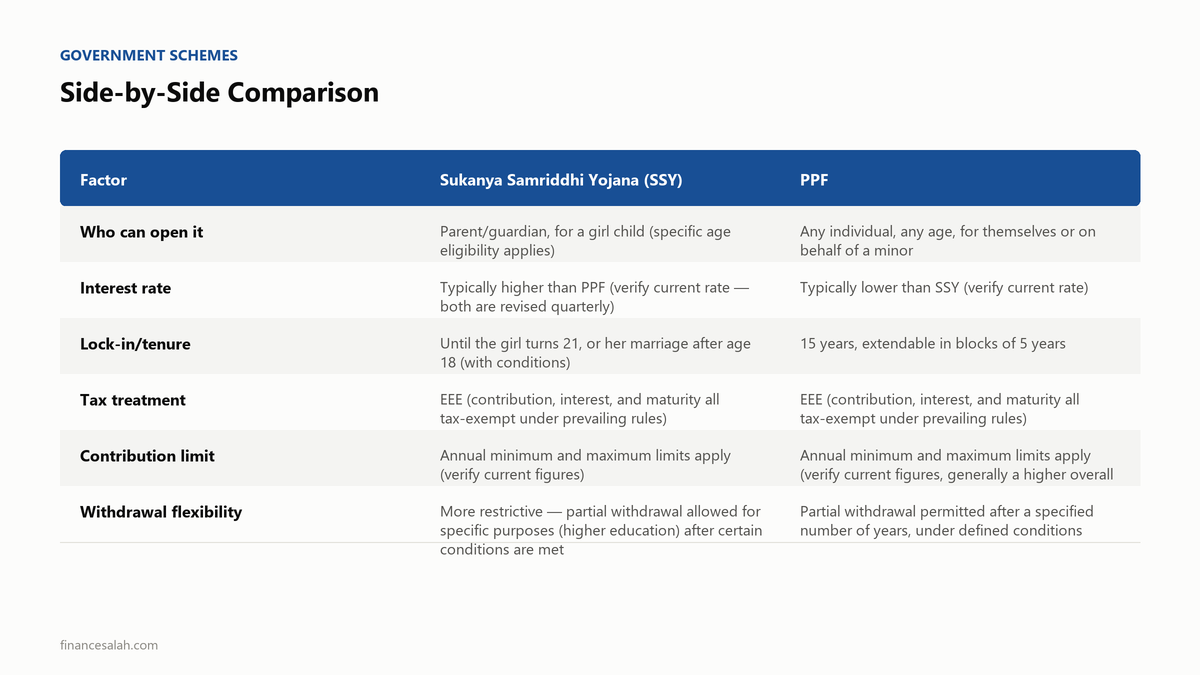
Side-by-Side Comparison
| Factor | Sukanya Samriddhi Yojana (SSY) | PPF |
|---|---|---|
| Who can open it | Parent/guardian, for a girl child (specific age eligibility applies) | Any individual, any age, for themselves or on behalf of a minor |
| Interest rate | Typically higher than PPF (verify current rate — both are revised quarterly) | Typically lower than SSY (verify current rate) |
| Lock-in/tenure | Until the girl turns 21, or her marriage after age 18 (with conditions) | 15 years, extendable in blocks of 5 years |
| Tax treatment | EEE (contribution, interest, and maturity all tax-exempt under prevailing rules) | EEE (contribution, interest, and maturity all tax-exempt under prevailing rules) |
| Contribution limit | Annual minimum and maximum limits apply (verify current figures) | Annual minimum and maximum limits apply (verify current figures, generally a higher overall ceiling than SSY) |
| Withdrawal flexibility | More restrictive — partial withdrawal allowed for specific purposes (higher education) after certain conditions are met | Partial withdrawal permitted after a specified number of years, under defined conditions |
| Purpose flexibility | Specifically tied to a girl child’s future (education/marriage) | General purpose — retirement, any long-term goal, not restricted to children |
Always verify current interest rates, contribution limits, and specific rules on official government portals — both schemes’ rates are revised quarterly by the government, and rules are periodically updated.
Eligibility: The Deciding Factor for Many Families
This is often the actual deciding factor, more than returns: SSY can only be opened for a girl child, generally up to a specified age limit (commonly cited as up to 10 years old, though always verify the current rule), and only a specified number of accounts per family (commonly up to two, with some exceptions for twins/triplets — verify current rules).
If you don’t have a daughter, or she’s past the eligible age window, PPF is the relevant comparable option — this alone resolves the decision for many families before returns even become a consideration.
Interest Rates Compared
Both SSY and PPF have their interest rates set and revised quarterly by the Government of India, and historically, SSY’s rate has generally been set higher than PPF’s, reflecting the scheme’s specific policy goal of incentivizing savings for girl children.
Always check the current quarter’s official rates directly on the National Savings Institute or India Post websites before making a decision based on rate comparison — rates shift, and the specific gap between the two schemes varies over time rather than being a fixed, permanent differential.
Withdrawal Rules: Where They Genuinely Differ
- SSY allows partial withdrawal (commonly up to 50% of the balance, per prevailing rules) specifically for the girl child’s higher education once she reaches a specified age or has passed a specified class, and can be closed for her marriage after she turns 18 (subject to specific conditions) — the scheme is structurally built around these two specific life events.
- PPF allows partial withdrawal after a specified number of years (commonly from the 7th year onward, per prevailing rules) for any purpose, without being tied to specific life events — offering more general-purpose flexibility.
This structural difference matters: SSY is genuinely built around a daughter’s education/marriage timeline specifically, while PPF is more flexible but not specifically incentivized toward those exact purposes.
Pros and cons of each scheme’s withdrawal structure
| SSY | PPF | |
|---|---|---|
| Pros | Purpose-built structure encourages disciplined, uninterrupted saving toward a specific milestone | Genuine flexibility to use funds for any purpose once the withdrawal window opens |
| Cons | Less useful if your family’s actual need turns out to be something other than education or marriage | Less specifically incentivized or structured around a child’s future compared to SSY’s purpose-built design |
Neither structure is objectively superior — SSY’s rigidity is a feature for families confident their goal is specifically education or marriage, while PPF’s flexibility better serves families who want to keep their options genuinely open.
Which Should You Actually Choose?
- If you have an eligible daughter and your primary goal is specifically her education or marriage, SSY’s typically higher interest rate and purpose-built structure make it a strong, often-recommended default choice for at least a portion of that savings goal.
- If you don’t have an eligible daughter, or want a more general-purpose long-term savings vehicle (retirement, flexible future use), PPF is the more broadly applicable option.
- Many financial planners suggest using both where eligible — SSY for a dedicated daughter’s-future corpus, and PPF for broader family retirement/long-term savings — rather than treating them as mutually exclusive alternatives competing for the same money.
Common Mistakes
- Opening an SSY account without checking the current age eligibility window, only to find the daughter doesn’t qualify.
- Assuming SSY’s interest rate is always meaningfully higher without checking the current quarter’s actual rates for both schemes.
- Not understanding SSY’s specific withdrawal restrictions (tied to education/marriage) before committing significant funds, if genuine flexibility for other purposes might be needed.
- Treating SSY and PPF as mutually exclusive when many families can reasonably use both for different, complementary purposes.
- Missing the annual minimum contribution requirement for either scheme, which can affect the account’s status if not maintained.
Myth vs Fact
| Myth | Fact |
|---|---|
| “SSY and PPF offer the same interest rate.” | SSY’s interest rate has typically been set higher than PPF’s, reflecting its specific policy goal, though always verify the current quarter’s actual rates for both, since rates are revised periodically. |
| “I can open an SSY account for a daughter of any age.” | SSY has a specified age eligibility window (commonly up to 10 years old, verify current rule) — a daughter past this age is not eligible for a new SSY account. |
| “SSY funds can be withdrawn for any purpose, like a PPF.” | SSY withdrawal is specifically tied to the girl child’s higher education (partial, under conditions) or marriage (closure, after 18, under conditions) — it’s more purpose-restricted than PPF’s more general withdrawal rules. |
| “I have to choose one or the other.” | Many families use both — SSY specifically for a daughter’s future, and PPF for broader family retirement or long-term savings — since they serve complementary, not identical, purposes. |
Expert Tips
- Check the current quarter’s official interest rates for both schemes before assuming a fixed rate differential — this changes periodically.
- Open an SSY account as early as possible within the eligibility window, if it fits your plan, since a longer accumulation period benefits from more years of compounding.
- Don’t over-commit to SSY if genuine flexibility might be needed — its purpose-restricted withdrawal rules mean it’s less suited for funds you might need for something other than education/marriage.
- Consider both schemes together as part of a broader family savings plan, rather than evaluating SSY in isolation from your other long-term savings needs.
- Set up automated monthly contributions rather than relying on annual lump-sum deposits, so the minimum annual contribution requirement is met consistently without last-minute scrambling near the financial year-end.
- Revisit your combined SSY and PPF contribution strategy at least once a year, factoring in your daughter’s approaching milestones and any changes to your own retirement timeline.
Checklist
- [ ] Confirm your daughter’s eligibility for SSY (age window, existing accounts per family)
- [ ] Check the current quarter’s official interest rates for both SSY and PPF
- [ ] Understand SSY’s specific withdrawal rules (education/marriage-tied) versus PPF’s more general rules
- [ ] Decide whether SSY, PPF, or a combination of both fits your family’s broader savings goals
- [ ] Confirm annual minimum contribution requirements for whichever scheme(s) you choose
- [ ] Revisit your allocation periodically as rates and family circumstances change
Frequently Asked Questions
Q: Which has a better interest rate, Sukanya Samriddhi Yojana or PPF?
A: SSY’s interest rate has typically been set higher than PPF’s, reflecting the scheme’s specific policy goal — but always check the current quarter’s official rates for both, since both are revised periodically by the government.
Q: Can I open a Sukanya Samriddhi account for my daughter at any age?
A: No — SSY has a specified age eligibility window (commonly up to 10 years old, though this should be verified against current rules), so a daughter past this age would not be eligible for a new account.
Q: Can I use PPF savings for my daughter’s education instead of SSY?
A: Yes — PPF is general-purpose and not restricted to specific life events, so it can be used for a daughter’s education, marriage, or any other long-term goal, offering more flexibility than SSY’s purpose-tied structure.
Q: Can I have both SSY and PPF accounts?
A: Yes — many families use both, with SSY specifically dedicated to a daughter’s future (education/marriage) and PPF serving broader family long-term or retirement savings goals, since they aren’t mutually exclusive.
Q: What are SSY’s withdrawal rules?
A: SSY allows partial withdrawal (commonly up to 50% of the balance, per prevailing rules) for the girl child’s higher education once specific conditions are met, and permits account closure for her marriage after she turns 18, subject to specific conditions.
Q: What happens to an SSY account if the family moves to a different city?
A: SSY accounts are generally transferable between authorized banks or post offices across India if the family relocates, similar to other government savings scheme transfer provisions — check the current transfer process with your account-holding institution.
Q: Can grandparents open a Sukanya Samriddhi account for their granddaughter?
A: Generally, the account is opened by a parent or legal guardian, though specific eligibility for other family members may vary — verify current rules on the official National Savings Institute portal for who exactly is permitted to open the account.
Q: Does SSY offer better returns than mutual funds for a daughter’s future?
A: SSY offers fixed, government-guaranteed returns with no market risk, while mutual funds carry market risk but have historically offered higher long-term growth potential — many financial planners suggest a combination rather than relying exclusively on either for a long-horizon goal like a daughter’s education.
Conclusion
Sukanya Samriddhi Yojana and PPF are both safe, government-backed, tax-efficient savings instruments, but they’re built for different purposes — SSY specifically for a daughter’s education or marriage with a typically higher rate and purpose-restricted withdrawal, and PPF as a more general-purpose, flexible long-term savings vehicle. For families with an eligible daughter, using both — rather than choosing one exclusively — is often the most sensible approach.
Check your daughter’s SSY eligibility and the current quarter’s official rates for both schemes this week before deciding your allocation. FinanceSalah’s comparison of NPS vs PPF vs mutual funds is a useful companion read for your own broader retirement planning alongside this decision, and our guide on building wealth on a normal salary ties both goals into one coherent family financial plan.
Sources & Further Reading
- National Savings Institute — Sukanya Samriddhi Yojana — official SSY scheme rules and current interest rate
- National Savings Institute — PPF Scheme — official PPF scheme rules and current interest rate
- India Post — Small Savings Schemes — official account opening process and current rates
Related Reading
- NPS vs PPF vs Mutual Fund for Retirement
- Section 80C vs New Tax Regime 2026
- Fixed Deposit vs Recurring Deposit in India: Which Is Better
- How Much Should I Save Every Month in India
- Government Schemes for Unemployed Graduates in India
- Realistic Plan to Build Wealth on ₹30,000 Salary in India
This article is for general educational purposes and does not constitute personalized financial advice. Interest rates, eligibility criteria, and scheme rules are revised periodically by the government — always verify current details on official National Savings Institute or India Post portals before opening an account.