
Table of Contents
- Why Credit Report Errors Happen
- Common Types of Errors
- Step-by-Step: How to Raise a Dispute
- How Long Resolution Actually Takes
- If the Bureau Doesn’t Resolve It
- Common Mistakes
- Myth vs Fact
- Expert Tips
- Checklist
- FAQs
Introduction
Discovering a wrong entry on your credit report — a loan you never took, a payment marked late when it wasn’t, an account that isn’t actually yours — is unsettling, especially when you’re about to apply for a loan or credit card. The good news: there’s a formal, regulator-mandated dispute process specifically for this, and it’s more accessible than most people realize. Here’s exactly how to use it.
Why Credit Report Errors Happen
Credit bureaus (CIBIL/TransUnion, Experian, Equifax, and CRIF High Mark, the four bureaus operating in India) compile your report from data reported by lenders — banks, NBFCs, and other credit providers. Errors typically originate from:
- Data entry mistakes by the lender when reporting to the bureau.
- Delayed updates — a loan you closed months ago still showing as active, because the lender hasn’t reported the closure yet.
- Identity mix-ups — another person’s data appearing on your report due to similar names, addresses, or identifier errors.
- Fraudulent accounts — an account opened in your name without your knowledge, a more serious category requiring both a dispute and often a broader fraud response.
A real case that shows how quietly these errors accumulate
Consider Farhan, who discovered while applying for a car loan that his credit report showed a personal loan he’d closed eighteen months earlier as still active with an outstanding balance. He hadn’t checked his report in the interim, assuming that once a loan was paid off, the record would simply update itself automatically and permanently. In reality, the lender’s system had processed his final payment correctly on their end, but the update to the credit bureau had failed to sync during a routine data submission cycle — a genuinely common, unglamorous technical failure rather than any deliberate error. The car loan application was delayed by several weeks while he raised and tracked the dispute. His main takeaway, which he now shares with friends: check your report periodically, not only when you’re about to need it for something urgent, precisely because these errors tend to sit quietly until they collide with a time-sensitive application.
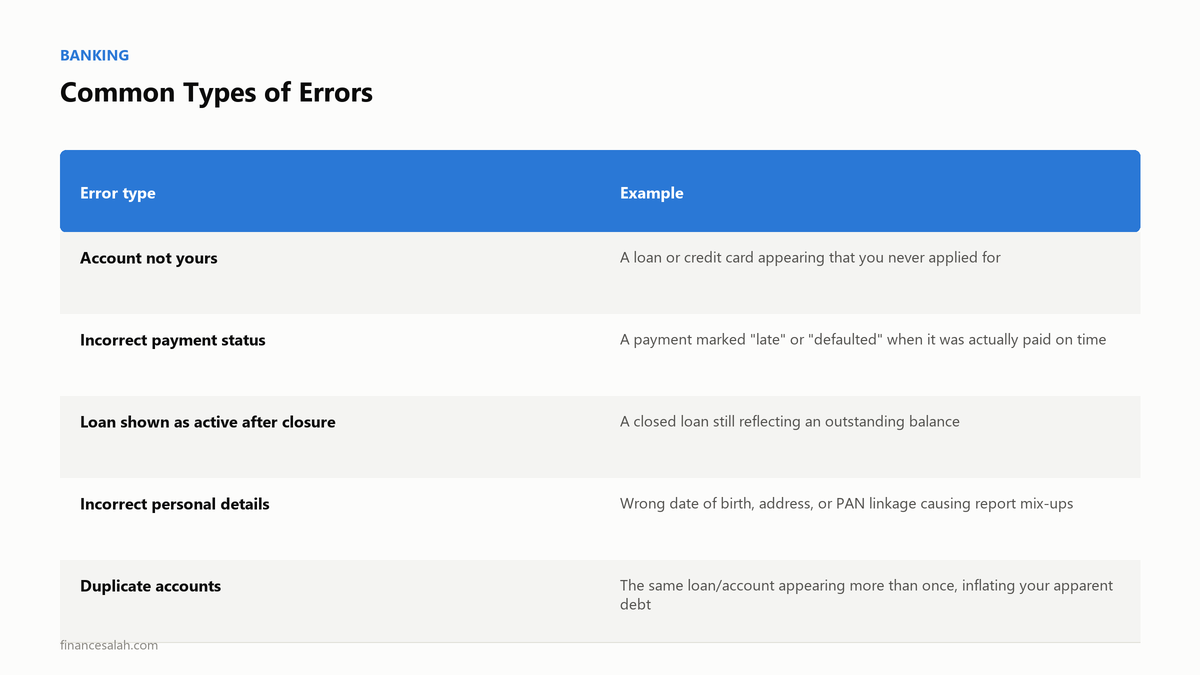
Common Types of Errors
| Error type | Example |
|---|---|
| Account not yours | A loan or credit card appearing that you never applied for |
| Incorrect payment status | A payment marked “late” or “defaulted” when it was actually paid on time |
| Loan shown as active after closure | A closed loan still reflecting an outstanding balance |
| Incorrect personal details | Wrong date of birth, address, or PAN linkage causing report mix-ups |
| Duplicate accounts | The same loan/account appearing more than once, inflating your apparent debt |
| Incorrect credit limit or sanctioned amount | Wrong figures affecting your credit utilization calculation |
Step-by-Step: How to Raise a Dispute
- Get your current credit report from the specific bureau where you spotted the error (CIBIL, Experian, Equifax, or CRIF High Mark) — errors can appear on one bureau’s report and not another’s, since each compiles data somewhat independently.
- Identify the exact error — the specific account, the specific incorrect field (status, amount, dates), documented clearly.
- Raise the dispute directly through the bureau’s official online dispute portal — all four bureaus operating in India are required to provide an accessible dispute mechanism.
- Provide supporting documentation where relevant — loan closure letters, payment receipts, or identity documents, depending on the error type.
- Track your dispute reference number — the bureau will provide one upon submission, needed for any follow-up.
- The bureau forwards the dispute to the reporting lender for verification, since the bureau itself doesn’t originate the data — it’s the lender who ultimately confirms or corrects it.
- Receive resolution confirmation and re-check your report once the bureau confirms the correction has been processed.
How Long Resolution Actually Takes
Per RBI’s regulatory framework for credit information companies, disputes are generally required to be resolved within a specified timeframe — commonly around 30 days from when the dispute is raised, though this can vary depending on the complexity of the specific case and how quickly the reporting lender responds to the bureau’s verification request.
If the lender doesn’t respond within the specified window, RBI’s framework includes provisions for the bureau to act on the available information, which can include removing or correcting the disputed entry — always follow up if you haven’t received resolution within the expected timeframe.
Pros and cons of the dispute timeline
| Pros of the current system | Cons worth being aware of |
|---|---|
| A clear, regulator-mandated timeframe exists, giving you a concrete point to escalate if missed | 30 days can feel long if you’re mid-application for a time-sensitive loan |
| The bureau is required to actively pursue verification from the lender, not just log your complaint | Complex disputes (identity mix-ups, fraud-related entries) can genuinely take longer than the standard timeframe |
| A dispute reference number creates a trackable, documented record | You bear the responsibility of following up if the timeline is exceeded — it’s not always proactively communicated |
If the Bureau Doesn’t Resolve It
- Escalate directly with the specific lender whose reported data is disputed, since they’re the actual source of the information the bureau is verifying.
- File a complaint with the RBI’s grievance redressal mechanism if the bureau or lender doesn’t resolve the dispute within the expected timeframe — RBI has specific provisions for credit information company-related grievances.
- Consider the RBI Ombudsman framework if the matter remains unresolved through the above channels, which covers certain categories of financial service complaints, including credit information disputes in specified circumstances.
- Keep a written record of every step — dispute reference numbers, dates, and correspondence — since this documentation is essential if escalation becomes necessary.
When escalation is genuinely necessary versus when patience is warranted
Not every dispute that takes longer than expected requires immediate escalation — occasional delays happen for legitimate reasons, particularly if the reporting lender is slow to respond or the error involves cross-referencing multiple records. A reasonable approach is to follow up directly with the bureau once the standard resolution window has passed without any update, treat that follow-up as your first checkpoint, and only move to formal escalation (the lender directly, then RBI’s grievance mechanism) if the follow-up itself goes unanswered for a further meaningful period. This staged approach avoids both extremes — neither giving up too early nor escalating prematurely before the standard process has had a fair chance to work.
Common Mistakes
- Only checking one credit bureau’s report, missing an error that might exist on a different bureau’s version of your data.
- Not documenting the specific error precisely before raising a dispute, leading to delays if the bureau needs clarification.
- Assuming a dispute is resolved without re-checking the report after receiving a resolution notification — always verify the correction actually appears.
- Waiting to check your credit report until right before a major loan application, when a dispute resolution timeline (potentially weeks) could delay your actual borrowing plans.
- Not keeping supporting documents (loan closure letters, payment receipts) that could speed up dispute verification.
Myth vs Fact
| Myth | Fact |
|---|---|
| “I can’t do anything about an error on my credit report.” | There’s a formal, RBI-regulated dispute mechanism specifically for this, available directly through each credit bureau’s online portal, generally required to be resolved within about 30 days. |
| “Checking my credit report too often will hurt my score.” | Checking your own credit report (a “soft inquiry”) does not affect your credit score — only lender-initiated “hard inquiries” from actual credit applications can have a minor impact. |
| “All four credit bureaus in India show identical information.” | Each bureau compiles data somewhat independently based on what’s reported to them — an error can exist on one bureau’s report and not appear on another’s, so checking only one may miss something. |
| “Once I raise a dispute, the error is automatically removed immediately.” | The bureau forwards the dispute to the reporting lender for verification — resolution isn’t instant and depends on the lender’s response, generally within the regulatory timeframe. |
Expert Tips
- Check your report from all four bureaus periodically, not just one, since errors can be bureau-specific.
- Keep loan closure letters and payment receipts organized as you go, so you have documentation readily available if a dispute becomes necessary later.
- Raise disputes well before you need a clean report for a major application (home loan, large personal loan), given the resolution timeline involved.
- Follow up proactively if you haven’t heard back within the expected resolution window, rather than assuming silence means the issue is being handled.
Checklist
- [ ] Obtain your current credit report from the relevant bureau(s)
- [ ] Identify and document the exact error (account, field, correct vs incorrect data)
- [ ] Raise the dispute through the bureau’s official online portal
- [ ] Attach supporting documentation where relevant
- [ ] Record your dispute reference number
- [ ] Follow up if resolution exceeds the expected ~30-day window
- [ ] Re-check your report after resolution confirmation to verify the correction
Frequently Asked Questions
Q: How do I dispute an error on my CIBIL report?
A: Raise the dispute directly through CIBIL’s official online dispute portal, providing the specific account and error details along with any supporting documentation — the bureau will forward it to the reporting lender for verification.
Q: How long does it take to fix a credit report error in India?
A: Per RBI’s regulatory framework for credit information companies, disputes are generally required to be resolved within about 30 days, though this can vary depending on case complexity and the reporting lender’s response time.
Q: Does checking my own credit report hurt my score?
A: No — checking your own credit report is a “soft inquiry” and does not affect your credit score. Only “hard inquiries” from actual credit applications by lenders can have a minor impact.
Q: What should I do if my dispute isn’t resolved?
A: Escalate directly with the specific lender whose data is disputed, and if still unresolved, file a complaint through RBI’s grievance redressal mechanism or relevant Ombudsman framework for credit information disputes.
Q: Should I check all four credit bureaus, or is one enough?
A: It’s worth checking all four (CIBIL, Experian, Equifax, CRIF High Mark) periodically, since each compiles data somewhat independently — an error appearing on one bureau’s report may not appear on another’s.
Q: What should I do if I find an account on my report that I never opened?
A: This may indicate identity fraud rather than a simple data error — raise a dispute immediately through the bureau, and also consider reporting it to the specific lender and, if warranted, filing a cybercrime or police complaint given the potential fraud dimension.
Q: Can a credit report error affect my loan interest rate, not just approval?
A: Yes — since your credit score partly determines the interest rate a lender offers, an inaccurate negative entry can result in a higher quoted rate even if your application is still approved, making correction worthwhile even when a loan seems likely to go through anyway.
Q: Is there a fee to dispute an error on my credit report?
A: No — raising a dispute through the credit bureau’s official portal is a free process, mandated as part of the regulatory framework governing credit information companies in India.
Conclusion
A credit report error is genuinely fixable through a formal, regulator-backed process — not something you have to just live with. Document the specific error clearly, raise the dispute through the correct bureau’s official portal, keep your reference number, and follow up if resolution takes longer than the expected timeframe. Checking your report periodically, before you urgently need it clean, gives you time to resolve issues without derailing an upcoming loan application.
Pull up your credit report today and check it carefully — catching an error now, well before you need to borrow, saves significant stress later. FinanceSalah’s guide on building credit from a secured card is a useful next read if your score needs rebuilding alongside any corrections, and our home loan eligibility guide explains exactly why a clean, accurate credit report matters so much when you eventually apply.
Sources & Further Reading
- Reserve Bank of India — Credit Information Companies Regulations — official dispute resolution timeframes and grievance mechanisms
- CIBIL — Dispute Resolution — official online dispute portal
- RBI — Banking Ombudsman / Grievance Redressal — escalation framework for unresolved disputes
Related Reading
- How to Check Your CIBIL Score for Free in India
- Secured Credit Card to Build Credit Score From Zero in India
- Home Loan Eligibility in India: How Much Can You Get?
- How to Build Credit Score in India With No Credit History
- UPI Safety Tips India: Avoid Digital Payment Fraud
- Personal Loan vs Gold Loan: Which Is Cheaper in India?
This article is for general educational purposes and does not constitute personalized financial or legal advice. Dispute processes, timelines, and regulations may change — always verify current procedures directly with the relevant credit bureau and RBI’s official resources.