
Introduction
Since India introduced the option to choose between the old tax regime (with deductions like Section 80C) and the new tax regime (lower slab rates, most deductions removed), the question “which one saves me more” has become an annual decision for salaried taxpayers rather than a one-time choice. The honest answer: it depends entirely on how much you actually claim in deductions — and for many people, that answer has shifted as the new regime’s rates have become more competitive over successive budgets, including the changes covered in our Budget 2026 tax slabs breakdown.
The Core Trade-off
Old regime: higher slab rates, but you can claim deductions — Section 80C (up to a specified annual limit, covering investments like ELSS, PPF, life insurance premiums, and principal repayment on home loans), Section 80D (health insurance premiums), HRA exemption, home loan interest deduction, and several others.
New regime: significantly lower slab rates across most income brackets, but nearly all deductions are removed — no 80C, no 80D, no HRA exemption (with a few exceptions retained, which change with each budget, so always verify current-year specifics).
The decision reduces to a single comparison: does the tax saved by your total eligible deductions under the old regime exceed the tax saved by the new regime’s lower rates?
Why This Isn’t a One-Time Decision
Your answer can change year to year based on:
– Whether you’ve taken on a new home loan (adds significant interest + principal deductions)
– Whether your 80C investments (ELSS, PPF, insurance) are fully utilized or minimal
– Changes to slab rates or deduction rules in each year’s budget
– Changes in your income level, since the relative benefit of lower new-regime rates vs. old-regime deductions isn’t uniform across all income brackets
This is why it’s worth recalculating each year rather than assuming last year’s answer still holds — especially in years with significant tax policy changes, like the update covered in our Budget 2026 breakdown.
A Simplified Way to Decide
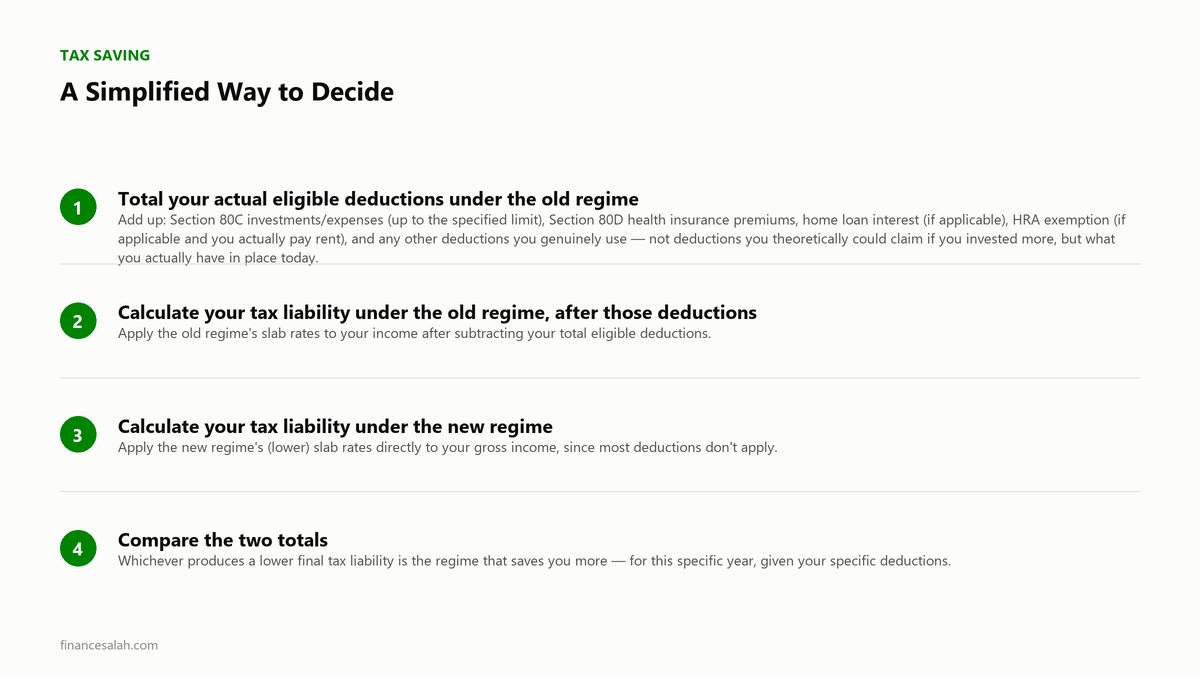
Step 1: Total your actual eligible deductions under the old regime
Add up: Section 80C investments/expenses (up to the specified limit), Section 80D health insurance premiums, home loan interest (if applicable), HRA exemption (if applicable and you actually pay rent), and any other deductions you genuinely use — not deductions you theoretically could claim if you invested more, but what you actually have in place today.
Step 2: Calculate your tax liability under the old regime, after those deductions
Apply the old regime’s slab rates to your income after subtracting your total eligible deductions.
Step 3: Calculate your tax liability under the new regime
Apply the new regime’s (lower) slab rates directly to your gross income, since most deductions don’t apply.
Step 4: Compare the two totals
Whichever produces a lower final tax liability is the regime that saves you more — for this specific year, given your specific deductions.
When the Old Regime (With 80C) Tends to Win
- You have a home loan, where interest and principal deductions are often substantial
- You already maximize Section 80C (₹1.5 lakh limit historically, though always verify the current year’s limit) through ELSS, PPF, or insurance, and also claim 80D and HRA
- Your total genuine deductions are large relative to your income — broadly, the more deductions you can substantiate, the more likely the old regime wins
When the New Regime Tends to Win
- You have few or no significant deductions — no home loan, minimal 80C investment, live with family (no HRA claim)
- You prefer the simplicity of not needing to plan and lock money into 80C-eligible investments purely for tax purposes, especially if those investments don’t otherwise fit your financial goals
- Your income falls in a bracket where the new regime’s lower rates provide a bigger absolute benefit than your realistic deduction total would offset under the old regime
Don’t Let the Tax Tail Wag the Investment Dog
A common mistake: choosing 80C investments purely to minimize tax, regardless of whether they’re a good fit for your actual financial goals. ELSS funds, for instance, come with a mandatory lock-in and market-linked risk — appropriate for some investors, not for someone who needs that money more liquid. If the new regime’s lower rates make forced 80C investing unnecessary for your tax situation, that can free you to choose investments purely on their own merits (see our guide on choosing your first mutual fund) rather than shoehorning decisions around a tax deduction.
Frequently Asked Questions
Q: Can I switch between old and new regime every year?
A: Salaried individuals generally have the flexibility to choose between regimes each financial year when filing returns, though the specific rules around switching frequency can differ for those with business income — check current rules or consult a tax professional for your specific employment situation.
Q: Is the new tax regime the default now?
A: In recent budgets, the new regime has been positioned as the default option, with taxpayers needing to actively opt for the old regime if they prefer it — always confirm the current year’s default and opt-in/opt-out process, since this has evolved across budgets.
Q: Do I need to decide before or after making my 80C investments for the year?
A: Ideally before, or at least well before the financial year ends — deciding your likely regime early helps you know whether it’s worth continuing 80C-eligible investments for tax purposes that year, rather than investing first and calculating afterward.
Q: Should I consult a CA to decide, or can I calculate this myself?
A: The calculation above is straightforward enough to do yourself with your actual numbers for most simple salaried situations, but if you have multiple income sources, complex deductions, or are unsure about eligibility for specific exemptions, a chartered accountant can confirm the more favorable choice and ensure correct filing.
Conclusion
There’s no universally “better” regime — the old regime with 80C deductions wins for taxpayers with substantial genuine deductions (especially a home loan and maxed-out 80C/80D), while the new regime’s lower rates tend to win for those with few deductions who prefer simplicity. Recalculate this comparison every year using your actual numbers, since policy changes and your own financial situation both shift the answer over time.
Related Reading
- 7 New Tax Slabs 2026: How to Save Up to ₹60,000
- How to Choose Your First Mutual Fund India
- How Much Should I Save Every Month in India (By Salary Bracket)
This article is for general educational purposes and does not constitute personalized tax advice. Tax slabs, deduction limits, and regime rules are revised periodically — verify current figures with the Income Tax Department or a qualified chartered accountant before filing.