
Introduction
If you need money reasonably quickly and have gold jewelry sitting unused, a gold loan is one of the fastest, most accessible borrowing options in India — often disbursed within hours. A personal loan is the other common quick-access option. They’re priced differently, carry different risks, and the “cheaper” answer depends on more than just the headline interest rate.
How Gold Loans Are Priced
Gold loans are secured — you pledge gold jewelry or coins as collateral, and the lender assesses its value (typically lending 60-75% of the assessed value, per regulatory limits on loan-to-value ratio) and disburses a loan against it. Because the loan is secured by a tangible, easily-liquidated asset, gold loan interest rates are typically among the lowest available for a quick, minimal-paperwork loan — commonly in the 9-18% annual range depending on the lender and loan-to-value ratio chosen, often on the lower end of that range compared to an unsecured personal loan.
The real risk with a gold loan isn’t the interest rate — it’s the collateral. If you default, the lender can auction your pledged gold to recover the loan amount. This is a fundamentally different risk profile than an unsecured personal loan, where default affects your credit score and invites collection efforts, but doesn’t put a specific physical asset on the line.
How Personal Loans Are Priced
Personal loans are unsecured — no collateral, priced based on your income, credit score, and existing obligations, commonly in the 10-18% annual range for a borrower with reasonable credit, sometimes higher for thinner credit files. Because there’s no collateral backing the loan, personal loan rates factor in the lender’s higher risk of an unrecoverable default, which is part of why a gold loan can sometimes undercut a personal loan’s rate for the same borrower.
Side-by-Side Comparison
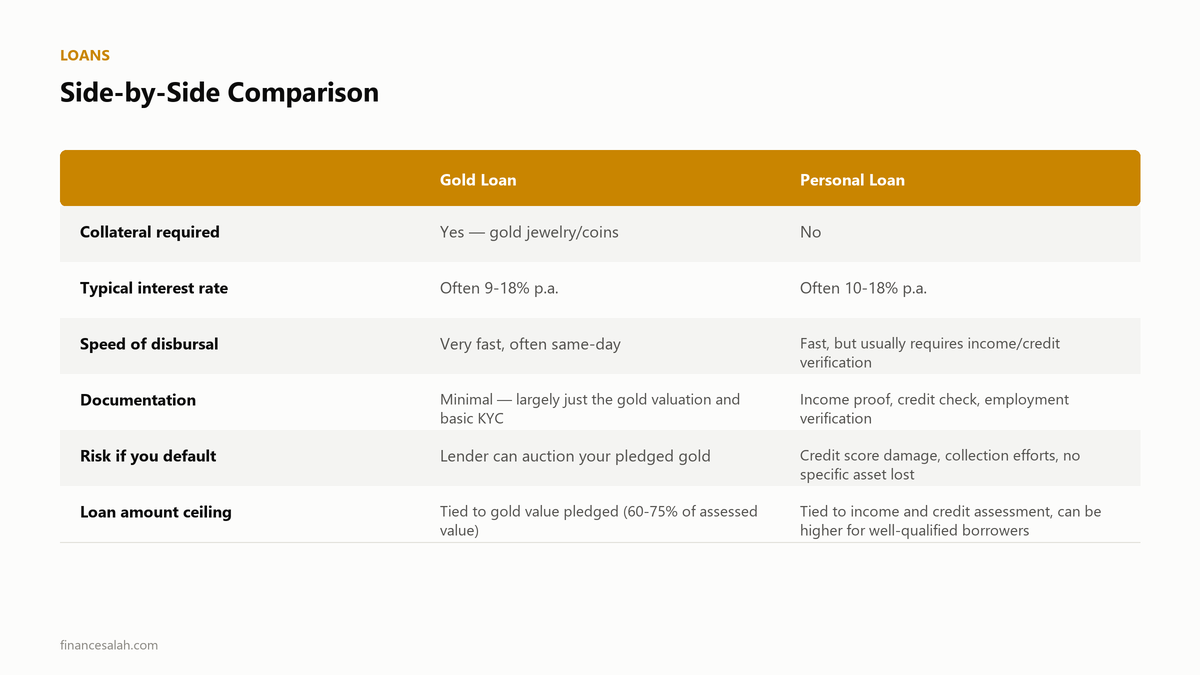
| Gold Loan | Personal Loan | |
|---|---|---|
| Collateral required | Yes — gold jewelry/coins | No |
| Typical interest rate | Often 9-18% p.a. | Often 10-18% p.a. |
| Speed of disbursal | Very fast, often same-day | Fast, but usually requires income/credit verification |
| Documentation | Minimal — largely just the gold valuation and basic KYC | Income proof, credit check, employment verification |
| Risk if you default | Lender can auction your pledged gold | Credit score damage, collection efforts, no specific asset lost |
| Loan amount ceiling | Tied to gold value pledged (60-75% of assessed value) | Tied to income and credit assessment, can be higher for well-qualified borrowers |
| Best suited for | Quick access, minimal paperwork, when the rate genuinely undercuts personal loan | Larger amounts, no gold to pledge, longer tenure needs |
When a Gold Loan Is Genuinely the Better Choice
- You need funds very quickly and have gold sitting idle that isn’t earning you anything (unused jewelry doesn’t generate a return sitting in a locker)
- Your credit score or income situation would mean a personal loan comes at a high interest rate or gets rejected outright — a gold loan’s approval depends primarily on the gold’s value, not your credit history
- You’re confident in your ability to repay on schedule, since the consequence of default is losing a specific, often sentimentally significant asset
When a Personal Loan Is the Better Choice
- You don’t have gold to pledge, making the comparison moot
- You have strong credit and qualify for a personal loan at a rate competitive with or better than available gold loan offers — always compare actual quotes, since the “gold loans are always cheaper” assumption doesn’t hold universally
- You’d rather risk a credit score impact than risk a specific physical asset — this is a legitimate personal risk preference, not just a financial calculation
- You need a larger amount than your available gold would secure
A Word of Caution on Gold Loan Auction Risk
Gold loan default consequences are sometimes underestimated because the process feels informal (a local branch, minimal paperwork) — but the lender’s right to auction pledged gold upon sustained default is real and contractually binding. Before taking a gold loan, be realistic about your repayment capacity, exactly as you would with any other loan — the ease of approval doesn’t reduce the seriousness of the obligation.
Frequently Asked Questions
Q: Is gold loan interest always lower than personal loan interest?
A: Often, but not universally — always compare actual quoted rates from specific lenders for your situation rather than assuming. The rate gap depends on your personal loan eligibility (credit score, income) as much as on the gold loan market rate.
Q: What happens to my gold if I repay the loan fully and on time?
A: You get your pledged gold back in full once the loan (principal plus interest) is repaid — the lender has no further claim on it once the obligation is settled.
Q: Can I get a gold loan without any income proof?
A: Generally yes — gold loans typically rely primarily on the value of the pledged gold and basic KYC, making them accessible even without formal income documentation, unlike most personal loans.
Q: Is it safe to pledge gold with a bank vs a non-banking finance company (NBFC)?
A: Both banks and RBI-regulated NBFCs offer gold loans and are subject to regulatory oversight on loan-to-value limits and lending practices — check that any lender you use is properly regulated, and compare rates and storage/security practices for your gold before choosing.
Conclusion
Gold loans are often — but not always — cheaper than personal loans, and are faster and easier to access with minimal documentation, at the real risk of losing pledged gold on default. A personal loan avoids that specific asset risk but typically requires stronger credit/income verification and can carry a higher rate for thinner credit files. Always compare actual quoted rates for your specific situation rather than assuming either option is automatically cheaper.
Related Reading
- Personal Loan vs Credit Card Debt: Which to Pay Off First?
- Credit Card EMI vs Personal Loan: Which Is Cheaper?
- How to Check Your CIBIL Score for Free in India
This article is for general educational purposes and does not constitute personalized financial advice. Interest rates cited are illustrative ranges and vary by lender, gold valuation method, and credit profile.