

Introduction: Why “Under ₹400” Small‑Caps Are So Attractive Right Now
If you’ve been googling things like “undervalued small cap stocks India under 400 rupees 2025 or 2026” or “best stocks under 500 India 2026”, you’re not alone. Retail investors want shares that are affordable per unit, have growth potential, and don’t require lakhs to start building a portfolio.
At the same time, the small‑cap space is crowded with hype and risk. Many stocks under ₹400 are cheap for a reason—weak balance sheets, poor governance, or cyclical earnings. This guide filters that universe into 5 fundamentally stronger, listed companies with prices below ~₹400 as of early 2026, using publicly available data from reputed research and stock‑screening platforms.
Disclaimer: This article is for education only, not stock recommendations or SEBI‑registered investment advice. Always do your own research or consult a professional before investing.
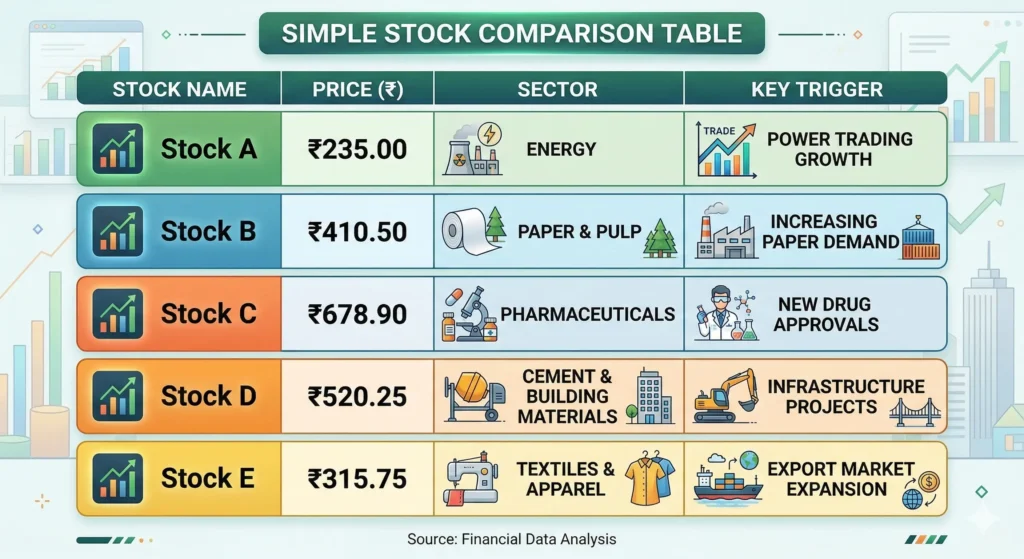
Table of Contents
What “Undervalued” Really Means for Small‑Cap Stocks
How We Shortlisted 5 Stocks Under ₹400
Stock #1 – PTC India Ltd (Power Trading + High Dividend)
Stock #2 – Shreyans Industries Ltd (Paper + Cheap Valuation)
Stock #3 – Gujarat Themis Biosyn Ltd (Niche Pharma Play)
Stock #4 – HeidelbergCement India Ltd (Steady Cash‑Flow Cement)
Stock #5 – Himatsingka Seide Ltd (Export‑Led Textile Player)
How a Beginner Can Build a Simple Investment Plan Around These
Risks of Investing in Small‑Cap Stocks Under ₹400
FAQs on Small‑Cap and Dividend Investing for Beginners
1. What “Undervalued” Really Means in Small‑Caps
In large caps, valuation is often about comparing P/E or P/B ratios with peers. In small‑caps, survival, governance and cash flows are just as important as a low P/E.
For this article, “undervalued” means:
The stock trades below ₹400 per share, keeping it accessible for small monthly SIP‑style investing.
Valuation metrics like P/E and P/B are reasonable or lower than what you’d expect for that business quality, based on public data from platforms like Equitymaster, 5paisa and small‑cap screens.
The company has established operations and positive earnings, not a speculative micro‑cap story.
2. How We Shortlisted 5 Stocks Under ₹400
From widely followed lists like “stocks under ₹500” and BSE Small‑Cap constituents, we picked companies that:
Were trading below ~₹400 at the time of writing.
Have consistent profits and meaningful business history.
Operate in sectors with structural demand (power, cement, pharma, textiles, paper).
Often show up in screens for value or income (dividend) investors, making them attractive for “dividend stocks under 500” and “dividend investing for beginners” searchers.
The five case studies are examples, not the only options. Think of them as a starting watchlist if you’re researching Indian stocks under 500 rupees 2026 and want to focus on the more fundamentally sound names.
3. Stock #1 – PTC India Ltd: Power Trader With Value + Dividend Story
Approx. price range (early 2026): around ₹155–₹165 per share.
Sector: Power trading and energy services.
PTC India is a pioneer in India’s power trading market. It holds a Category‑I trading licence, the highest level granted by the regulator, allowing it to trade unlimited volumes of electricity between generators and distribution companies.
Financially, Equitymaster’s analysis shows PTC India trading at a P/E of about 5.7 and P/B of around 0.8, with a healthy historical dividend payout. This combination—low earnings multiple, below‑book valuation and consistent dividends—is exactly what value investors hunt for when they search “undervalued small‑cap stocks to watch out in 2026”.
For beginners looking at “dividend stocks for passive income”, PTC India is a classic example of how a relatively boring business (power trading margins in paise per unit) can still generate cash, pay dividends and potentially re‑rate if the market starts valuing it closer to peers.
4. Stock #2 – Shreyans Industries Ltd: Old‑Economy Paper at a Discount
Approx. price: around ₹150–₹220 during 2025–26.
Sector: Writing and printing paper.
Shreyans Industries makes writing and printing paper from agri‑residues like wheat straw and sugarcane waste, running two mills in Punjab. Even though paper sounds like a dull business, demand for packaging, education and office supplies gives it a steady base.
In the Equitymaster “undervalued smallcap” study, Shreyans traded at a P/E of about 5.9 and P/B near 0.7, with a 50% dividend declared for FY24‑25. Later price data from 5paisa still shows it in the sub‑₹250 zone, keeping it firmly in the “stocks under 400” bucket.
For someone learning dividend investing for beginners, Shreyans illustrates a simple idea: you don’t always need flashy growth. A stable commodity business bought at a sensible valuation can reward patient investors through dividends and modest capital gains over a full cycle.
5. Stock #3 – Gujarat Themis Biosyn Ltd: Niche Pharma Under ₹300
Approx. price: around ₹298 per share.
Sector: Active pharmaceutical ingredients (APIs) and specialty pharma.
Gujarat Themis Biosyn appears in multiple “best stocks below ₹500” lists as a small but profitable pharma company with a share price under ₹300 and a few hundred crores in market cap.
Unlike generic pharma giants, this company operates in niche API segments, which can mean higher margins—but also concentration risk if a key product faces pricing pressure. Several stock‑screening tools classify it among smaller, fundamentally sound counters in the healthcare/pharma space.
For retail investors searching “small cap stocks” or “Indian stocks under 500 rupees 2026”, Gujarat Themis shows how a focused pharma niche can create value without needing a four‑digit stock price. But position sizing and risk control are crucial because regulatory or product‑specific shocks can hit small pharma harder than diversified giants.
6. Stock #4 – HeidelbergCement India Ltd: Cement Player at Mid‑Cap Valuations
Approx. price: around ₹150–₹200 per share.
Sector: Cement and building materials.
HeidelbergCement India is the local arm of a global cement group, operating grinding and integrated plants that serve housing and infrastructure demand. In Samco’s and other value‑oriented lists, it often appears among low‑to‑mid price stocks with reasonable profitability and dividends.
Cement is cyclical, but long‑term tailwinds—urbanisation, affordable housing, and government infra spending—support demand. With a price under ₹200 and a history of dividends, Heidelberg fits nicely into “best stocks under 500 India 2026” type screens while still having a multinational parent backing.
For a beginner building a simple investment plan, adding one cement name like Heidelberg can give exposure to India’s capex cycle without paying premium valuations that many larger cement majors command.
7. Stock #5 – Himatsingka Seide Ltd: Textile Exporter at Single‑Digit Price
Approx. price: about ₹90–₹95 per share.
Sector: Home textiles and bed linen exports.
Himatsingka Seide designs and manufactures premium bed linen and home textile products, with a strong export footprint. The company benefits when global demand for home furnishings rises and cotton/raw‑material cycles are favourable.
5paisa’s March 2026 list of “stocks below ₹500” shows Himatsingka in the sub‑₹100 range, after a period of price correction. That makes it interesting for investors looking for turnaround‑type small‑caps under 400, provided they are comfortable with export‑cycle volatility and currency swings.
If you’re searching for “best smallcap stocks India 2026” with a consumer/export angle, Himatsingka demonstrates how an established brand‑backed exporter can temporarily fall out of favour, creating potential value for patient, risk‑tolerant investors.
8. How a Beginner Can Turn This List Into a Simple Investment Plan
If you’re a 25‑year‑old earning ₹30k and wondering “how should I start investing for long‑term growth?”, jumping all‑in on small‑caps is dangerous. Your emergency fund and SIP in diversified funds should come first—exactly what your existing content and calculators already teach.
A simple, beginner‑friendly framework:
Step 1 – Build emergency fund (3–6 months) using your emergency fund calculator + liquid funds vs FD guide.
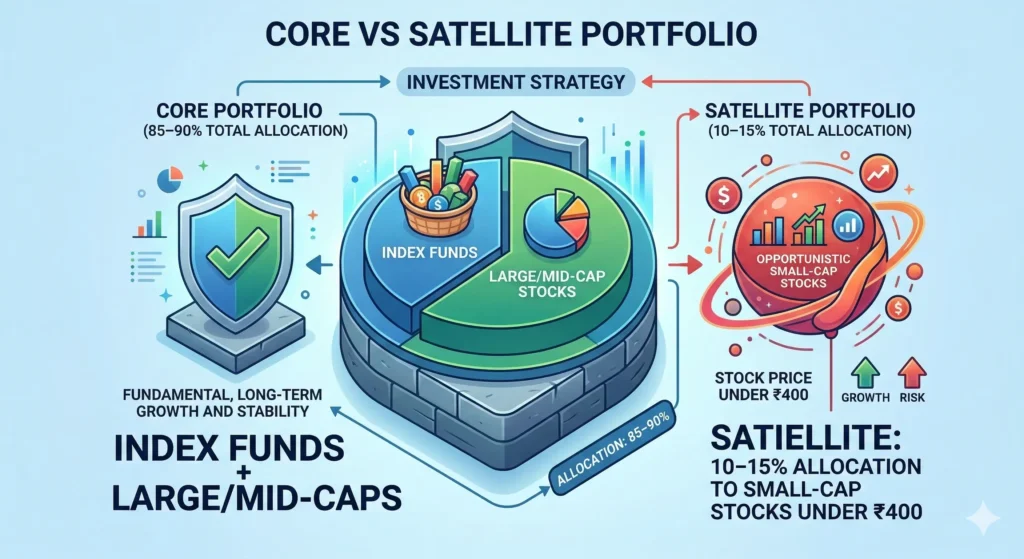
Step 2 – Start a core SIP in 1–2 broad‑market mutual funds (Nifty 50 / Nifty Next 50) as your main wealth engine.
Step 3 – Allocate only 10–15% of your equity portfolio to direct stocks like these 5 undervalued small‑caps, preferably via a monthly SIP into each stock rather than lump‑sum.
This way, searches like “where to invest 1000 rupees per month” or “invest ₹8,000/month in SIP plans” can naturally lead users from your emergency fund + SIP content to this small‑cap deep‑dive as an optional satellite strategy, not a replacement for core investing.
9. Key Risks of Small‑Cap Stocks Under ₹400
Before you or your readers get too excited about “top small cap stocks 2026 India”, you must clearly state the risks:
Higher volatility: Small‑caps can fall 30–50% in a correction even if business remains okay. Many names in small‑cap indices show this behaviour.
Lower liquidity: Getting in or out with bigger amounts may move the price, especially in thinly traded counters.
Business concentration: Companies like Shreyans (paper) or Himatsingka (home textiles) are tied to narrow product lines; a demand shock can hit profits hard.
Information gap: Unlike large caps, small‑caps have fewer analyst reports and less media coverage, so retail investors must read annual reports and results carefully.
That’s why professional research houses repeatedly warn that lists of “undervalued small‑cap stocks” are not recommendations, but starting points for further analysis.
10. FAQs – Small‑Cap & Dividend Investing for Beginners
You can use these in your FAQ section + FAQ schema.
Q1. Are small‑cap stocks under ₹400 good for beginners?
They can be part of a portfolio, but not the core. Beginners should first build an emergency fund and SIP into diversified index or large‑cap funds, then add a small allocation (10–15% of equity) to carefully researched small‑caps.
Q2. How do I find undervalued small‑cap stocks in India under 400 rupees?
Use stock screeners to filter market cap, P/E, P/B, debt‑to‑equity and return on equity, then cross‑check company news, quarterly results and management quality on trusted research sites.
Q3. Can small‑cap stocks be used for dividend‑based passive income?
Yes, some like PTC India and Shreyans Industries have paid regular dividends with modest payout ratios, but dividend stability is less predictable than in large PSU or FMCG stocks, so treat it as bonus income, not guaranteed cash flow.
Q4. What is a simple investment plan for a 25‑year‑old with ₹5,000–₹8,000 per month?
A practical split is:
60–70% into diversified equity mutual fund SIPs,
20–30% into a flexi‑cap or mid‑cap fund,
10–15% into a basket of 4–6 researched small‑cap stocks under ₹400, bought via monthly SIP.
Q5. Should I use rupee cost averaging (SIP) for small‑cap stocks too?
Yes. Rupee cost averaging through monthly SIPs into small‑caps reduces timing risk and aligns with your existing GSC terms like “rupee cost averaging example” and “rupee cost averaging benefits” that your users already search for.