
Table of Contents
- What Gig Income Actually Looks Like
- The Hidden Costs That Eat Into Earnings
- A Realistic Net Income Picture
- How Much Gig Workers Actually Manage to Save
- A Practical Savings System for Gig Income
- Tax Obligations Gig Workers Often Miss
- Common Mistakes
- Myth vs Fact
- Expert Tips
- Checklist
- FAQs
Introduction
Gig work — food delivery, ride-hailing, quick commerce delivery — gets discussed either as a desperate last resort or an easy flexible-income solution, with very little honest financial detail in between. This guide looks at the real picture: what gig workers actually earn after real costs, what typically gets saved (often less than assumed), and a practical system to save more consistently, whether gig work is your primary income or a bridge/side income.

What Gig Income Actually Looks Like
Gig platform earnings are typically structured around a mix of:
- Per-order/per-trip payouts, often with a base amount plus distance/time-based components
- Incentives for completing a target number of orders/trips within a time window (peak hour bonuses, daily/weekly targets)
- Surge/peak pricing during high-demand periods (meal times, weather events, festivals)
The critical nuance most people miss: headline “earn up to ₹X per day” figures typically represent an aggressive, peak-incentive-optimized day — hitting maximum targets during the best possible hours — not a typical or average day, and definitely not accounting for the real costs covered in the next section.
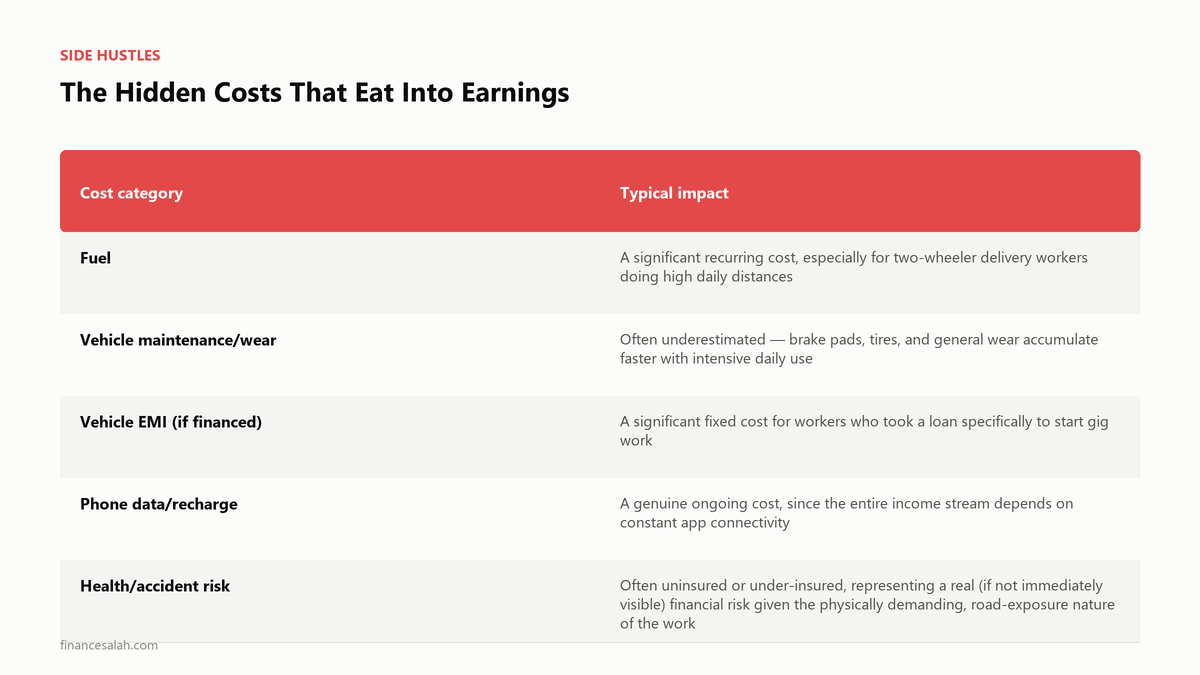
The Hidden Costs That Eat Into Earnings
This is where gross earnings and actual take-home income diverge significantly, and where most “gig income” discussions stop short of the honest picture:
| Cost category | Typical impact |
|---|---|
| Fuel | A significant recurring cost, especially for two-wheeler delivery workers doing high daily distances |
| Vehicle maintenance/wear | Often underestimated — brake pads, tires, and general wear accumulate faster with intensive daily use |
| Vehicle EMI (if financed) | A significant fixed cost for workers who took a loan specifically to start gig work |
| Phone data/recharge | A genuine ongoing cost, since the entire income stream depends on constant app connectivity |
| Health/accident risk | Often uninsured or under-insured, representing a real (if not immediately visible) financial risk given the physically demanding, road-exposure nature of the work |
| Platform commission/fees (where applicable) | Varies by platform and structure |
A realistic estimate: for two-wheeler delivery gig work specifically, these combined costs commonly consume a substantial portion of gross earnings — often in the range of 20-35% depending on distance covered, vehicle type, and fuel prices — meaning the “take-home” number that matters for savings planning is meaningfully lower than the gross figure typically advertised.
A Realistic Net Income Picture
| Scenario | Gross daily earnings (illustrative) | Approx. costs | Realistic net |
|---|---|---|---|
| Moderate daily hours, average conditions | Illustrative mid-range figure | 20-30% of gross | Meaningfully lower than headline figures suggest |
| High daily hours, incentive-optimized | Illustrative higher figure | Similar % but higher absolute cost due to more distance covered | Higher net, but at a significant time and vehicle-wear cost |
Why this table is intentionally illustrative rather than exact: actual per-order rates, incentive structures, and cost bases vary significantly by city, platform, vehicle type, and change periodically — the point isn’t a specific number, it’s the consistent principle that net income is meaningfully lower than gross, and any savings plan must be built on net, not gross, figures.
How Much Gig Workers Actually Manage to Save
Given the cost structure above, and the fact that gig income is often used to cover immediate family expenses rather than build savings, actual savings rates among gig workers tend to be low or inconsistent — not because of poor financial discipline necessarily, but because the net income margin after real costs is often thin, especially for workers relying on gig work as primary rather than supplementary income.
This is a structural reality worth naming honestly, rather than assuming gig work naturally produces meaningful savings the way a stable salary with a clear net figure might.
A Practical Savings System for Gig Income
Given thin and variable net margins, the approach needs to be realistic rather than aspirational:
- Track gross earnings AND actual costs (fuel, maintenance) for at least 2-4 weeks to find your true net income — most gig workers have never calculated this precisely, only tracking gross app-reported earnings.
- Set aside a fixed percentage of net (not gross) income daily, even if small (5-10%), directly after each significant payout, rather than trying to save from whatever’s left at week’s end.
- Prioritize a small emergency fund specifically covering vehicle repair/replacement before general savings — a breakdown that stops you from working is the single most direct threat to gig income continuity.
- Separately budget for planned vehicle maintenance (services, tire replacement) rather than treating these as unexpected costs each time — they’re predictable if tracked.
- Consider platform-specific or independent insurance options for accident/health coverage specifically relevant to the physical risk of the work, given the often-limited employer-style safety net compared to salaried employment.
Tax Obligations Gig Workers Often Miss
Gig income is genuinely taxable business/professional income in India, same as any other self-employed earnings — see our detailed guide on freelance income tax in India for beginners, which applies to this income structure too. Key points specifically relevant to gig workers:
- All gig platform income counts toward your total taxable income for the year, regardless of how informal it might feel.
- Vehicle-related costs (fuel, maintenance, depreciation) may be claimable as legitimate business expenses if you’re not using a simplified presumptive taxation approach — track these from day one rather than trying to reconstruct them at filing time.
- GST registration thresholds and rules can apply differently depending on the specific platform arrangement — this is genuinely complex and worth a specific consultation with a tax professional given the variation across platform types and states.
Common Mistakes
- Budgeting and saving based on gross app-reported earnings rather than actual net income after fuel, maintenance, and other real costs.
- Not tracking vehicle maintenance costs systematically, leading to these appearing as “surprise” expenses that derail savings plans repeatedly.
- Ignoring tax obligations because gig income feels informal or platform-mediated rather than “real” self-employment income.
- Going without any accident/health coverage given the genuinely elevated physical risk profile of delivery/ride-hailing gig work.
- Comparing personal earnings to inflated “earn up to ₹X” platform marketing figures and feeling like a personal failure when actual net income is meaningfully lower — this is a structural gap in how earnings are marketed, not usually a personal shortfall.
Myth vs Fact
| Myth | Fact |
|---|---|
| “Gig platform ‘earn up to ₹X per day’ figures represent a typical day’s take-home income.” | These figures typically represent an aggressive, incentive-optimized gross earnings day, not typical net income after real costs like fuel and maintenance. |
| “Gig income isn’t ‘real’ enough to owe tax on.” | Gig platform income is genuinely taxable business/professional income, same as any self-employed earnings, regardless of how informal or platform-mediated it feels. |
| “Vehicle maintenance costs are occasional surprises, not a regular budget item.” | For workers covering significant daily distance, maintenance costs are predictable and recurring — they should be budgeted proactively, not treated as unexpected each time. |
| “Gig workers can’t realistically build any savings given thin margins.” | It’s genuinely harder given thin net margins, but a percentage-based system tracking true net income (not gross) makes consistent, if modest, saving achievable. |
Expert Tips
- Calculate your true net income (gross minus fuel, maintenance, and other real costs) at least once, even if it’s tedious — this single number reframes every subsequent financial decision more realistically.
- Set aside a small percentage immediately after each significant payout, rather than waiting to see “what’s left” — decision fatigue and immediate needs both work against saving if it’s not automated or immediate.
- Prioritize a vehicle-specific emergency reserve early, since a breakdown directly threatens your ability to keep earning, unlike most other emergency fund use cases.
- Explore whether any government or platform-specific insurance/welfare schemes apply to your specific gig category — coverage options in this space have been expanding and vary by state and platform.
Checklist
- [ ] Track gross earnings and real costs (fuel, maintenance) for 2-4 weeks to find true net income
- [ ] Set a percentage-based savings rule tied to net income, not gross
- [ ] Build a small vehicle-repair-specific emergency reserve first
- [ ] Budget proactively for predictable vehicle maintenance, not as surprise expenses
- [ ] Check accident/health insurance options relevant to gig work specifically
- [ ] Track gig income for tax purposes from day one
- [ ] Reassess your true net income periodically as fuel prices and platform structures change
Frequently Asked Questions
Q: How much do Swiggy, Zomato, or Uber gig workers actually take home after costs?
A: Meaningfully less than gross app-reported earnings — fuel, vehicle maintenance, and related costs commonly consume a substantial portion (often 20-35% for two-wheeler delivery work) of gross earnings, so realistic savings planning must be based on actual net income, not headline gross figures.
Q: Do gig workers in India need to pay income tax?
A: Yes — gig platform income is genuinely taxable business/professional income, same as any self-employed earnings, and is added to your total income for tax calculation purposes. See our freelance income tax guide for beginners.
Q: Why do “earn up to ₹X per day” platform figures feel unrealistic?
A: These figures typically represent an aggressive, incentive-optimized gross earnings scenario during peak hours, not typical net take-home income after accounting for fuel, maintenance, and other real costs.
Q: How can a gig worker with variable income still build savings?
A: By tracking true net income (not gross), setting aside a fixed percentage immediately after each payout rather than at the end of the week, and prioritizing a vehicle-specific emergency reserve given how directly a breakdown threatens continued earning.
Q: Should gig workers get separate health or accident insurance?
A: Given the genuinely elevated physical risk profile of delivery and ride-hailing work and often-limited employer-style safety nets, evaluating dedicated accident/health coverage — including any platform-specific or government scheme options — is a reasonable and often under-considered priority.
Conclusion
Gig economy income in India is real, taxable income with genuine costs that are frequently underestimated in how the work is marketed and discussed. Building meaningful savings as a gig worker starts with knowing your true net income (not gross), prioritizing a vehicle-specific safety net given how directly your earning ability depends on your vehicle, and treating tax obligations as seriously as any other form of self-employment.
Track your actual gross earnings and real costs for the next two weeks to calculate your true net income — this single number changes how every other financial decision should be made. And once you’ve got that number, FinanceSalah’s guide on building an emergency fund with irregular income covers what to do with it next.
Sources & Further Reading
- Income Tax Department e-Filing Portal — tax treatment of gig platform income
- Ministry of Labour and Employment — evolving policy discussion on gig and platform worker welfare
- Goods and Services Tax Portal — GST rules relevant to certain platform-based earnings
Related Reading
- Freelance Income Tax in India for Beginners
- Side Income Ideas for Salaried Employees in India
- How to Build an Emergency Fund With Irregular Freelance Income
- Government Schemes for Unemployed Graduates in India
- Passive Income Ideas in India With ₹10,000
This article is for general educational purposes and does not constitute personalized financial or tax advice. Gig platform earnings, incentive structures, and costs vary significantly by city, platform, and vehicle type, and change periodically — figures presented here are illustrative, not specific projections.