
Table of Contents
- Week 1: Stabilize
- Week 2: Assess and Plan
- Week 3: Start Rebuilding Income
- Week 4: Review and Adjust
- Documents You’ll Need Throughout
- Common Mistakes
- Myth vs Fact
- Expert Tips
- 30-Day Checklist
- FAQs
Introduction
The first 30 days after a layoff feel chaotic precisely because there’s no clear structure to follow — everything feels urgent at once. This guide breaks those 30 days into four distinct weeks, each with a specific financial focus, so you’re not trying to do everything at the same time, in a panic.
Week 1: Stabilize
The goal of week one is purely defensive — protect what you have, don’t create new problems, and get accurate information.
- Get your Full & Final (F&F) settlement details in writing from HR — notice pay, gratuity (if eligible), leave encashment, and any severance, itemized clearly.
- Confirm your health insurance transition timeline — when exactly does employer-provided cover end, and what’s the conversion window to an individual policy without fresh medical underwriting?
- List every recurring financial commitment — EMIs, SIPs, insurance premiums, subscriptions — with exact amounts and dates.
- Calculate your true runway (liquid assets ÷ essential monthly expenses) — see our detailed guide on surviving financially after losing your job to AI for the exact method.
- Pause, don’t cancel, discretionary spending and non-emergency SIPs.
- Do not make any major financial decision this week — no EPF withdrawal, no personal loan, no breaking long-term investments in a panic.
Week 2: Assess and Plan
By week two, the initial shock has usually settled enough to plan deliberately rather than react.
- Contact every lender proactively if your runway suggests you might struggle with upcoming EMIs — ask specifically about moratorium or restructuring options before you miss a payment.
- Decide your job search strategy: target role/salary range, timeline before considering a lower-paying bridge role, and which industries/companies to prioritize.
- Update your LinkedIn, resume, and portfolio with your most recent, quantified achievements — do this deliberately, not as an afterthought.
- Check eligibility for any relevant government schemes — see our guide on government schemes for unemployed graduates in India, which also covers general job-matching and skilling resources useful beyond just fresh graduates.
- Decide on your health insurance path — convert your group policy, or purchase a new individual policy, based on the timeline you confirmed in week one.
Week 3: Start Rebuilding Income
Week three is when passive job-searching should turn into active income-rebuilding, on two parallel tracks.
- Apply actively and consistently — treat the job search itself like a structured daily task with specific targets (a set number of applications, follow-ups, networking conversations per day), not an open-ended activity.
- Start one bridge income source — freelancing in your existing skill area, consulting, or gig work — see our detailed guide on side income ideas for salaried employees (the same options generally apply, just at higher time-availability now).
- Reach out to your professional network directly, not just passively updating your LinkedIn status — direct, specific asks (“do you know of any openings in X”) generally outperform a general “I’m looking” post.
- Track your job search and bridge-income activity together in one place — applications sent, responses received, bridge income earned — so you can see real progress, not just effort.
Week 4: Review and Adjust
By the end of the first month, you have enough real data to make an honest assessment rather than guessing.
- Recalculate your runway using actual spending from the past month, not your original estimate — most people find their real burn rate differs from their initial guess.
- Assess your job search response rate honestly. If you’re getting few or no responses after genuinely consistent effort, this is useful information — it may mean adjusting your target role, salary expectations, or approach, not just “trying harder” at the same approach.
- Decide whether your bridge income needs to scale up (more hours, higher rates) if the job search is taking longer than initially hoped.
- Revisit your survival budget — is it sustainable for another 30, 60, 90 days at the current burn rate, or does it need further adjustment?
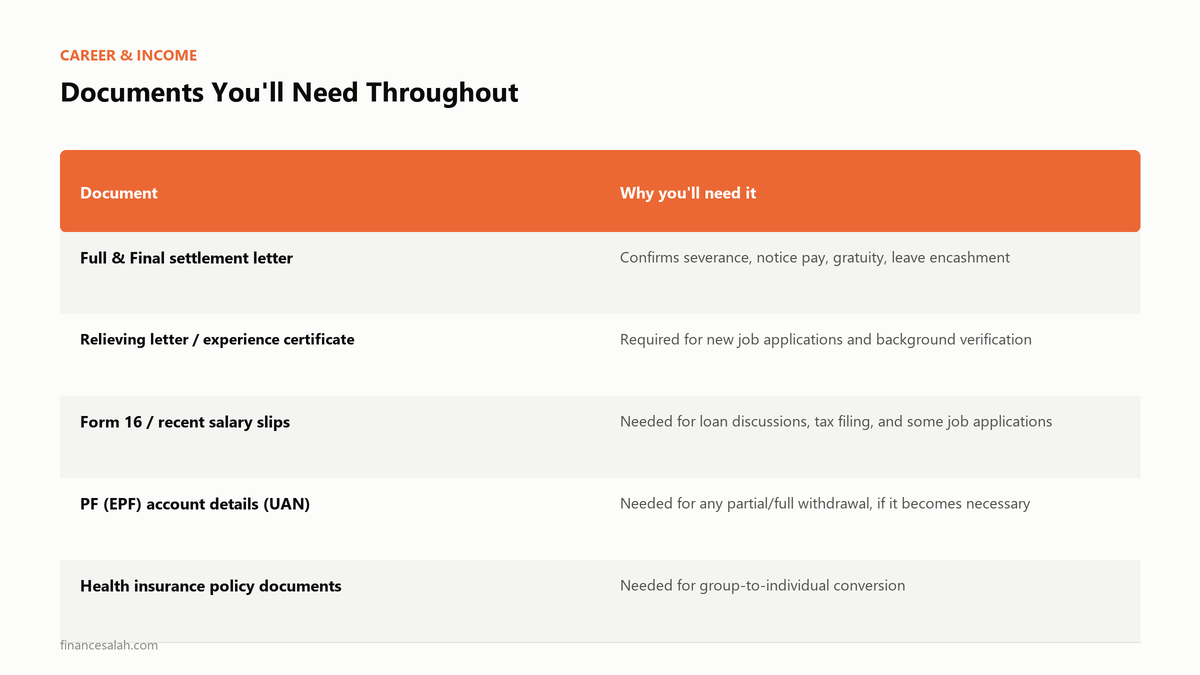
Documents You’ll Need Throughout
Keep these organized and accessible from day one — you’ll need them repeatedly across the month for settlements, insurance, loan conversations, and job applications:
| Document | Why you’ll need it |
|---|---|
| Full & Final settlement letter | Confirms severance, notice pay, gratuity, leave encashment |
| Relieving letter / experience certificate | Required for new job applications and background verification |
| Form 16 / recent salary slips | Needed for loan discussions, tax filing, and some job applications |
| PF (EPF) account details (UAN) | Needed for any partial/full withdrawal, if it becomes necessary |
| Health insurance policy documents | Needed for group-to-individual conversion |
| Bank statements | Needed to calculate your true runway and for any loan restructuring conversation |
Common Mistakes
- Trying to solve everything in week one — settlement, job search, side income, budget — instead of following a staged approach that reduces overwhelm.
- Delaying the health insurance decision because “there’s time” — conversion windows are often shorter than people assume (commonly 30-45 days from group policy end).
- Not tracking actual spending during the month, relying only on the original runway estimate, which is often inaccurate once real data comes in.
- Waiting until week 3-4 to start any bridge income activity, losing valuable weeks of potential earnings.
- Comparing your timeline to someone else’s layoff-to-reemployment story rather than tracking your own specific data (response rates, runway, bridge income) to make decisions.
Myth vs Fact
| Myth | Fact |
|---|---|
| “I should figure out my next job before worrying about anything else.” | Health insurance continuity and runway calculation are time-sensitive in week one specifically — delaying these for the job search alone creates avoidable risk. |
| “Bridge income isn’t worth pursuing since I’ll have a new job soon.” | Starting bridge income by week 2-3 provides real financial cushion regardless of how long the search takes, and costs little to start alongside job applications. |
| “A 30-day plan means I should have a new job within 30 days.” | The 30-day plan is about structuring your ACTIONS across the month, not promising a specific reemployment timeline, which varies significantly by role, industry, and market conditions. |
| “Contacting lenders about EMI difficulty will hurt my credit score.” | Proactively requesting moratorium/restructuring options is generally viewed very differently from missing a payment silently — it’s a normal, available conversation, not a credit-damaging one by itself. |
Expert Tips
- Set specific, measurable weekly goals (applications sent, networking conversations had, bridge-income hours worked) rather than vague daily to-do lists — measurable goals make week 4’s honest assessment actually possible.
- Tell your close network the real situation early, specifically and directly, rather than a vague “exploring options” message — specific asks get specific help.
- Batch financial admin tasks (settlement follow-ups, insurance calls, lender conversations) into dedicated blocks rather than letting them interrupt job search time throughout the day.
- Revisit this 30-day structure again for the next 30 days if the search continues — the weekly-focus approach remains useful beyond just the first month.
30-Day Checklist
- [ ] Get F&F settlement details in writing (Week 1)
- [ ] Confirm health insurance transition timeline (Week 1)
- [ ] Calculate true runway and pause discretionary spending (Week 1)
- [ ] Contact lenders proactively if needed (Week 2)
- [ ] Define job search strategy and update resume/LinkedIn (Week 2)
- [ ] Convert or purchase health insurance (Week 2)
- [ ] Start structured, daily job applications (Week 3)
- [ ] Begin one bridge income source (Week 3)
- [ ] Reach out directly to professional network (Week 3)
- [ ] Recalculate runway with real spending data (Week 4)
- [ ] Honestly assess job search response rate and adjust approach (Week 4)
Frequently Asked Questions
Q: What’s the very first thing I should do after being laid off in India?
A: Get your Full & Final settlement details in writing from HR and confirm your health insurance transition timeline — both are time-sensitive and should be addressed in the first few days, before anything else.
Q: Should I start freelancing or gig work immediately after a layoff, or focus only on job search?
A: Starting a bridge income source by week 2-3 alongside your job search is generally recommended — it provides real financial cushion regardless of how long the search takes and doesn’t meaningfully slow down a well-structured job search.
Q: How do I know if my job search approach needs to change?
A: After roughly 3-4 weeks of consistent, genuine effort, honestly review your response rate. A very low response rate despite real effort is useful information suggesting an adjustment to target roles, salary expectations, or application approach — not just “trying harder” at the same approach.
Q: What happens to my health insurance after a layoff?
A: Employer-provided group health cover typically ends on your last working day or shortly after. Most insurers offer a conversion window (commonly 30-45 days) to move to an individual policy without fresh medical underwriting — confirm your specific timeline immediately, as this window can be shorter than expected.
Q: Should I tell my professional network about my layoff?
A: Yes, and specifically rather than vaguely — a direct message asking about openings in a specific role/industry generally gets more useful responses than a general “I’m looking for opportunities” post.
Conclusion
The first 30 days after a layoff feel overwhelming mainly because everything seems urgent simultaneously. Structuring the month into four distinct weekly focuses — stabilize, assess and plan, rebuild income, review and adjust — turns an overwhelming period into a manageable, staged process with clear, honest checkpoints.
If you’re in week one right now, start with the single most time-sensitive item — confirming your health insurance transition timeline — today. And for the broader financial picture beyond just this month, FinanceSalah’s guides on emergency fund sizing and severance negotiation cover what comes next.
Sources & Further Reading
- EPFO Member Portal — official EPF withdrawal rules
- IRDAI — group-to-individual health insurance conversion rules
- National Career Service Portal — job-matching and skilling resources
- Income Tax Department e-Filing Portal — Form 16 and settlement-related tax context
Related Reading
- How to Survive Financially After Losing Your Job to AI
- How Many Months’ Emergency Fund for an IT Layoff
- How to Negotiate a Severance Package After Layoff in India
- Side Income Ideas for Salaried Employees in India
- Government Schemes for Unemployed Graduates in India
This article is for general educational purposes and does not constitute personalized financial, legal, or career advice. Individual layoff circumstances, company policies, and job market conditions vary significantly.