
Table of Contents
- Why the Standard Emergency Fund Advice Fails Freelancers
- Step 1: Find Your Baseline Income
- Step 2: Separate “Living On” Income From “Extra” Income
- Step 3: Set a Realistic, Larger Target
- A Percentage-Based Savings System That Actually Works
- Where to Keep This Money
- Common Mistakes
- Myth vs Fact
- Expert Tips
- Checklist
- FAQs
Introduction
Standard emergency fund advice assumes a predictable monthly salary — “save a fixed amount every month until you hit your target.” That falls apart the moment your income is ₹80,000 one month and ₹15,000 the next. This guide is a system built specifically for that reality: a variable-income structure, not a fixed one.
Why the Standard Emergency Fund Advice Fails Freelancers
Fixed monthly savings targets assume two things that don’t hold for freelance income: predictable timing and predictable amount. Freelancers face both income timing risk (a client pays late) and income amount risk (a slow month with fewer projects) simultaneously — which is exactly why freelancers arguably need an emergency fund more urgently than salaried employees, even though building one is structurally harder.
Step 1: Find Your Baseline Income
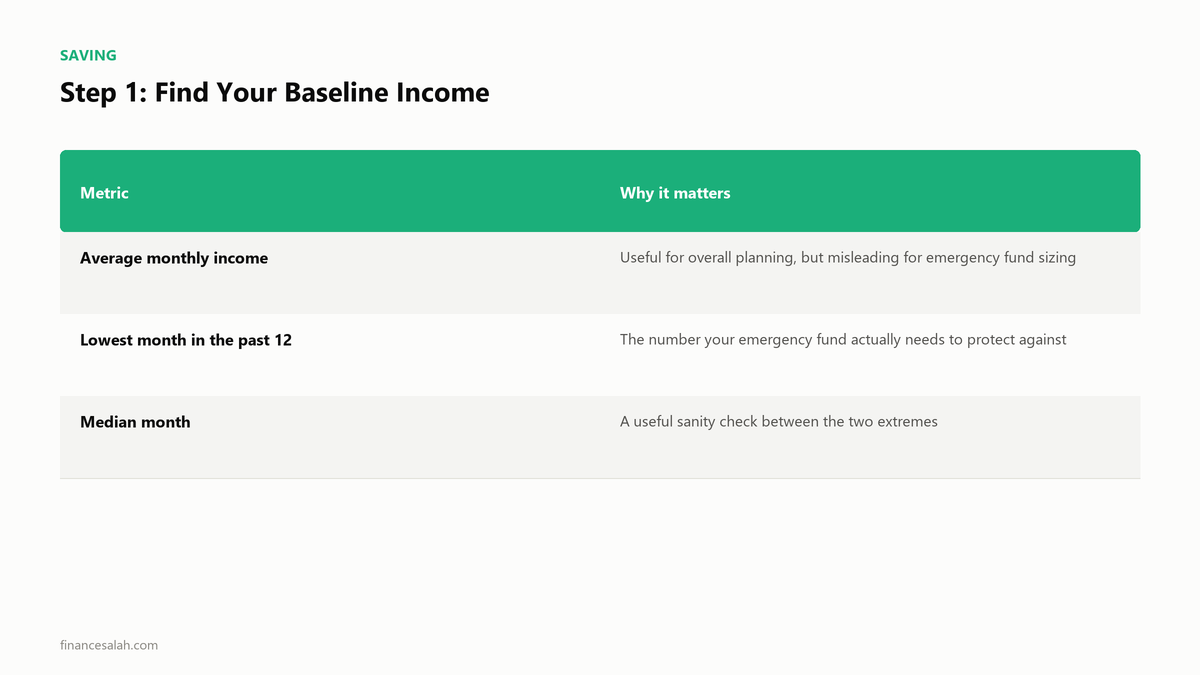
Look at your last 12 months of freelance income (or as many months as you have if you’re newer) and identify your lowest-earning months, not your average. Your baseline should be based on a realistically low month, not your best month or even your typical month.
| Metric | Why it matters |
|---|---|
| Average monthly income | Useful for overall planning, but misleading for emergency fund sizing |
| Lowest month in the past 12 | The number your emergency fund actually needs to protect against |
| Median month | A useful sanity check between the two extremes |
Practical approach if you’re newer to freelancing (less than 12 months of data): use your lowest month so far, and revisit this calculation every quarter as you build more data.
Step 2: Separate “Living On” Income From “Extra” Income
This is the core system: you don’t save “whatever’s left” — you decide upfront which income is for living expenses and which is for saving, based on your baseline, not your actual monthly total.
- Calculate your essential monthly expenses (rent, food, utilities, insurance, minimum debt payments).
- If your baseline (lowest) month covers these expenses, great — your system just needs the percentage-based approach below layered on top.
- If your baseline month does NOT cover these expenses, this is critical information: it means your current freelance income isn’t yet stable enough to rely on exclusively, and either your expenses need to come down, your income needs a floor-raising strategy (a retainer client, part-time stable income alongside freelancing), or both — before an emergency fund conversation even makes sense.
Step 3: Set a Realistic, Larger Target
Freelancers should generally target a larger emergency fund than salaried employees — where a salaried employee might aim for 6 months, a freelancer with genuinely variable income should consider 9-12 months of essential expenses, given:
- No employer notice period or severance to bridge a gap
- Income variability itself creates ongoing “mini emergencies” (a slow quarter) that a salaried employee simply doesn’t face
- Client concentration risk — losing one or two major clients can meaningfully affect income for months
A Percentage-Based Savings System That Actually Works
Instead of a fixed rupee amount each month, save a fixed percentage of every payment received, regardless of the payment’s size:
| Income tier this month | Suggested allocation |
|---|---|
| Below baseline (a slow month) | 0-5% to savings — prioritize covering essentials first |
| At or slightly above baseline | 10-15% to savings |
| Well above baseline (a strong month) | 25-40% to savings — strong months are exactly when the fund grows fastest |
This system self-corrects for income variability automatically: slow months naturally save less (or nothing), and strong months do the heavy lifting for your emergency fund target — which matches the actual shape of freelance income far better than a fixed monthly number.
Where to Keep This Money
Given the added instability of freelance income (see our related guide on freelance income tax in India for beginners for the tax-specific savings account concept), consider a three-account structure:
- Operating account — where all client payments land initially
- Tax reserve account — 25-30% of every payment moved here immediately (see the freelance tax guide above)
- Emergency fund account — a separate liquid fund or sweep-in FD, fed by the percentage-based system above
Keeping these separate, even though it feels like extra admin, prevents the single most common freelancer money mistake: treating a strong month’s full payment as available spending money before taxes and savings are accounted for.
Common Mistakes
- Basing the emergency fund target on average income instead of the lowest realistic month — this understates how much protection is actually needed.
- Saving a fixed rupee amount regardless of the month’s income, which either becomes impossible in slow months or under-saves in strong months.
- Mixing tax reserves and emergency fund savings into one account, making it unclear how much is actually available for either purpose when needed.
- Treating a single large client payment as “extra” spending money rather than applying the percentage-based savings rule consistently regardless of payment size.
- Not revisiting the baseline calculation periodically as your freelance business matures and income patterns change.
Myth vs Fact
| Myth | Fact |
|---|---|
| “Freelancers can’t really build an emergency fund because income is too unpredictable.” | Unpredictable income actually makes a percentage-based (not fixed-amount) savings system more effective, not impossible — the system just needs to match the income pattern. |
| “6 months is enough for a freelancer, same as a salaried employee.” | Freelancers generally benefit from a larger target (9-12 months) given the absence of severance/notice period and the added instability of variable income. |
| “I should wait until my income is stable before starting to save.” | Starting the percentage-based system immediately, even saving 0% in slow months, builds the habit and captures strong months as they come, rather than waiting indefinitely for “stability” that may take years to arrive. |
Expert Tips
- Automate the percentage transfer the moment a payment clears, rather than deciding manually each time — decision fatigue is a major reason freelancers under-save even with good intentions.
- Revisit your baseline every quarter, not just once a year — freelance income patterns can shift meaningfully within months as your client base evolves.
- Treat a retainer or recurring client relationship as a priority even at a slightly lower rate than project-based work — the income stability itself has real value beyond the headline rate.
- Build the tax reserve and emergency fund simultaneously, not sequentially — treating them as separate, parallel priorities from day one avoids a painful catch-up later.
Checklist
- [ ] Review the past 12 months of freelance income and identify your lowest month
- [ ] Confirm your baseline month covers essential expenses (if not, address income/expense stability first)
- [ ] Set a target of 9-12 months of essential expenses for your emergency fund
- [ ] Set up a percentage-based savings system tied to each payment’s size, not a fixed monthly amount
- [ ] Open separate operating, tax reserve, and emergency fund accounts
- [ ] Automate the percentage transfer on every payment received
- [ ] Revisit your baseline and targets every quarter
Frequently Asked Questions
Q: How much emergency fund should a freelancer in India have?
A: Generally 9-12 months of essential expenses, higher than the typical 6-month guidance for salaried employees, given the lack of severance/notice period and the added instability of variable income.
Q: How do I save consistently if my freelance income changes every month?
A: Use a percentage-based savings system tied to each payment’s size (saving a higher percentage in strong months, less or nothing in slow months) rather than a fixed monthly rupee target, which doesn’t match variable income patterns.
Q: Should I calculate my emergency fund target based on my average monthly income?
A: No — base your essential expense coverage on your lowest realistic month from the past 12 months, not your average, since the emergency fund’s job is to protect against the worst realistic scenario, not the typical one.
Q: Where should a freelancer keep their emergency fund?
A: In a separate, liquid account from both your operating income and your tax reserve — typically a liquid mutual fund or sweep-in fixed deposit, kept distinctly separate from day-to-day spending money.
Q: What if my lowest-earning month doesn’t even cover my essential expenses?
A: This is important information before an emergency fund conversation makes full sense — it may mean you need to reduce essential expenses, build more income stability (e.g., a retainer client or part-time stable income), or both, before the standard percentage-based savings system becomes realistic.
Conclusion
An emergency fund is arguably more important for freelancers than for salaried employees, precisely because it’s structurally harder to build with variable income. The fix isn’t willpower — it’s a system that matches the actual shape of freelance income: a percentage-based savings rule tied to each payment, a larger target (9-12 months), and separate accounts that keep taxes, savings, and spending from blurring together.
Pull up your last 12 months of freelance income today and identify your actual lowest-earning month — that number, not your average, is your real starting point. And once your emergency fund system is running, FinanceSalah’s guide on freelance income tax will help you get the rest of your money admin in order too.
Sources & Further Reading
- Income Tax Department e-Filing Portal — advance tax and TDS reconciliation for freelance income
- SEBI Investor Education — guidance on liquid funds and mutual fund basics
Related Reading
- Freelance Income Tax in India for Beginners
- Emergency Fund Calculator for Young Indians
- Side Income Ideas for Salaried Employees in India
- How Many Months’ Emergency Fund for an IT Layoff
- How to Survive Financially After Losing Your Job to AI
This article is for general educational purposes and does not constitute personalized financial advice. Every freelancer’s income pattern and expenses differ — adjust the framework above to your specific situation.