
Table of Contents
- The Wrong Way to Think About “AI-Proof” Skills
- The Four Categories of Genuinely Durable Skills
- Skills by Career Stage
- How to Actually Build These Skills Alongside a Full-Time Job
- Should You Learn to Use AI Instead of Fearing It?
- Common Mistakes
- Myth vs Fact
- Expert Tips
- Checklist
- FAQs
Introduction
The honest answer to “which skills are completely AI-proof” is: none, permanently. That’s the wrong question to be asking. The right one is which skills are hardest to automate right now and in the near-to-medium term, and which give you the most leverage even as AI tools keep improving. This guide sticks to that practical, realistic version — specific skill categories, how to prioritize them by career stage, and how to actually build them while you’re still working full-time.
The Wrong Way to Think About “AI-Proof” Skills
A lot of “future-proof careers” content treats this as a binary — “creative jobs are safe, repetitive jobs aren’t” — which is too simplistic. AI tools are increasingly capable in creative domains (writing, basic design) too. The more useful framing is:
Tasks that combine judgment, context, relationship, and accountability in ambiguous situations are harder to automate than tasks that are pattern-based, repetitive, or rules-based — regardless of which industry they sit in.
This is why a senior client-relationship manager and a specialized surgical nurse are both relatively durable roles despite being in completely different industries, while both entry-level content writing and basic manual QA testing are both exposed, again despite being in different industries.
The Four Categories of Genuinely Durable Skills
1. Judgment Under Ambiguity
Tasks requiring a decision when the “right answer” isn’t clearly defined by existing data or rules — complex negotiation, strategic prioritization, ethical/legal judgment calls, crisis management. AI tools can support these decisions with information, but the accountability and final judgment remain human for the foreseeable future.
2. Deep Human Relationship and Trust
Roles where the value is substantially about trust built over time — therapy and counselling, senior sales relationships, healthcare provider-patient relationships, high-stakes advisory roles (legal, financial, medical). Even where AI tools assist heavily behind the scenes, the human relationship itself remains the product.
3. Physical Dexterity in Unstructured Environments
Skilled trades and hands-on work in unpredictable physical environments (electricians, plumbers, specialized technicians, healthcare hands-on care) remain significantly harder and more expensive to automate than most white-collar, computer-based tasks, contrary to older assumptions that physical work was more “at risk” than office work.
4. Cross-Domain Integration and Systems Thinking
The ability to connect insights across multiple domains and translate them into a coherent strategy — this is where “AI + human” combinations tend to outperform either alone, and it’s a skill that compounds with broad experience rather than a single narrow specialization.
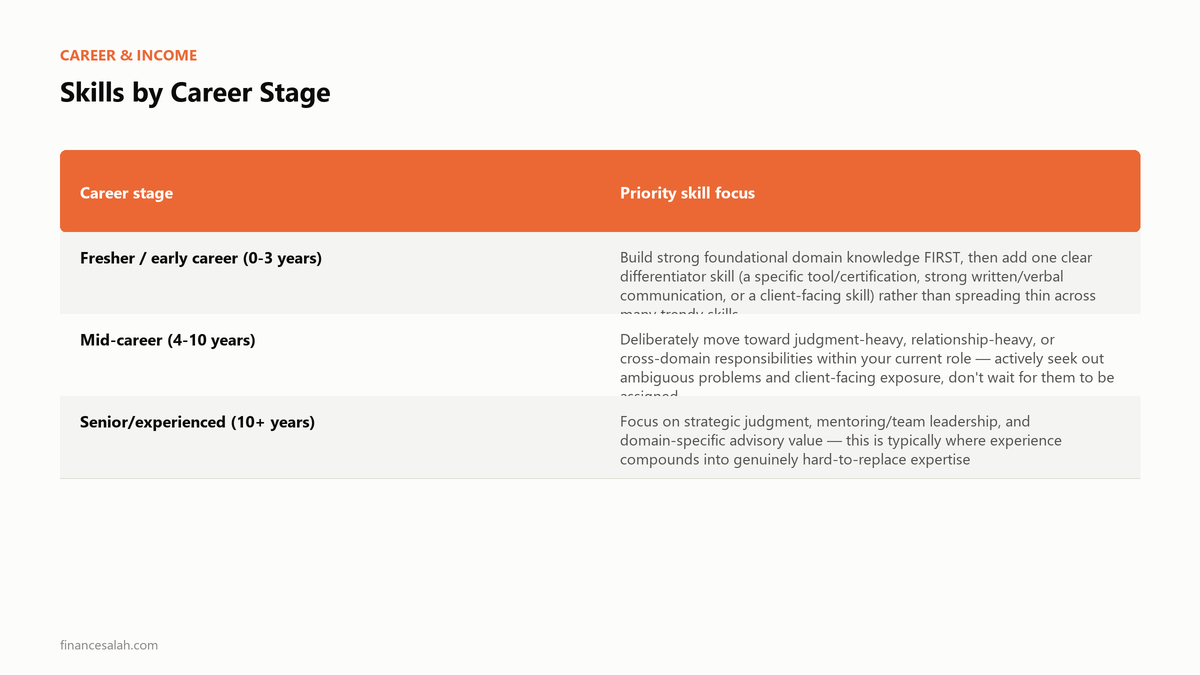
Skills by Career Stage
| Career stage | Priority skill focus |
|---|---|
| Fresher / early career (0-3 years) | Build strong foundational domain knowledge FIRST, then add one clear differentiator skill (a specific tool/certification, strong written/verbal communication, or a client-facing skill) rather than spreading thin across many trendy skills |
| Mid-career (4-10 years) | Deliberately move toward judgment-heavy, relationship-heavy, or cross-domain responsibilities within your current role — actively seek out ambiguous problems and client-facing exposure, don’t wait for them to be assigned |
| Senior/experienced (10+ years) | Focus on strategic judgment, mentoring/team leadership, and domain-specific advisory value — this is typically where experience compounds into genuinely hard-to-replace expertise |
How to Actually Build These Skills Alongside a Full-Time Job
- Volunteer for ambiguous, judgment-heavy tasks at work rather than only the clearly-defined ones — this is often free, immediately available skill-building that doesn’t require an external course.
- Seek client-facing or cross-team exposure deliberately, even in a support role — relationship and communication skills compound with genuine practice, not passive learning.
- Pick one focused certification or skill course at a time, directly tied to a near-term application at work or in a side project, rather than accumulating unused certificates.
- Practice explaining complex things simply — this single communication skill underlies judgment-heavy, relationship-heavy, and cross-domain work across almost every field.
- Use government and low-cost skilling resources where relevant — see our guide on government schemes for unemployed graduates in India for skilling programs that may apply even if you’re currently employed and looking to add a certification.
Should You Learn to Use AI Instead of Fearing It?
Yes, and this deserves direct emphasis: the most durable position in most fields right now isn’t “resisting AI,” it’s “being the person who directs AI tools most effectively within their domain expertise.” A financial analyst who can prompt and verify AI-generated analysis efficiently, catching its errors and adding real judgment, is more valuable than one who ignores the tools entirely — and more durable than one who blindly trusts AI output without applying judgment.
Practical starting point: spend a few hours actually using the AI tools relevant to your field (whatever they are for your specific domain), understanding both their genuine capabilities and their common failure patterns — this hands-on understanding is itself becoming a baseline professional skill, not an optional add-on.
Common Mistakes
- Trying to learn a completely unrelated “safe” field from scratch without leveraging existing domain experience — a slower, harder path than building durable skills adjacent to what you already know.
- Collecting certifications without applying them to real work or projects — unused certificates add little real durability compared to demonstrated, applied skill.
- Ignoring AI tools out of principle or fear rather than learning to use them effectively within your domain — this is often the actual risk, not the tools themselves.
- Waiting for an employer to assign judgment-heavy or client-facing work rather than proactively seeking it out.
- Treating this as a one-time fix (“I did a course, I’m safe now”) rather than an ongoing habit of skill development as tools and job requirements continue to evolve.
Myth vs Fact
| Myth | Fact |
|---|---|
| “Creative jobs are completely safe from AI; only repetitive jobs are at risk.” | AI tools are increasingly capable in creative domains too — durability depends more on judgment, relationship, and ambiguity-handling than on the industry or “creativity” label itself. |
| “Learning to code guarantees a future-proof career.” | Entry-level and boilerplate coding tasks are themselves increasingly automatable — the durable version of technical skill is architecture, judgment, and complex problem-solving, not routine implementation alone. |
| “I need a completely new career to be safe from AI.” | Often, deliberately shifting toward more judgment-heavy, relationship-heavy responsibilities within your existing field is more achievable and effective than starting over entirely. |
| “Avoiding AI tools protects my job.” | Learning to use AI tools effectively within your domain is increasingly a baseline professional skill — avoidance is often the bigger long-term risk, not the tools themselves. |
Expert Tips
- Audit your current role for automatable vs durable tasks honestly — most roles are a mix, and the goal is deliberately shifting your time toward the durable portion over time, not assuming your whole role is either completely safe or completely at risk.
- Build a specific, visible track record in one durable skill area (a documented client relationship success, a complex judgment call that worked out, a cross-team project you led) rather than a vague claim of “adaptability.”
- Learn the AI tools relevant to your specific field hands-on, not just conceptually — practical fluency with common failure patterns is what actually differentiates you.
- Revisit this skills audit annually, since which tasks are “durable” continues to shift as AI capabilities evolve.
Checklist
- [ ] Honestly audit your current role’s tasks: automatable vs judgment/relationship-heavy
- [ ] Identify one durable skill category (judgment, relationship, physical/unstructured, cross-domain) most relevant to your field
- [ ] Volunteer for one ambiguous or client-facing task at work in the next month
- [ ] Pick one focused certification/course tied to a near-term application, not a random trending skill
- [ ] Spend hands-on time learning the AI tools relevant to your specific domain
- [ ] Document a specific track record in your chosen durable skill area
- [ ] Revisit this audit annually
Frequently Asked Questions
Q: Which skills are completely safe from AI automation?
A: No skill is permanently and completely safe, since AI capabilities continue to evolve — but skills involving judgment under ambiguity, deep human relationships/trust, physical dexterity in unstructured environments, and cross-domain integration remain significantly harder to automate right now and in the near-to-medium term.
Q: Should I switch careers entirely to avoid AI job loss?
A: Not necessarily — for most people, deliberately shifting toward more judgment-heavy, relationship-heavy, or cross-domain responsibilities within their existing field is more achievable and often just as effective as starting an entirely new career.
Q: Is learning to code still a good AI-proofing strategy?
A: Basic and boilerplate coding tasks are themselves increasingly automatable — the more durable technical skill is complex architecture, judgment-heavy problem-solving, and system design, not routine implementation coding alone.
Q: Should I learn to use AI tools, or avoid them to protect my job?
A: Learning to use AI tools effectively within your specific domain — including understanding their common failure patterns — is increasingly a baseline professional skill. Avoiding them entirely is often a bigger long-term risk than engaging with them.
Q: How often should I reassess which skills are “durable” against AI automation?
A: At least annually, since AI capabilities and job requirements continue to shift — a skills audit done once and never revisited can become outdated within a couple of years.
Conclusion
There’s no permanent list of “AI-proof” skills, but there is a clear, practical direction: build judgment, relationships, and cross-domain thinking within your existing field, learn to use AI tools effectively rather than avoiding them, and treat this as an ongoing habit rather than a one-time fix. The goal isn’t finding a career AI will never touch — it’s continuously building the parts of your value that stay hardest to replace.
Honestly audit your current role’s tasks this week — which parts are automatable, and which require real judgment or relationship — and pick one durable skill to deliberately build over the next quarter. If the picture looks concerning, FinanceSalah’s guide on surviving an AI-driven job loss is worth bookmarking too, just in case.
Sources & Further Reading
- Skill India — official skilling and certification programs relevant to reskilling
- National Career Service Portal — career counselling and job-matching resources
- Ministry of Labour and Employment — labour market policy context
Related Reading
- How to Survive Financially After Losing Your Job to AI
- Government Schemes for Unemployed Graduates in India
- Is Moonlighting Legal for Salaried Employees in India?
- How to Negotiate a Salary Hike in India After Your Appraisal
- Side Income Ideas for Salaried Employees in India
This article is for general educational purposes and reflects general career trends, not a guarantee about any specific role or industry’s future. AI capabilities and job market conditions continue to evolve, and individual outcomes vary based on role, company, and market.