
Table of Contents
- Why This Information Is So Hard to Find
- Skilling and Training Schemes
- Self-Employment and Startup Loan Schemes
- Job Search and Placement Support
- State-Level Schemes (Why You Should Check Separately)
- How to Actually Apply: A Step-by-Step Approach
- Common Mistakes
- Myth vs Fact
- Expert Tips
- Checklist
- FAQs
Introduction
If you’ve graduated and are struggling to find a job, you’ve probably already searched “government help for unemployed graduates in India” and come up with either nothing specific or a confusing scatter of scheme names with no clear next step. This guide organizes what’s actually available — skilling programs, self-employment loans, and job-matching platforms — with a practical approach to actually applying, not just a list of names.
Important caveat up front: government scheme names, eligibility criteria, and application processes change periodically, and some schemes vary by state. This guide gives you the categories and starting points to search from — always verify current details on the official scheme website or your nearest government employment exchange/Common Service Centre before relying on any specific detail here.
Why This Information Is So Hard to Find
Three structural reasons this is genuinely underserved content:
- Schemes are split across central and state governments, each with separate portals, so no single “unemployed graduate” search surfaces everything relevant to your specific state.
- Scheme names change or get relaunched under new branding periodically, making older search results and articles outdated.
- Most schemes are designed for specific categories (women, SC/ST/OBC, specific age brackets, specific sectors) rather than “graduates” as a blanket category, so a general graduate has to identify which specific scheme categories actually apply to them.
Skilling and Training Schemes
These focus on building job-ready skills, often with a stipend or free training component.
- Skill development and training programs under the broader “Skill India” umbrella — typically offer free or subsidized short-term training in specific trades and sectors, sometimes with a certification and placement assistance component. Search for the current scheme name and your state’s implementation on the official Skill India portal.
- Sector-specific skill councils — many industries (IT, retail, healthcare, BFSI) have dedicated Sector Skill Councils offering certification programs recognized by employers in that specific industry.
- State-level skill missions — most states run their own skill development missions with region-specific training centers; these are often more accessible (shorter waitlists, local language training) than national-level programs.
Why this matters for a graduate specifically: many skilling programs assume you’re targeting a vocational/trade role, which may feel like a step back for a degree holder — but a recognized short-term certification in a specific in-demand skill (data entry, basic IT support, specific software tools, digital marketing basics) can meaningfully shorten your job search compared to a generic degree with no specific verifiable skill certification.
Self-Employment and Startup Loan Schemes
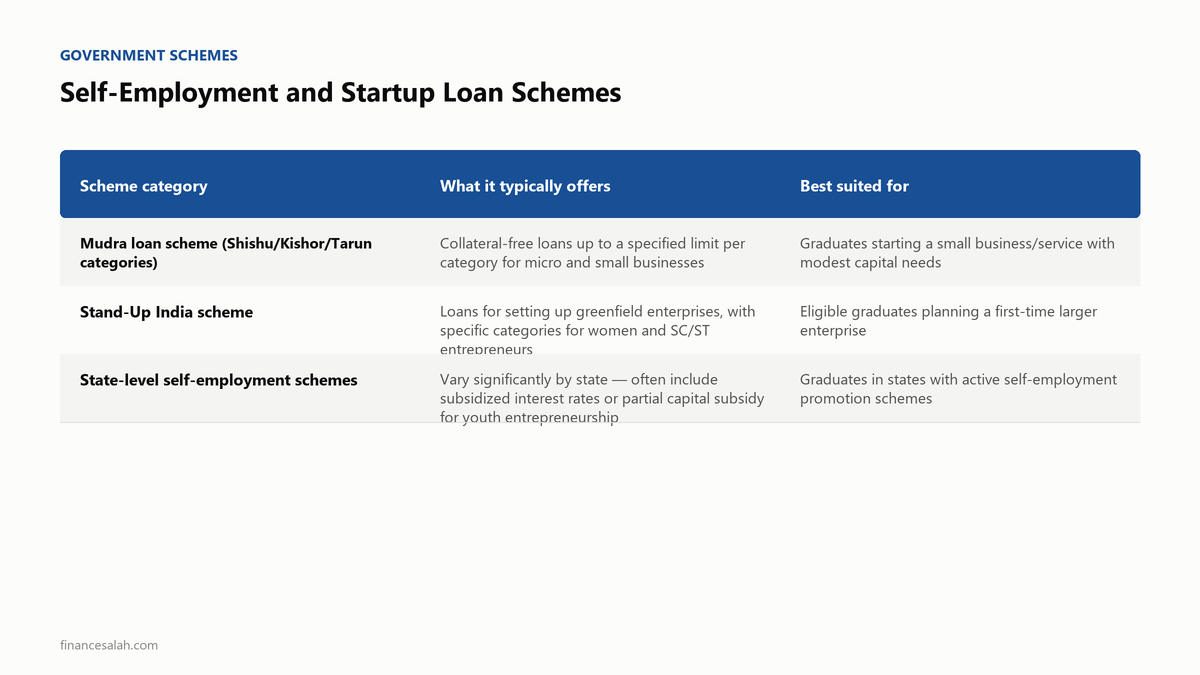
If your path forward is self-employment rather than a job search, several government-backed loan schemes exist specifically to reduce the capital barrier:
| Scheme category | What it typically offers | Best suited for |
|---|---|---|
| Mudra loan scheme (Shishu/Kishor/Tarun categories) | Collateral-free loans up to a specified limit per category for micro and small businesses | Graduates starting a small business/service with modest capital needs |
| Stand-Up India scheme | Loans for setting up greenfield enterprises, with specific categories for women and SC/ST entrepreneurs | Eligible graduates planning a first-time larger enterprise |
| State-level self-employment schemes | Vary significantly by state — often include subsidized interest rates or partial capital subsidy for youth entrepreneurship | Graduates in states with active self-employment promotion schemes |
Always verify current loan limits, interest subsidy details, and eligibility criteria directly on the respective scheme’s official portal or through your nearest bank’s MSME/priority sector lending desk — these figures are revised periodically and vary by category.
Job Search and Placement Support
- National Career Service (NCS) portal — a government-run job-matching platform connecting job seekers with employers, along with career counselling resources and information on job fairs and skilling programs, often linked from state employment exchanges.
- State employment exchanges — registering with your state’s employment exchange, while sometimes seen as outdated, still connects you to specific government job notifications and occasionally private-sector placement drives run through the exchange.
- Apprenticeship schemes — several central schemes support apprenticeship placements with stipends at private and public sector companies, which can be a meaningful bridge between graduation and a full-time role, especially if your degree lacks direct industry-relevant experience.
State-Level Schemes (Why You Should Check Separately)
Because a large share of youth employment and self-employment schemes are implemented (and sometimes designed) at the state level, searching only for central government schemes misses a significant portion of what you may actually be eligible for. Search specifically for “[your state] unemployment/employment scheme for graduates” on your state government’s official portal, or visit your nearest Common Service Centre (CSC) for in-person guidance — many rural and semi-urban areas are better served through CSCs than online research alone.
How to Actually Apply: A Step-by-Step Approach
- Identify your category first — general graduate, woman, SC/ST/OBC, specific sector background, age bracket — since many schemes are targeted, not universal, and this determines which specific schemes are even relevant to check.
- Check both central and your specific state’s schemes separately — don’t assume a central scheme search covers everything.
- Visit the official scheme portal directly, not a third-party summary site, for current eligibility and application steps — scheme details change, and outdated third-party content is common.
- Prepare standard documents in advance — Aadhaar, education certificates, bank account details, category certificates (if applicable) — most applications require the same core document set.
- Use your nearest Common Service Centre (CSC) if you’re unsure how to navigate an online application — CSCs exist specifically to help citizens access government schemes and can walk you through the process in person.
Common Mistakes
- Assuming no schemes exist simply because a broad web search doesn’t surface them clearly — most schemes exist but are poorly indexed for a general “unemployed graduate” search term.
- Only checking central government schemes and missing state-specific options, which are often more accessible and less competitive.
- Not checking category-specific eligibility (gender, caste category, sector, age) before assuming you don’t qualify for something, or assuming you do without verifying.
- Relying on outdated third-party articles for specific loan amounts, interest rates, or application links instead of the current official portal.
- Paying any “agent” or third party a fee to “guarantee” access to a government scheme — legitimate government schemes do not require payment to apply, and this is a common scam pattern targeting job seekers.
Myth vs Fact
| Myth | Fact |
|---|---|
| “There’s no real government support for unemployed graduates in India.” | Multiple skilling, self-employment loan, and job-matching schemes exist at both central and state levels — the challenge is fragmented information, not absence of support. |
| “Government skilling programs are only for people without a degree.” | Many skilling and certification programs are open to graduates and can meaningfully complement a degree with an in-demand, verifiable practical skill. |
| “Mudra and Stand-Up India loans require significant collateral.” | These schemes are specifically designed to be largely collateral-free within their respective limits, to reduce the capital barrier for new entrepreneurs. |
| “I need to pay an agent to access these schemes.” | Legitimate government schemes never require a payment to apply — any such request is a red flag for a scam. |
Expert Tips
- Register on the National Career Service portal even if you’re also using private job platforms — it costs nothing and occasionally surfaces government and PSU openings not listed elsewhere.
- Combine a skilling certification with your existing degree rather than treating them as alternatives — “B.Com + a recognized digital marketing/data analytics certification,” for example, is a stronger combination than either alone.
- Visit your nearest CSC in person if online research feels overwhelming — this is exactly what these centers exist for, and staff can walk you through eligibility and applications directly.
- Re-check scheme details every few months — government schemes are periodically relaunched, renamed, or have revised eligibility, so information even a year old can be outdated.
Checklist
- [ ] Identify your specific eligibility category (general, gender, caste category, sector, age bracket)
- [ ] Search both central government schemes and your specific state’s schemes separately
- [ ] Register on the National Career Service (NCS) portal
- [ ] Check current Mudra/Stand-Up India eligibility if considering self-employment
- [ ] Prepare standard documents (Aadhaar, certificates, bank details, category certificates)
- [ ] Visit your nearest Common Service Centre if online navigation is difficult
- [ ] Never pay any agent or third party to “guarantee” scheme access
Frequently Asked Questions
Q: What government schemes are available for unemployed graduates in India?
A: Broadly, three categories exist: skilling/training schemes (often under the Skill India umbrella and state skill missions), self-employment loan schemes (like Mudra loans and Stand-Up India), and job-matching support (the National Career Service portal and state employment exchanges). Specific scheme names and eligibility vary and should be verified on official portals.
Q: Can I get a loan from the government to start my own business as a fresh graduate?
A: Yes, schemes like Mudra loans (across Shishu, Kishor, and Tarun categories based on loan amount) and Stand-Up India are designed to provide largely collateral-free loans for new and small enterprises — verify current limits and eligibility on the official scheme portals or through participating banks.
Q: Is the National Career Service portal free to use?
A: Yes, it’s a free government job-matching and career resource platform — there is no legitimate reason to pay any third party to access it or similar official schemes.
Q: Do government skilling schemes provide any stipend during training?
A: Some skilling and apprenticeship schemes include a stipend during the training period, though this varies significantly by specific scheme and sector — check the specific scheme’s official details rather than assuming a stipend applies universally.
Q: How do I find schemes specific to my state, not just central government schemes?
A: Search your state government’s official portal directly for “[your state] employment/self-employment scheme for youth/graduates,” or visit your nearest Common Service Centre (CSC) for in-person guidance, since a general web search often surfaces only central schemes.
Conclusion
Government support for unemployed graduates in India genuinely exists across skilling, self-employment financing, and job-matching categories — it’s simply fragmented across central and state portals with inconsistent branding over time. The practical path forward is identifying your specific eligibility category, checking both central and state-level options separately, and using official portals (or your nearest CSC) rather than outdated third-party summaries, including this one, for exact current details.
Register on the National Career Service portal today, and search your specific state’s employment portal for any state-level scheme you may be missing. And while you’re building toward your next role, FinanceSalah’s guides on financial mistakes freshers make and low-investment business ideas might be worth a look too.
Sources & Further Reading
- National Career Service Portal — Ministry of Labour and Employment’s official job-matching platform
- Skill India — official skilling and certification programs
- Ministry of MSME — Udyam/Mudra Loan Portal — official self-employment loan scheme details
- Digital India / Common Services Centres — in-person help accessing government schemes
Related Reading
- How to Survive Financially After Losing Your Job to AI
- Financial Mistakes Freshers Make With Their First Salary
- Low Investment Business Ideas for Students in India
- Side Income Ideas for Salaried Employees in India
- What to Do Financially in the First 30 Days After a Layoff
This article is for general educational purposes only. Government scheme names, eligibility criteria, loan limits, and application processes change periodically and vary by state — always verify current details on the official scheme portal, your nearest bank, or a Common Service Centre before applying. This is not official government guidance.