
Introduction
You need to finance something big — a laptop, a medical bill, a wedding expense — and you’re weighing two familiar options: convert it to a credit card EMI, or take a personal loan. Both spread the cost over months. Both show up as “credit” on your file. But they’re priced very differently, and the difference is often larger than either option’s marketing suggests.
How Credit Card EMI Actually Works
When you convert a purchase (or an existing bill) to EMI, the bank breaks the amount into fixed monthly installments over a chosen tenure (usually 3–24 months), charging interest — typically 13–24% per annum, though the marketed “No Cost EMI” offers (0% interest) exist for specific retail partnerships, usually electronics.
The catch with “No Cost EMI”: it’s rarely truly free. The interest is usually built into the product price upfront (the cash price would have been lower), or a “processing fee” is charged separately that approximates what the interest would have been. It’s not a scam, but “no cost” is a marketing framing more than a literal description — always compare the EMI total to the cash price of the same item elsewhere.
For converting an existing credit card bill to EMI (not a No Cost EMI purchase, but converting debt you’ve already incurred): this is typically priced at standard credit card EMI rates, usually cheaper than carrying the balance at full credit card interest (which can run 36–42% annually) but still meaningfully more expensive than a personal loan in most cases.
How a Personal Loan Is Priced Differently
A personal loan is underwritten as its own product — the bank assesses your income, existing obligations, and credit score, and prices the loan accordingly, typically 10–18% per annum for a borrower with reasonable credit, disbursed as a lump sum with a fixed EMI over a chosen tenure (usually 1–5 years).
Why personal loans are usually cheaper than credit card EMI: credit cards are unsecured, revolving, and priced for the average cardholder risk pool including those who might default — the interest rate reflects that broad risk. A personal loan is individually underwritten against your specific credit profile, so a borrower with good credit typically gets a meaningfully better rate than the blanket rate baked into credit card EMI conversion.
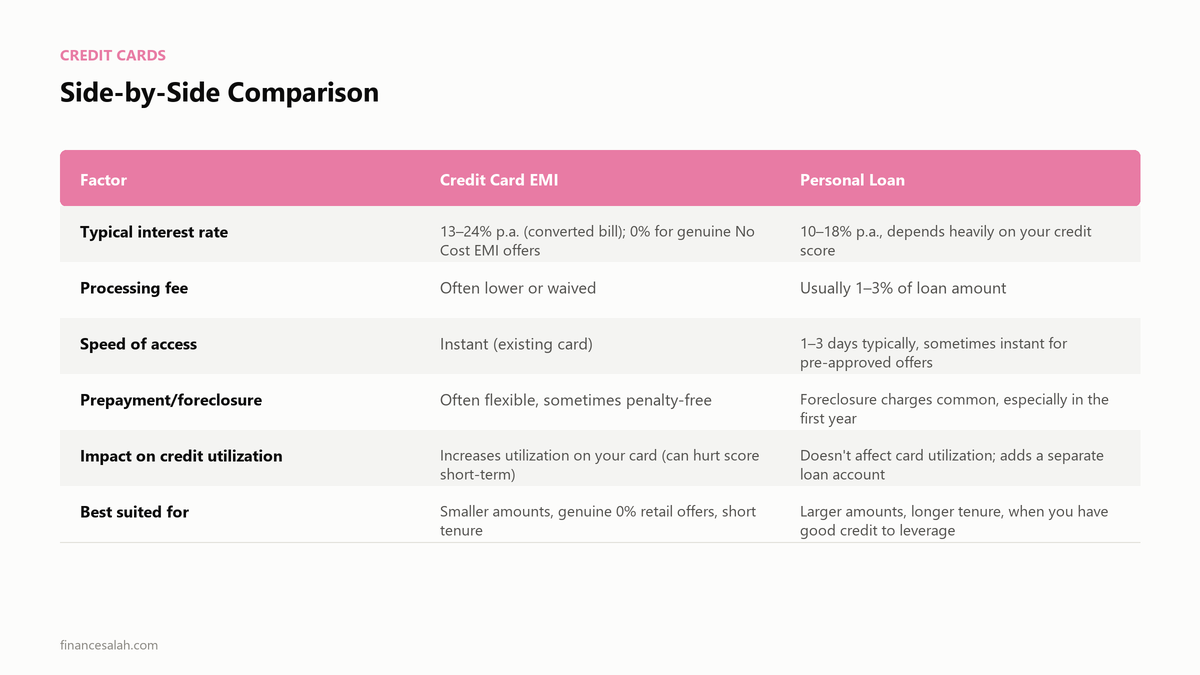
Side-by-Side Comparison
| Factor | Credit Card EMI | Personal Loan |
|---|---|---|
| Typical interest rate | 13–24% p.a. (converted bill); 0% for genuine No Cost EMI offers | 10–18% p.a., depends heavily on your credit score |
| Processing fee | Often lower or waived | Usually 1–3% of loan amount |
| Speed of access | Instant (existing card) | 1–3 days typically, sometimes instant for pre-approved offers |
| Prepayment/foreclosure | Often flexible, sometimes penalty-free | Foreclosure charges common, especially in the first year |
| Impact on credit utilization | Increases utilization on your card (can hurt score short-term) | Doesn’t affect card utilization; adds a separate loan account |
| Best suited for | Smaller amounts, genuine 0% retail offers, short tenure | Larger amounts, longer tenure, when you have good credit to leverage |
The Deciding Question: Is It a Genuine 0% Offer, or a Converted Bill?
This is the actual fork in the decision tree:
- If it’s a genuine No Cost EMI at point of purchase (common with electronics retailers) — this is very likely the cheapest option available, since you’re not paying interest at all, only possibly a small processing fee. Compare the total cost to the outright cash price to confirm there’s no hidden markup, but if the numbers check out, take it.
- If you’re converting an already-incurred credit card bill to EMI — this is almost always more expensive than a personal loan would be for the same amount and tenure, especially for larger sums (₹50,000+) or longer tenures (12+ months), because the interest rate gap compounds significantly over time.
A Worked Example
For a ₹1,00,000 expense over 12 months:
- Credit card EMI at ~18% p.a.: approximately ₹9,300/month, totaling close to ₹1,11,500 — roughly ₹11,500 in interest.
- Personal loan at ~13% p.a. (assuming reasonably good credit): approximately ₹8,900/month, totaling close to ₹1,07,000 — roughly ₹7,000 in interest.
The gap (roughly ₹4,000–₹5,000 in this illustrative example) grows larger with bigger amounts, longer tenures, or a wider interest-rate gap between your specific credit card’s EMI rate and the personal loan rate you’d qualify for. Always get an actual personal loan quote before defaulting to credit card EMI for anything beyond a small, short-tenure amount — the rate gap is exactly why this comparison is worth 10 minutes before committing.
When Credit Card EMI Genuinely Wins
- A true 0% “No Cost EMI” retail offer, verified against the cash price
- A small amount over a short tenure, where the rate difference in absolute rupee terms is negligible
- You need funds instantly and can’t wait even 1–2 days for a personal loan to disburse
- You have no existing personal loan eligibility (new to credit, or income doesn’t yet qualify) but already have an active credit card
Frequently Asked Questions
Q: Does converting a credit card bill to EMI hurt my credit score?
A: It can increase your reported credit utilization while the EMI balance is outstanding, which may have a modest short-term effect on your score. It doesn’t inherently hurt your score the way a missed payment would, but it’s not neutral either.
Q: Is a personal loan always approved faster than converting to EMI?
A: No — converting an existing credit card bill to EMI is typically instant since it’s the same account. A personal loan, even a fast pre-approved one, usually takes at least a few hours to a couple of days for disbursal.
Q: What if I don’t qualify for a personal loan at a good rate?
A: If your credit score or income means you’d only qualify for a personal loan at a rate similar to or worse than the credit card EMI rate, the comparison collapses — in that case, compare actual quoted rates from both, don’t assume the personal loan is automatically cheaper.
Q: Can I foreclose a credit card EMI early without penalty?
A: This varies significantly by bank and card — some allow penalty-free foreclosure, others charge a percentage of the outstanding amount. Check this specifically before converting, especially if you expect a bonus or windfall that might let you close it early.
Conclusion
For a genuine 0% retail EMI offer, take it — it’s very likely the cheapest financing available. For converting an existing bill or financing a larger, longer-tenure expense, get an actual personal loan quote before assuming credit card EMI is convenient enough to be worth its usually-higher cost. The gap between the two, especially at ₹50,000+ over 12+ months, is often large enough to be worth the extra day it takes to apply for a loan.
Related Reading
- Personal Loan vs Credit Card Debt: Which to Pay Off First?
- How to Get Out of Credit Card Debt in India: Step-by-Step
- Personal Loan vs Gold Loan: Which Is Cheaper in India?
This article is for general educational purposes and does not constitute personalized financial advice. Interest rates cited are illustrative ranges and vary by lender, credit profile, and over time — always compare actual quoted rates before deciding.